Teenage prodigy finishes doctorate, then signs up for a second PhD
This week a 15‑year‑old Belgian researcher completed a doctorate in theoretical quantum physics at the University of Antwerp and immediately moved to a second doctoral programme in medical science that emphasises artificial intelligence. The young scientist, Laurent Simons, defended a thesis about Bose polarons in ultracold matter — a technical subject at the frontier of many‑body quantum physics — and has said publicly he intends to work toward technologies he calls “super‑humans.”
From ultracold atoms to quasiparticles
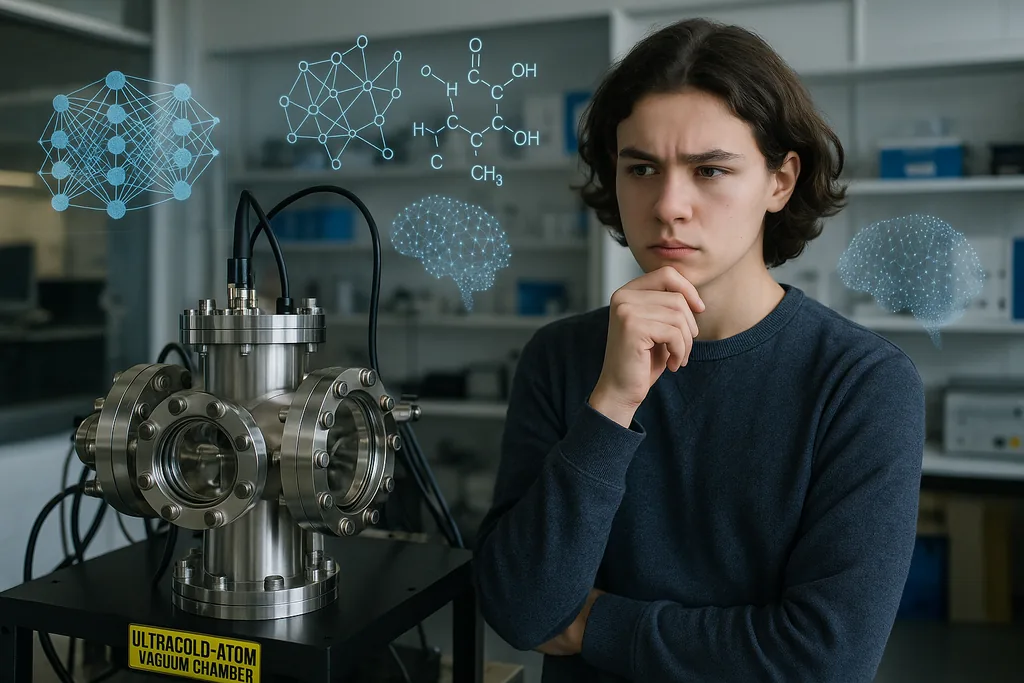
Simons’s doctoral work focused on Bose polarons — impurities that interact with a Bose–Einstein condensate, a state of matter that appears when atoms are cooled near absolute zero and act like a single coherent wave. In plain terms, a Bose–Einstein condensate lets physicists study how large groups of particles behave collectively, and a polaron is a useful way to model how a single particle disturbs and becomes dressed by that collective medium.
Those studies are highly mathematical and demand familiarity with many‑body theory, statistical physics and non‑equilibrium dynamics. Researchers working on Bose polarons aim to understand fundamental interactions that matter for condensed‑matter physics, precision sensing and some architectures for quantum simulation and quantum information. While Simons’s thesis lives in that theoretical space, the techniques and concepts echo across material science and, in the longer term, quantum technologies.
Universities and institutes that host ultracold‑atom programmes often make that connection explicit: experiments and models developed to understand quasiparticles can later inform sensors, quantum bits and new materials. Simons’s internship at the Max Planck Institute for Quantum Optics — noted in coverage of his academic timeline — places him inside one of the laboratories most associated with experimental advances in ultracold physics.
How he accelerated through degrees
That speed provoked practical questions along the way: institutions and supervisors have to decide whether a candidate’s intellectual maturity and welfare suit advanced coursework and research. Simons’s family has reportedly turned down offers from technology companies keen to employ him directly, preferring to keep him in formal academic training rather than placing a minor into a corporate research lab.
Shortly after the PhD defence he travelled to Munich to begin work in clinical and AI‑focused medical science — a move that shifts him from abstract many‑body physics into an applied, interdisciplinary space where computation, biology and medicine intersect.
Ambition: AI, longevity and “super‑humans”
In interviews and on social media Simons has framed his next stage as part of a long‑term project to extend and enhance human capacities. He told Belgian broadcaster VTM that after physics he wants to “start working towards my goal: creating super‑humans.” That phrase has a broad interpretation: in contemporary research it can mean anything from improved diagnostics and regenerative medicine to cognitive augmentation powered by machine learning.
Practical roadmaps people point to include AI‑driven diagnostics that spot disease earlier, cell‑reprogramming experiments that reverse aging hallmarks in model systems, and gene‑editing or biomaterials that repair tissues. Large, well‑funded private efforts such as Altos Labs and research organisations such as Calico have invested in approaches like cellular reprogramming and biomolecular analysis; journals including Nature Aging and clinical venues like Cell Reports Medicine have published incremental advances in senolytic therapies, biomarkers and AI applications in medicine.
But the term “super‑human” carries speculative weight. Most biomedical researchers treat radical enhancement — dramatically extending healthy human performance or lifespan far beyond current limits — as a multi‑decade challenge, not an immediate engineering project. Progress tends to be incremental, and changes that look dramatic in mice or cell cultures often do not translate straightforwardly to humans.
Where science ends and speculation begins
Simons brings an unusual combination of skills: deep theoretical training in quantum systems and now formal study of medicine and AI. That interdisciplinary mix can spark creativity — ideas born in one field sometimes feed breakthroughs in another — but it also raises a familiar caution. Expertise in one domain does not automatically transfer to another, especially in medicine, where clinical trials, safety, regulation and ethics are central.
Researchers who follow longevity and enhancement emphasise three realities. First, many biological processes that underlie aging are complex, redundant and only partially understood; interventions that work in laboratory models rarely deliver the same impact in people. Second, AI is a powerful amplifier for pattern detection and hypothesis generation, but models require careful curation and prospective validation in clinical settings. Third, interventions that alter human physiology raise social, legal and ethical questions about consent, equity and risk that are often as hard as the science itself.
Those concerns are heightened when a researcher is still a minor. Institutions and regulators have frameworks about what kinds of clinical and translational work are appropriate for different career stages, and oversight committees play an important role in vetting research proposals that touch on human subjects or germline modification.
What this moment means for science and policy
Simons’s rapid ascent crystallises a broader conversation about acceleration in science. The past decade has seen faster pathways into advanced research, combined with dramatically more powerful computational tools. That can be a public good: brilliant, motivated people can contribute earlier and cross disciplinary boundaries that historically took decades to bridge.
But the story also highlights governance needs. High‑stakes fields — from gene editing to human enhancement — depend on robust peer review, transparent methods and ethical safeguards. The fact that a teenager is talking about designing “super‑humans” does not make it easier to answer who decides which experiments proceed, on what timetable, and with what protections for participants and society.
What to watch next
Simons’s next steps will be concrete indicators of where his interests land. Will his PhD work in medical science produce peer‑reviewed findings about AI diagnostics or regenerative interventions? Will he publish translational research that moves beyond concept? Those outputs will matter more than public declarations of long‑term goals.
For now, his case is notable for what it says about talent, aspiration and the shifting boundaries of disciplinary silos. It is also a reminder that ambition needs the counterweight of rigorous methods and responsible oversight — especially when the ambitions involve changing what it means to be human.
Sources
- University of Antwerp (PhD confirmation and degree records)
- Max Planck Institute for Quantum Optics (internship affiliation)
- Nature Aging (journal reporting on longevity research)
- Cell Reports Medicine (journal reporting on translational medicine and AI in healthcare)