A year that bent how we look up, down and inward
On a single slate of headlines in 2025, telescopes, LiDAR scanners, hospital monitors and chipmakers all pushed at the borders of the known. Astronomers returned data that forced a rethink of how the first black holes and galaxies formed; surveyors rewrote maps of pre‑Columbian cities and Roman villas; neurologists and start‑ups implanted a new generation of brain chips in people; and artificial intelligence moved from lab assistant to active co‑pilot in research programs. Together these developments sketched a simple truth: the tools we built this decade are now changing the questions we can ask.
Cosmic surprises: seeds, dark energy and an emboldened Moon programme
One of the clearest threads in 2025 was the tension between observation and cosmology. The Dark Energy Spectroscopic Instrument (DESI) collaboration released its largest three‑year dataset — a 3D map of some 15 million galaxies and quasars — and reported that, when combined with other probes, the simplest model of a time‑constant dark energy (Lambda) may not fully explain the universe’s expansion history. The result does not yet clear the community’s usual five‑sigma bar, but the new DESI analyses strengthen earlier hints that dark energy’s influence could be changing with time, a finding that would have enormous consequences for cosmology if it holds up under future scrutiny.
At smaller angular scales, the James Webb Space Telescope continued to produce puzzles. A class of objects dubbed “little red dots” — compact, intensely red sources at cosmic dawn — were shown to host rapidly growing black holes in some cases, or to be otherwise inconsistent with simple galaxy‑formation models. Teams using Webb’s infrared spectrographs found at least one LRD embedding a supermassive black hole less than a billion years after the Big Bang, and Nature‑level studies tied samples of LRDs to massive halos, forcing theorists to refine ideas about how the first black holes seeded and grew. These findings are shifting how astronomers model the interplay between stars, gas and black holes in the infant universe.
Closer to home, the human return to the Moon continued to be a patchwork of progress and engineering caution. NASA kept rolling Artemis hardware through its Vehicle Assembly Building and prepared systems for the first crewed test flights, even while the agency and commercial partners adjusted schedules to incorporate fixes and safety reviews. Meanwhile commercial landers and lunar cargo services made incremental gains: Firefly’s Blue Ghost demonstrated a successful commercial lunar landing and NASA’s Commercial Lunar Payload Services programme continued to seed scientific payloads and rovers for polar regions. The combination of government and commercial steps has pushed lunar exploration from concept to operational reality in ways that will matter for both science and industry over the next decade.
Buried stories: LiDAR, mosaics and reshaping ancient maps
Back on Earth, advances in remote sensing and patient excavation yielded stories that reopened old debates about social organization and cultural contact. Large LiDAR surveys continued to reveal the scale and layout of long‑hidden settlements across Mesoamerica; at Aguada Fénix and other Middle Preclassic sites researchers argued that monumental earthworks reflected communal cosmograms rather than strictly palatial control, complicating narratives of early state formation. Those landscape‑scale readings—visible only with airborne laser mapping—have changed the contours of modern archaeology by letting teams see architecture beneath jungle canopy without intrusive digging.
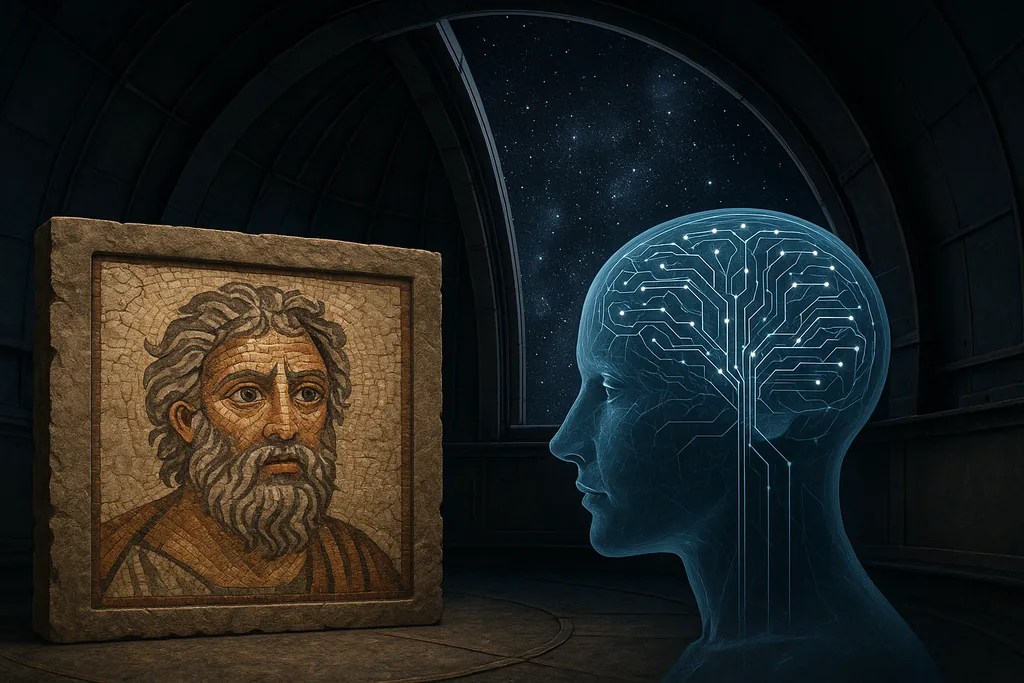
In Britain, a different kind of excavation reframed how Roman provincial art transmitted Mediterranean ideas. The so‑called Ketton mosaic — a large, richly populated Roman floor discovered earlier in the decade and recently reinterpreted — appears to depict a version of the Trojan War tied to Aeschylus rather than Homer, taking scholars back to lost repertories of Greek drama and showing how provincial craftsmen reused and remixed classical imagery. That discovery highlights how a single object, properly contextualised, can reshape our sense of what stories people in the provinces thought important.
Minds and machines: brain chips, consciousness research and the therapy frontier
2025 was a watershed for brain–computer interfaces. A range of groups—start‑ups in the United States, a fast‑moving Chinese programme, and hospital collaborations—moved from bench demonstrations to multiple human implants, reporting patients who could control cursors, type, or operate robotic limbs by thought. In the U.S., companies received accelerated regulatory designations for devices aimed at restoring speech and movement, and rival efforts from Paradromics and Precision Neuroscience reported first‑in‑human tests and regulatory clearances of their own systems. Across the field the narrative shifted from proof‑of‑principle experiments to scaled clinical programmes and the hard ethical questions that accompany devices capable of reading and routing neural signals.
At the same time neuroscientists kept pressing at the biological edges of consciousness. Multi‑centre resuscitation studies and operating‑room protocols (building on the AWARE family of trials) used objective stimuli, continuous EEG and oximetry during cardiac arrest and deep hypothermic procedures to test whether coherent awareness or implicit memory could be detected when traditional markers of brain function were suppressed. Feasibility work published in clinical journals confirms that carefully instrumented protocols are now possible; results so far have been cautiously interpreted, but they have reopened rigorous inquiry into how awareness behaves at the margins of life. Those studies do not settle big metaphysical questions, but they do offer measurable, replicable ways to probe experience under extreme physiological conditions.
Meanwhile clinical neuroscience and psychiatry made therapeutic moves that matter to our collective sense of mind. Large phase‑3 trials of synthetic psilocybin reported positive signals in treatment‑resistant depression, prompting drug developers to plan rolling regulatory submissions and renewed hopes for regulatory decisions within a few years. Those results, if confirmed in broader populations, will affect how medicine uses altered states to treat mood and trauma disorders.
Tools of tomorrow: AI as scientific partner and the march to error‑corrected quantum machines
If 2025’s single structural change to how science happens was the increasing role of advanced AI, it was obvious in the way projects were run. Artificial intelligence models moved from helping with literature review to steering wet‑lab designs, accelerating materials discovery, improving weather forecasts and detecting anomalies in astronomical surveys. Industry and government both boosted funding for AI‑driven research programmes, and agencies created cross‑cutting initiatives to make the new methods available to a wider research community; this was the year many teams described as the point at which AI stopped being a tool and started to become a research partner.
Looking ahead: why these strands matter together
What ties these stories together is not merely novelty but a set of converging dynamics: better instruments, larger datasets, machine intelligence that amplifies human insight, and a willingness to move experimental systems into clinical and operational environments earlier. That combination accelerates discovery but also raises questions about safety, equity and interpretation. Will DESI’s hint of evolving dark energy hold up when independent surveys and cosmic‑microwave background experiments are folded in? Can brain–computer interfaces scale ethically and safely beyond narrow clinical use? How will archaeologists reconcile large, non‑invasive surveys with the obligations of site stewardship and local communities? These are not academic questions; they are governance and design problems that will shape how useful — and how fair — 2026 and the rest of the decade become.
For readers, the practical takeaway is simple: 2025 was not a single‑issue year. It was a cross‑cutting moment in which telescopes, chips, sensors and algorithms converged to let us ask bolder questions—and in many cases to get beginnings of answers. That combination leaves us with urgent opportunities and responsibilities: to verify surprises carefully, to deploy new tools with humility, and to make sure the scientific gains are broadly shared.
Sources
- Nature Astronomy (paper on Little Red Dots and early black hole growth)
- Dark Energy Spectroscopic Instrument / Lawrence Berkeley National Laboratory (DESI data releases)
- NASA (James Webb Space Telescope and Artemis programme briefings)
- University of Leicester (research on the Ketton Roman mosaic)
- Journal of Cardiothoracic Surgery (feasibility study on consciousness during deep hypothermic circulatory arrest)
- Precision Neuroscience, Neuralink and related clinical trial filings (FDA and company materials on brain–computer interface trials)
- IBM Quantum / technical reporting and independent technical coverage of quantum error‑correction roadmaps