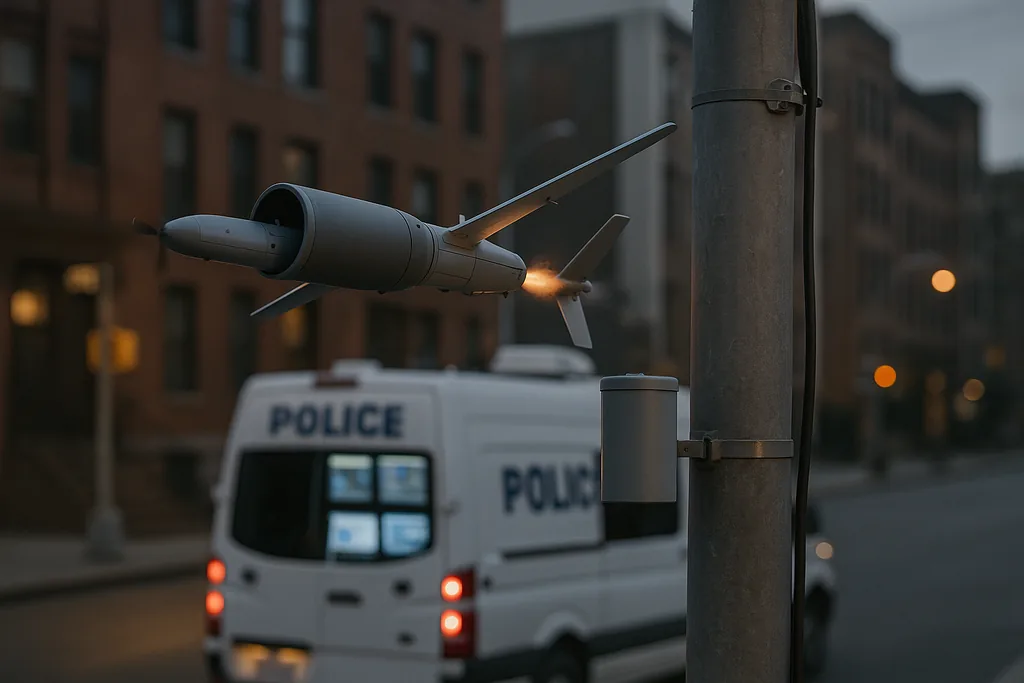
Instant launch, live eyes—before the 911 call
On 10 December 2025 two companies from opposite sides of the globe said they had stitched together a system that, on paper, will detect a gunshot and put a camera‑equipped drone above the shooter in less than 20 seconds. The announcement, issued jointly by DefendEye (Kraków) and EAGL Technology (Albuquerque), describes a cloud‑to‑cloud integration between EAGL's DragonFly gunshot sensor and AEROS platform and DefendEye's instant‑launch, tube‑launched autonomous drone. The firms say the sensor validates a threat, triggers a launch tube that fires a drone in under 10 seconds, and streams live video to dispatch and tactical units—often before a single 911 call is placed.
How the system pieces fit together
The companies describe three linked stages. First, the DragonFly sensor performs energy capture and waveform analysis to detect impulsive sounds consistent with gunfire and to produce geolocation coordinates. EAGL's AEROS software then filters false positives and validates the event. Finally, once a shot is validated the AEROS cloud sends coordinates to a DefendEye launch tube: the company claims the drone can be airborne within 10 seconds and arrive above the shooter in under 20 seconds from detection.
Technically this relies on several components working in concert. The DragonFly unit is a compact, solar/battery‑operated sensor in a resonance chamber that EAGL says provides spherical coverage of up to about 18 acres per sensor. DefendEye's drone is reusable, AI‑assisted and designed for rapid, pilotless deployment from a sealed tube; the announced configuration carries day/night cameras with infrared illumination, a 30‑minute endurance claim, and a 5G SIM in each tube for live streaming and remote control. The companies stress the solution can be mounted on standard light poles, walls, corners or deployed on mobile command assets.
Both CEOs framed the system as an advance in the “drone as first responder” concept. Boaz Raz, EAGL's CEO, said the pairing allows organisations to "detect, respond, and communicate real‑time threats to law enforcement to stop the threat and save lives." James Buchheim, DefendEye's CEO, said the cloud bridge allows full remote control of drones deployed "in seconds, not minutes," with onboard AI identifying humans in the feed.
Where the performance claims matter—and where they don't
The headline figure—"under 20 seconds"—is compelling because it compares with conventional emergency response times measured in minutes. A drone positioned overhead within tens of seconds could provide immediate situational awareness to officers en route, record critical evidence and help commanders form tactics while injuries occur.
But the timeline depends on a chain of capabilities that all have real‑world limits. Gunshot localization in urban environments is technically challenging: impulsive sounds bounce off buildings, are partially absorbed by vegetation and vehicles, and can produce echoes that complicate time‑difference‑of‑arrival (TDOA) and waveform‑matching algorithms. The announced 18‑acre coverage per sensor implies that a sensor will generally be placed densely in areas of concern, yet in practice a networked array or multiple sensors will be needed for robust triangulation and to reduce false alarms.
Similarly, arrival time depends on where a drone is stored and local flight restrictions. A drone in a nearby tube may reach a location very quickly, but if the nearest launch point is hundreds of metres away or airspace is restricted (for example around airports or in some city centres) response times will lengthen. The companies note their Beyond Visual Line of Sight (BVLOS) capability and remind readers that BVLOS operations are subject to local aviation rules and approvals—an important caveat for any customer considering live deployments.
Privacy, safety and legal trade‑offs
This type of rapid, automated deployment raises difficult social and legal questions. The system intentionally delivers video of a place and people before an emergency call is made or before officers arrive. That raises obvious privacy concerns: who stores the footage, for how long, who can access it and under what legal standard? The vendors describe command‑center control and sharing with tactical units, but did not publish retention policies or access controls.
There are also safety questions. Onboard AI that "identifies humans" can assist operators, but it is not infallible. Misclassification—mistaking a reflection or group of mannequins for persons or failing to recognise a person behind cover—could affect law‑enforcement decisions. The possibility of false positives from the gunshot detector is meaningful: while EAGL claims AEROS eliminates false positives through waveform analysis, independent evaluation in complex environments is needed. Finally, any live system that links sensor, cloud and aircraft must consider misuse: spoofing or denial‑of‑service attacks could create false alarms, or adversaries could try to jam communications or the 5G link used for streaming and control.
Cybersecurity and operational resilience
Because the announced architecture is explicitly cloud‑connected and designed to allow remote control, cybersecurity is integral to safety. The launch tube's 5G connection and the cloud bridge between the AEROS and DefendEye command centers are convenient for operators—yet they create potential attack surfaces. A hardened, end‑to‑end encrypted telemetry and payload stream, strong device attestation, periodic firmware audits and robust supply‑chain safeguards will be necessary in any serious public‑safety deployment. The companies did not publish those defensive details in the release.
Operational resilience also includes electromagnetic threats. In conflict or criminal settings an opponent could attempt to jam GPS, 5G or other comms. The industry has been moving toward more resilient techniques—visual navigation, onboard autonomy and inertial navigation—to reduce dependence on single links. The wider drone ecosystem is already seeing similar advances: other developers are integrating visual navigation and edge AI to operate in degraded radio or GPS‑denied conditions.
How this fits into a broader drone landscape
The DefendEye–EAGL announcement arrives in a market where municipalities, schools and security teams are experimenting with unmanned systems for surveillance, perimeter monitoring and critical‑infrastructure inspection. Smaller nano and tube‑launched drones—some built for noiseless, covert reconnaissance—are proliferating, while defence‑oriented firms prioritise autonomy and GPS‑resilient navigation for contested environments. Together, these threads point to a near future in which on‑demand air assets are easier to field—but they also underline that technology outpaces regulation and public debate.
Next steps and what to watch
The companies present the partnership as a productised package, but actual operational rollout will depend on field pilots, local approvals for BVLOS flights, independent validation of gunshot detection and classification rates, and public‑safety procurement decisions. Community acceptance will hinge on transparent policies for footage retention, data sharing, audit logs and the legal standard for when drones may be deployed—especially in sensitive locations such as schools, hospitals or private residences.
For now the announcement is a technical milestone in a rapid‑response narrative: sensor networks, cloud orchestration and instant‑launch hardware combined to shorten the time between an attack and an aerial feed. Whether the model becomes a mainstream tool for police and first responders will depend on rigorous testing, legal frameworks and robust cyber and privacy safeguards as much as on seconds shaved from response times.
Sources
- DefendEye P.S.A. press release (Dec 10, 2025) — partnership announcement with EAGL Technology
- EAGL Technology — AEROS platform and DragonFly gunshot sensor technical materials