3I/ATLAS: Iceberg, Engine, or Enigma?
Why 3I/ATLAS has become a lightning rod
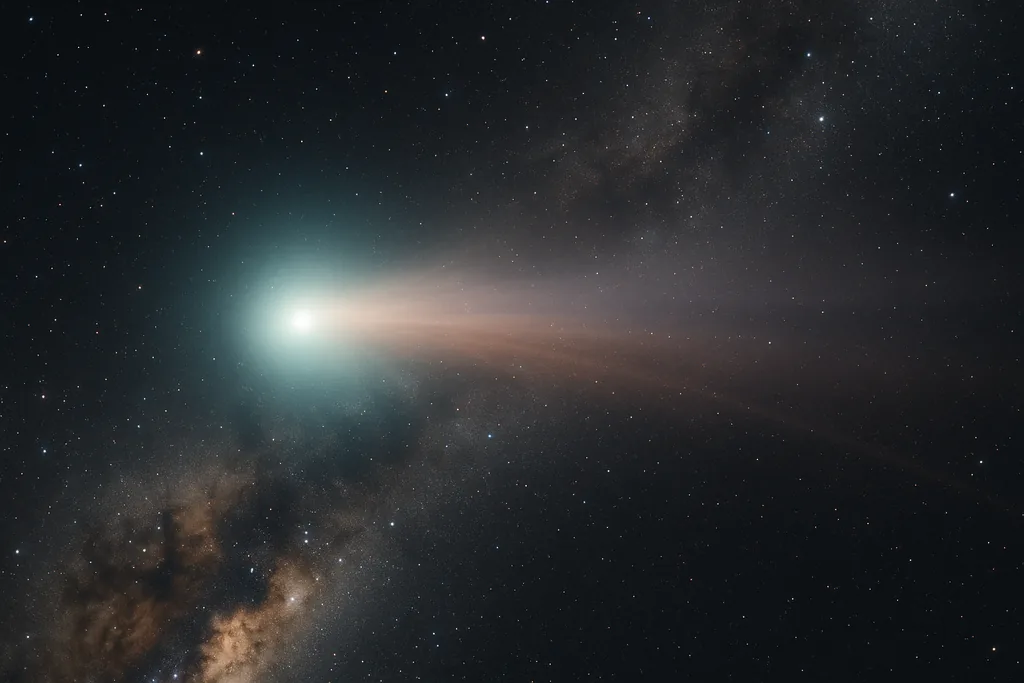
When the ATLAS survey telescope flagged an unusual, fast-moving object in July 2025, astronomers realized it was no routine visitor: its trajectory was hyperbolic, its appearance showed a coma, and it was the third confirmed interstellar object ever recorded. Since then a global observing campaign — from ground-based observatories to the James Webb Space Telescope — has produced a patchwork of surprising measurements that have been stitched into two competing narratives. One camp treats 3I/ATLAS as a natural but extreme comet, formed and processed in a different stellar environment; another, most publicly represented by one vocal scientist, argues the anomalies are sufficient to warrant consideration of a technological origin.
For readers tracking the headlines, the stakes matter: interstellar objects are unique samples from other planetary systems, and correctly reading their signatures reveals how planets and small bodies form and evolve across the galaxy. But if the nature of 3I/ATLAS were technological, that would be a far larger shift in our understanding. The quality and interpretation of the data therefore matters enormously for science and for public trust.
What the telescopes actually saw
Second, optical integral-field spectroscopy from the Keck Cosmic Web Imager detected narrow emission features attributable to cyanide-bearing molecules and, unexpectedly, neutral nickel atoms clustered close to the nucleus while iron lines remained essentially absent. The Keck team measured different spatial scales for the CN and Ni emission, suggesting distinct production or destruction pathways for each species. They proposed that volatile metal-carbonyl chemistry could explain the nickel signal without invoking exotic processes.
Third, polarimetric observations from several large telescopes reported an unusually deep negative polarization branch at small phase angles — a waveband-dependent signature of how sunlight scatters from grains in the coma and surface. In short, the light-scattering behaviour appears unlike typical comets or asteroids and points to unusual particle sizes, shapes or compositions in the dust.
Where the anomalies become an argument for the extraordinary
Avi Loeb has compiled a list of anomalies in a public essay: the aligned retrograde trajectory, sunward-directed jets, the nickel-rich gas with little iron, extreme polarisation, atypical brightening behaviour, and other odd coincidences around timing and approach geometry. He argues that the combination of these features is unlikely under simple natural models and that scientists should take seriously the possibility that 3I/ATLAS could be a technological artifact — or at least that searches for technosignatures deserve more funding alongside biosignatures. His piece has renewed debate about how the community should treat low-probability but high-consequence hypotheses.
How the mainstream interprets the same data
Most comet and small-body specialists have pushed back on the leap from anomaly to alien probe. There are alternative, natural explanations that fit the new data without invoking technology. Two explanations have gained traction among observers and modelers: an intrinsically CO2-rich nucleus (or a surface layer altered by long-term cosmic-ray processing), and exotic but plausible gas-phase chemistry near the nucleus that can free nickel atoms into the coma.
The JWST team’s CO2-dominated coma points to either a formation environment near the CO2 ice line of the parent protoplanetary disk or to chemical alteration of surface layers during a long interstellar journey. Laboratory and theoretical work suggests that galactic cosmic-ray irradiation can convert and concentrate carbon-bearing volatiles in a way that raises CO2 relative to H2O and can redden surface spectra — both observed features of 3I/ATLAS. In other words, interstellar exposure can make an otherwise ordinary nucleus behave oddly when it warms.
For the nickel signal, the Keck team favoured a metal–carbonyl hypothesis: in a CO/CO2-rich gas environment, volatile organometallic complexes like nickel tetracarbonyl are chemically plausible intermediates. Those molecules can photodissociate or thermally decompose near the nucleus to release neutral nickel atoms while iron remains sequestered in other mineral phases — producing an apparent Ni-rich signature in spectra without invoking industrial metallurgy. This is an unusual chemistry to find in a cometary coma, but not an impossible one.
What about the reported non‑gravitational acceleration and anti‑tail?
Claims of strong anomalous accelerations have been central to the more provocative readings of the object. But careful orbital fits through thousands of astrometric points find no compelling detection of a non‑gravitational perturbation over the long inbound arc; instead the residuals place strong upper limits on any rocket-like effect during that period. Other modelling shows that modest, anisotropic CO/CO2 outgassing — especially from localized jets — can produce small thrusts and can explain changes in brightness and morphology without requiring the wholesale loss of nucleus mass. In short, the apparent thrust can be matched by conventional comet physics once the object’s unusual composition and jet geometry are accounted for.
How to settle the question
- More, better data. Observations across wavelengths and time are the decisive input. The JWST and Keck results are powerful, but they are snapshots; follow-up spectra and resolved imaging after perihelion — especially from spacecraft at Mars or orbiting observatories that can observe at different solar elongations — will test whether the Ni signal evolves and whether jets and polarization change with activity.
- Laboratory and theoretical work. The metal‑carbonyl pathway is chemically plausible but rare; laboratory spectroscopy and photodissociation modelling at the low temperatures and UV fluxes relevant to 3.3–3.8 AU would help assess whether the measured nickel abundances are realistic for natural processes.
- Transparent debate about priors. Scientists must be explicit about how unlikely hypotheses are weighed. Extraordinary claims require extraordinary evidence, and that threshold should be clear in peer review and public communication.
Why this matters beyond curiosity
Even if 3I/ATLAS is ultimately explained as an extreme but natural interstellar comet, the episode will have been valuable. It has pushed instrument teams to respond rapidly, sharpened chemists’ and dynamicists’ models for volatile processing in interstellar space, and illustrated how the public receives scientific uncertainty. If it were technological — an outcome most researchers consider extremely unlikely today — the burden of proof would be immense and the consequences profound.
For now the most defensible position is cautious curiosity: the measurements are real and intriguing; natural mechanisms exist that can explain most of them; and a handful of open questions remain best addressed with more observations and lab work. The next months of monitoring and analysis will either whittle away the anomalies or deepen them — and either result will teach us something new about the galaxy’s small bodies.
James Lawson is an investigative science reporter for Dark Matter. He holds an MSc in Science Communication and a BSc in Physics from University College London and covers astronomy, space industry and emerging tech.