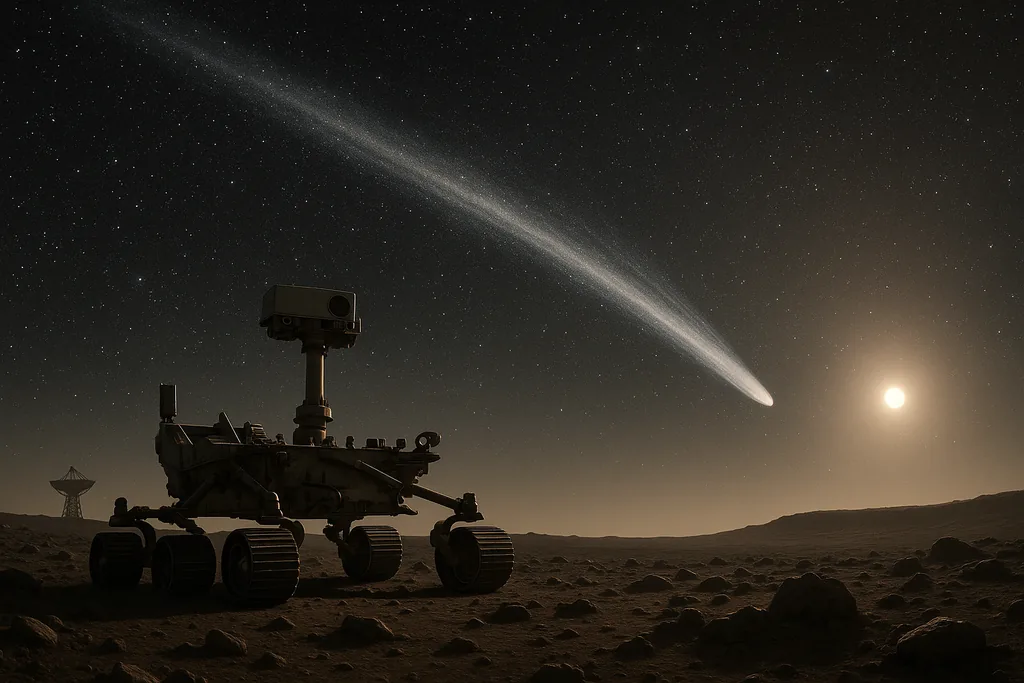
When the faint smudge known as 3I/ATLAS swept through the inner solar system last year it sparked a rare mix of serious science and headline-grabbing speculation. Telescopes from Chile to space telescopes and the Green Bank radio dish focused on the visitor as it reached perihelion on October 30, 2025 and came closest to Earth on December 19, 2025. After months of coordinated observations and a targeted technosignature search conducted on December 18, 2025, teams report that 3I/ATLAS shows the hallmarks of an ordinary comet from another star—interesting, ancient and natural, but not an alien spacecraft.
Multifaceted observations across the solar system
Listening for technosignatures: the radio sweep
Because 3I/ATLAS is only the third interstellar object astronomers have observed—after 1I/’Oumuamua in 2017 and 2I/Borisov in 2019—it presented a rare opportunity to test a provocative idea: could some interstellar objects be purposeful probes, broadcasting narrowband radio signals or other technosignatures? The Breakthrough Listen initiative and allied teams used the 100-m Robert C. Byrd Green Bank Telescope to search for precisely those signals across 1–12 GHz on December 18, 2025, about a day before the comet’s closest approach to Earth. Those observations reached a sensitivity equivalent to detecting isotropic transmitters at the ~0.1 watt level—the approximate order of magnitude of a mobile phone if it were broadcasting isotropically at that distance.
The raw scans produced hundreds of thousands of candidate hits before pipeline filters and localisation tests narrowed the set to nine events that warranted human inspection. Each of those candidate events was ultimately traced to terrestrial radio-frequency interference or appeared in off-target scans; none showed the consistent Doppler drift or sky-localised behaviour expected from a transmitter fixed to an interstellar object. The formal result reported on the arXiv and in accompanying notices is a nondetection: no credible narrowband technosignature was found from 3I/ATLAS within the frequencies and time observed. That negative finding is important because it places an explicit upper limit on continuous narrowband transmitters associated with the object in the bands surveyed.
Independent radio surveys and complementary limits
Breakthrough Listen’s Green Bank observations were not the only radio scrutiny. Teams using the Allen Telescope Array and other facilities performed searches across complementary frequency ranges and with different analysis pipelines; those campaigns likewise reported non-detections after aggressive filtering of radio-frequency interference. Different instruments set different upper limits on potential transmitters, but the convergent conclusion is the same: if 3I/ATLAS carried an active radio beacon, it was either far weaker than pocket-sized electronics or it did not radiate in the ranges and epochs investigators looked. These independent null results strengthen the scientific case that 3I/ATLAS is not broadcasting detectable engineered radio signals.
Why the "not aliens" result matters—scientific value, not disappointment
That announcement should not be read as anticlimactic to scientists. Interstellar comets are rare, and each one is a time capsule from another system: their dust and gas preserve chemical and isotopic records of formation conditions around a different star. Measuring composition, activity and dynamical history yields insights into planet formation, volatile delivery, and galactic mixing. Even without technosignatures, 3I/ATLAS provides a dataset far richer than what existed a decade ago: images from ground-based 8–10 metre telescopes, spectroscopy from space telescopes, and high-sensitivity radio sweeps that together paint a detailed portrait of an ancient cosmic refugee. Researchers emphasise that nondetections are still a form of information—specific constraints that guide future searches and instrument design.
Why did the alien theory stick around?
Public fascination with the “probe” idea traces to how rare and surprising interstellar visitors are, and to a handful of vocal scientists and commentators who have argued that unusual features warrant extraordinary scrutiny. Some pointed to unexpected jets, brief changes in brightness, or particular spectral lines as anomalies; others argued that intelligence ought to be considered among many hypotheses until disproved. That debate played out both in peer-reviewed studies and in opinion pieces. At the same time, the media ecosystem amplifies speculative explanations, especially when a rare cosmic object passes relatively close to Earth. The result was a steady stream of conjecture that outpaced the slow, methodical process of analysis and peer review.
Classification, secrecy and a Glomar response
Separately, a Freedom of Information Act request exposed another wrinkle: on January 5, 2026 the CIA issued a so-called Glomar response in reply to an inquiry about records on 3I/ATLAS, stating it could neither confirm nor deny the existence of records on the object. That legal posture—often used when confirming the existence of sensitive files would itself reveal classified sources or methods—reignited speculation that intelligence agencies might be treating the object differently from public scientific bodies. Some researchers, including Harvard’s Avi Loeb, voiced surprise at that equivocal reply and urged continued scrutiny; former intelligence officials and legal analysts point out that a Glomar response can be routine when an agency believes acknowledging records would expose sensitive capabilities, not because an object is extraterrestrial technology. The Glomar exchange does not change the astrophysical evidence collected to date.
Looking forward: more interstellar visitors ahead
3I/ATLAS is unlikely to be the last interstellar object we study closely. The Vera C. Rubin Observatory—now entering routine operations with its Legacy Survey of Space and Time—will dramatically increase the rate at which fast-moving, faint objects are discovered. Forecasts range from a handful to dozens of interstellar detections over Rubin’s first decade, depending on the underlying population and how efficiently moving-object pipelines can link fast tracks across repeated imaging. Larger samples will move the field beyond sensational single-object episodes into population science: we will learn how common different classes of interstellar bodies are, whether most are icy or rocky, and whether any display persistent, unexplained properties deserving of deeper scrutiny.
For now, the balance of evidence is straightforward: 3I/ATLAS is a scientifically valuable, decidedly natural interstellar comet. It invited extraordinary attention, and astronomers responded with the most sensitive, broad-ranging examinations available. Those searches turned up no technosignatures and instead produced a rich catalogue of observations that will inform comparative studies of comets and the galactic inventory of small bodies for years to come.
Sources
- NASA Science (Comet 3I/ATLAS overview and observing updates)
- Ben Jacobson-Bell et al., "Breakthrough Listen Observations of 3I/ATLAS with the Green Bank Telescope at 1-12 GHz" (arXiv preprint)
- S. Z. Sheikh et al., "A Search for Radio Technosignatures from Interstellar Object 3I/ATLAS with the Allen Telescope Array" (arXiv preprint)
- Green Bank Observatory / Robert C. Byrd Green Bank Telescope (instrument and observing details)
- Hubble Space Telescope and James Webb Space Telescope observation records and mission science teams