When a loom looks like software
On December 27, 2025, the China Association for Science and Technology posted a short video arguing that a two‑millennium‑old figured loom recovered from a tomb near Chengdu should be regarded as an early computer because it encoded patterns in physical cards and executed them mechanically. The claim — reported internationally on January 2, 2026 — ties a carefully excavated Western Han artefact to modern definitions of programmability and binary encoding. It also reopened a long-standing debate over how historians should name and rank the world’s earliest computing machines.
The Chengdu find and how it worked
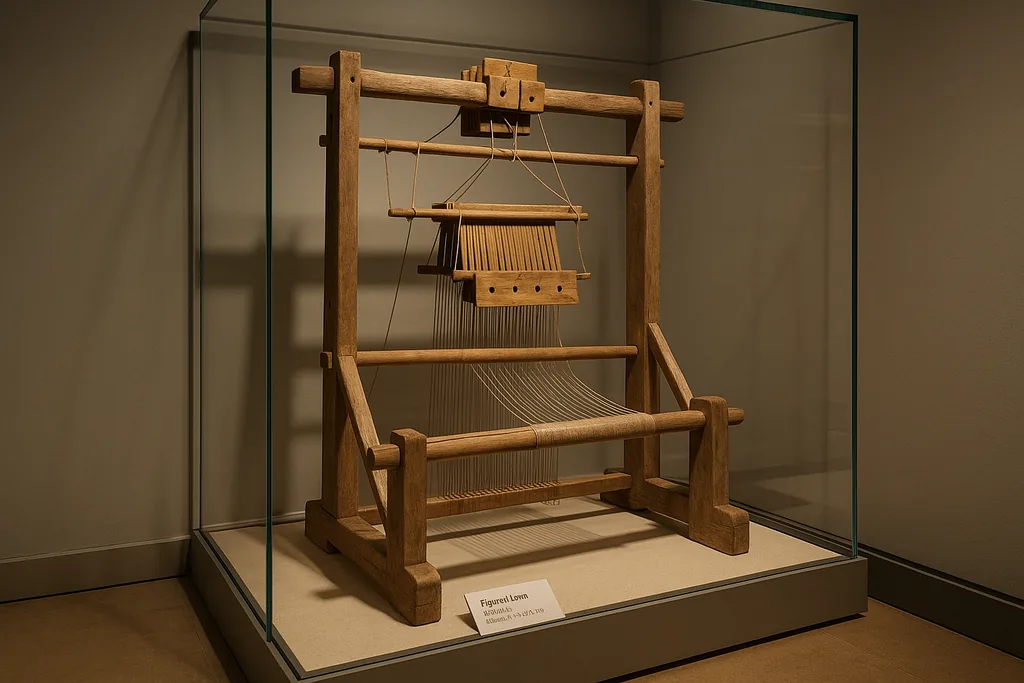
The object at the centre of the discussion is a model of a figured loom (ti hua ji) unearthed during a salvage excavation at the Laoguan Mountain site in Chengdu in December 2012. Archaeologists recovered four loom models from a Han‑period tomb identified as Tomb No. 2; textile researchers later judged them to be early, complete examples of automatic figure looms, and reconstructions have been made by specialists.
At the heart of the controversy is a definitional knot. If you define a computer as any device that takes an input, follows a set of instructions and produces a predictable output, then a programmable loom fits the bill: the pattern cards are inputs, the mechanism executes a repeatable program, and the woven cloth is the output. CAST made this point explicitly when it presented the loom as an input–output machine with separable hardware and software.
But historians and historians of technology usually distinguish between analogue and digital devices, between specialised calculators and general‑purpose machines, and between explicit symbolic processing and encoded mechanical guidance. For example, the Antikythera mechanism — an ancient Greek geared device dated to the late second century BCE — is widely described in the literature as the earliest known analogue astronomical computer because it calculated celestial cycles with gear trains rather than encoded punched cards. That judgement is based on detailed imaging and reconstruction work published in Nature and related journals. The Antikythera mechanism thus occupies a different conceptual niche from a loom whose purpose is to automate repetitive pattern production.
Precedents and descendants
There is a long continuity in human efforts to externalise instructions in a material form. In the European tradition the most famous bridge between weaving and computing is Joseph‑Marie Jacquard’s early‑19th‑century loom mechanism, which used punched cards to control patterns and directly inspired mechanical computing pioneers such as Charles Babbage. Punch cards remained a computing medium into the 20th century and are commonly cited as an early form of stored program. The thread that runs from Chinese figured looms to Jacquard and then to punched‑card data processing is therefore one of technique and analogy, even if the technologies served different social and industrial roles.
Meanwhile, modern accounts of ‘‘first computers’’ often place ENIAC and earlier conceptual machines (Babbage’s Analytical Engine) at the start of a discrete lineage toward electronic general‑purpose computation. The Electronic Numerical Integrator and Computer (ENIAC), completed in 1945 and publicly demonstrated in early 1946, is widely recognised as the first large, programmable electronic digital computer, while the Analytical Engine remains the thought experiment that mapped programmability onto arithmetic machinery. Those milestones are rarely compared directly with textile automation because they occupy different problem spaces — scientific calculation versus mass production — but conceptual cross‑fertilisation (cards, conditional branching, repeatability) is undeniable.
How historians weigh function, intent and context
Calling the Chengdu figured loom a ‘‘binary computer’’ makes an interpretive move: it strips the object of its cultural context (textile production in Han China) and highlights abstract formal properties (discrete states, reusable patterns). That move is useful for showing continuity in human ideas about encoding and automation, but it has limits. Specialists will emphasise the loom’s specific social role — producing luxury textiles — and the fact that its mechanical logic is domain‑specific rather than general‑purpose arithmetic. The Antikythera mechanism, by contrast, was explicitly designed to model astronomical cycles and to perform calculations of a scientific kind; this makes it easier for many historians to call it a ‘‘computer’’ in the sense used in the history of science.
Why the debate matters now
Beyond technical classification, the debate feeds into larger conversations about national scientific heritage and the global history of technology. CAST’s public endorsement of the Chengdu loom as proto‑computing hardware is part scholarship, part cultural narrative: it challenges Euro‑centric timelines and asserts that key ideas underlying information processing had non‑European roots long before industrial Europe. That argument is historically defensible — techniques for encoding instructions and automating labour existed in many places — but it also invites careful, critical scholarship that distinguishes analogy from direct lineage.
For engineers and technologists the loom story is valuable regardless of label. It is an example of sophisticated mechanical thinking — modular instruction sets, decoupling of pattern and machine, repeatability at industrial scale — that anticipates later engineering choices. For historians the find is an occasion to sharpen vocabulary: we can talk of ‘‘programmability’’ in multiple senses, and we can recognise several legitimate ‘‘firsts’’ depending on whether we prioritise generality, electronic computation, symbolic processing, or the earliest surviving example of a given design pattern.
Next steps for scholars
The conversation will move from headlines to journals. Archaeologists, textile historians and historians of technology will want to publish detailed analyses of the Chengdu looms, their mechanical reconstructions and the surviving pattern fragments; radiocarbon dates, wear analysis and controlled reconstructions will strengthen any claims about function. Comparative studies that place the Laoguan models alongside other early mechanised looms, and that articulate clear criteria for ‘‘computing’’ will be essential if the claim is to gain wider acceptance. Until that peer‑reviewed body of work appears, the most productive response is to treat CAST’s statement as a rigorous provocation rather than a settled reclassification.
Whatever the final verdict, the Chengdu loom underscores a wider truth: the technical ideas that make modern computing possible — encoded instructions, repeatable execution, separation of program and machine — have appeared repeatedly in different forms and in different places across history. The work now is to map those appearances carefully, in their social and material contexts, rather than collapsing them into a single origin story.
Sources
- South China Morning Post (report on the Chengdu figured loom and CAST video)
- Nature (Freeth et al., paper on the Antikythera Mechanism)
- Britannica / University of Pennsylvania materials on ENIAC (history of early electronic computers)
- Communications of the ACM (historical overview of punched‑card looms and their influence)
- China Silk Museum and Chengdu archaeological reports (reconstructions and artefact documentation)