A Million Robots Power Amazon Holidays
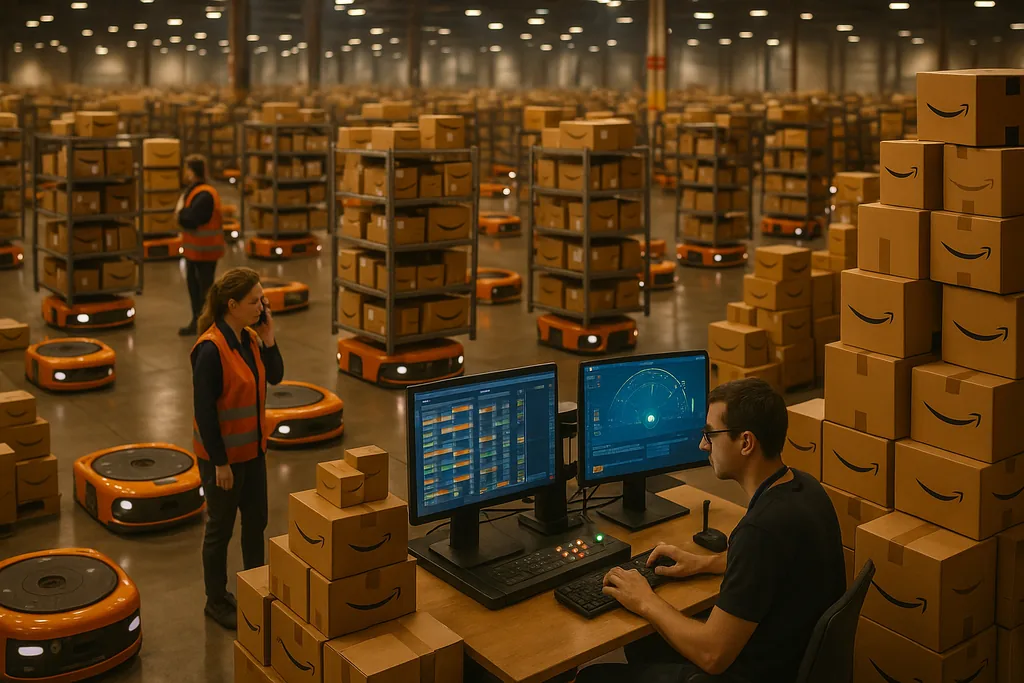
How one million machines keep the presents moving
This holiday season, Amazon’s fulfilment network looks less like a human relay race and more like a choreography of wheels, arms and algorithms. The company announced that its robotics fleet has passed the one‑million mark, a milestone that reflects more than a decade of automation work that began after the acquisition of a small robotics startup in 2012. These robots are now embedded across hundreds of facilities and are involved in a large share of the company’s parcel throughput.
What the robots actually do
Most of the machines you’ll see on a fulfilment centre floor are specialised for repetitive, high‑volume tasks: squat mobile pods that slide under shelving towers and ferry entire racks to human pickers; wheeled carriers that transport carts between stations; and increasingly, articulated arms that can handle fragile and irregularly shaped goods. Newer models add tactile sensing and dual‑arm dexterity so they can pick from dense shelves and manage delicate items. These robots shave walking time, reduce heavy lifting and rework the factory floor so people can focus on tasks that still require human judgement.
AI at the wheel: coordinating fleets
Robots do their best work when they’re coordinated. Amazon has introduced a fleet‑level AI layer designed to optimise how machines move through crowded aisles and minimise idle time. That system is billed as a generative AI model trained on internal operational data; its purpose is straightforward—cut travel times, reduce congestion and increase throughput. Early company statements suggest improvements on the order of single‑digit percentages in fleet speed, which translate into thousands of additional orders moved per day during peak weeks.
Scale and where it matters during holidays
Scale is the point. At roughly a million robots distributed across more than 300 sites, automation is no longer a novelty but an infrastructure layer. During peak shopping weeks—Black Friday, Cyber Monday and the December rush—robots reduce bottlenecks that used to appear when human pickers had to traverse long aisles for every item. With machines handling transport and some picking tasks, facilities can increase the speed at which orders flow from shelf to shipping label. The result is faster cut‑off times and the ability to promise tighter delivery windows to customers.
Numbers that change the workplace
The robot surge is reshaping labour metrics on the ground. Average headcounts per facility have fallen from previous highs and productivity per worker has surged as human roles focus more on machine oversight, maintenance and exception‑handling. The company highlights internal retraining programmes that aim to reskill warehouse staff into higher‑paid technical roles such as robot technicians and flow controllers. Still, managers and labour researchers point out that the sheer scale of automation introduces new staffing patterns and pressures that vary widely between sites.
Limits, safety and the bits robots can’t yet handle
Despite rapid gains, these systems are not a substitute for human flexibility. Robots struggle with tasks that require recognising items inside opaque packages, making judgement calls on damaged goods, or dealing with unexpected clutter. Safety frameworks and human‑robot interaction protocols are therefore crucial: many facilities keep humans in the loop for exception handling, and teams of technicians are required to keep fleets running smoothly during the busiest shifts. That interplay—machines doing the heavy lifting while humans handle nuance—remains the prevailing model.
What this means for jobs and communities
The million‑robot headline has already sparked debate about the future of warehouse work. On one hand, automation reduces repetitive strain and can cut dangerous manual handling. On the other, it can reduce demand for traditional picking roles and concentrate new opportunities in fewer technical positions. The company argues that upskilling programmes mitigate displacement; critics say such programmes do not always match local labour markets or the volume of workers seeking new roles. Policymakers, unions and businesses are now grappling with how to balance productivity gains against job transitions in regions dependent on fulfilment‑centre employment.
Supply chains, costs and customer experience
From the customer perspective, the automation story is mostly about speed and reliability. Lower labour friction and more predictable throughput help keep delivery promises intact during the holiday surge. For Amazon, the economics are compelling: robots reduce variable labour costs, compress fulfilment timelines and smooth seasonal demand swings. But this efficiency comes with capital and maintenance costs—robot procurement, facility redesigns and software investments—that the company offsets by redeploying human staff into higher‑value roles and by scaling the approach across many sites.
What to watch next
- Deeper AI coordination: Generative and reinforcement models that manage fleets at scale will be closely watched for both performance gains and safety implications.
- Robot dexterity: Expanding the range of items robots can handle will reduce exceptions, but the engineering challenge remains substantial.
- Labour outcomes: Whether retraining keeps pace with displacement, and how local economies adapt, will shape policy debates.
- Facility design: New fulfilment centres optimised for robotics—featuring denser layouts and different staff flows—will influence the next wave of automation deployment.