AI Could Redefine the Search for Alien Life
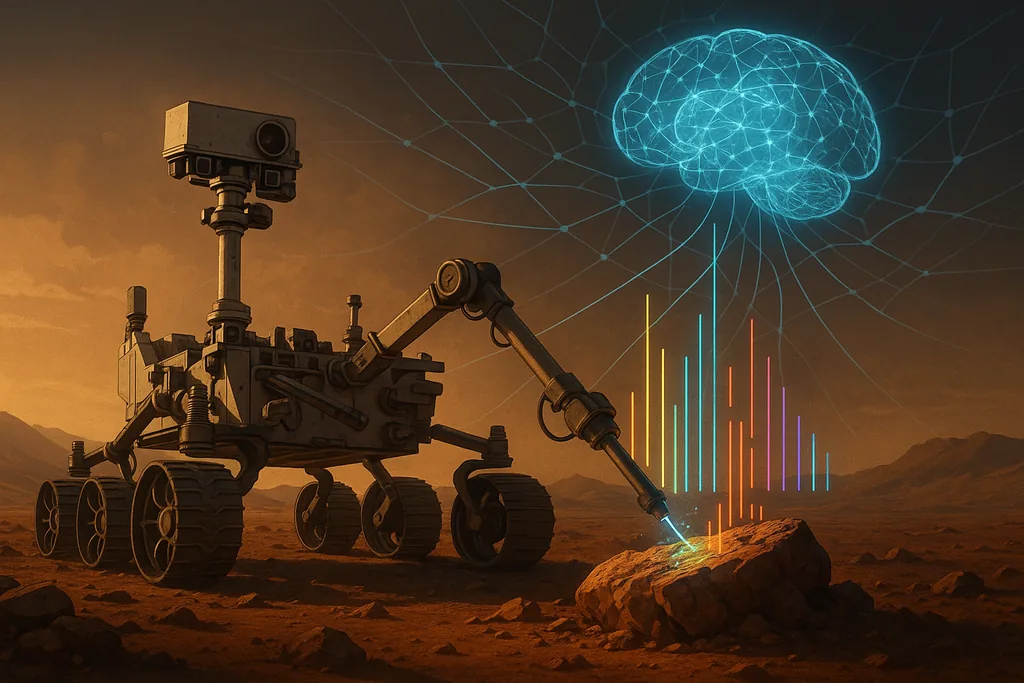
Researchers have combined high-resolution chemical analysis with machine learning to detect faint, billion‑year‑old biosignatures — a technique that may be adapted for rovers and future life‑detection missions.
New machine‑learning chemistry widens the hunt for life
A team of planetary scientists and geochemists has published results showing that an artificial intelligence trained on complex chemical breakdown products can reliably distinguish material that once came from living organisms from abiotic material — even when the original biomolecules are long gone. The work, reported in the Proceedings of the National Academy of Sciences, suggests a powerful new way to read the chemical "echoes" left behind by ancient life and raises the prospect of adapting the approach for use on other worlds.
How the method works
The researchers used pyrolysis–gas chromatography–mass spectrometry (py‑GC‑MS) to thermally break apart rock and organic samples and produce complex mixtures of small molecular fragments. Those fragment patterns — essentially chemical fingerprints — were fed into a supervised machine‑learning model trained on a large, diverse set of samples including modern plants and animals, ancient fossils, laboratory syntheses and meteorites. The model learned to recognise distributions of fragments that are characteristic of biological processing rather than any single molecule or biomarker.
Early results from more than 400 tested specimens show the algorithm can separate biotic from abiotic samples with very high accuracy, reporting above 90% success in many classification tasks. That performance is notable because it does not depend on finding intact lipids, DNA or obvious fossils — features that are rarely preserved when rocks have been heated, buried or chemically altered over billions of years.
Why this matters for astrobiology
The practical implication is straightforward: if subtle, degraded chemical patterns retain a statistical trace of biology on Earth, then the same statistical approach might reveal evidence of past life on Mars, icy moons or returned samples from other bodies. The method is intentionally agnostic about biochemistry — it seeks patterns in distributions rather than specific modern biomolecules — which is an advantage when we don't know what alien life would look like chemically.
Built on earlier machine‑learning biosignature work
This project builds on a body of research that has, over recent years, shown machine learning can detect statistical signals of biology in complex chemical data. A previous study developed an agnostic, ML‑based molecular biosignature classifier using py‑GC‑MS datasets and demonstrated robust discrimination between biotic and abiotic materials. The new work scales that idea up with a much larger sample set and with explicit targeting of the oldest, heavily altered rocks.
Technical strengths, and important caveats
- Strengths: The approach leverages instruments and methods with a flight heritage — mass spectrometers and thermal volatilisation techniques have already flown on Martian rovers — and adds an automated statistical layer that can flag unusual, life‑like chemistry even when known biomarkers are gone.
- Caveats: The model is trained on terrestrial chemistry, so its outputs must be interpreted cautiously when applied off Earth. Abiotic processes can produce complex organic mixtures that mimic biological distributions under some conditions, and planetary materials like perchlorates can alter pyrolysis products in ways that complicate interpretation. Rigorous blind tests against realistic abiotic analogues and cross‑validation with orthogonal methods (isotope ratios, mineral context, microscopy) will be essential.
- Instrumental limits: Miniaturising py‑GC‑MS for spaceflight is non‑trivial; flight instruments use different heating regimes and operate in constrained environments, which can change the pattern of decomposition products. Translating laboratory‑trained models to rover data will require careful calibration and likely mission‑specific retraining.
How this could change mission strategy
If matured and validated, an AI‑assisted chemical classifier would change how teams plan exploration. Instead of searching primarily for pristine fossils or narrowly defined biomarkers, mission planners could use distributed, statistical screening to identify promising strata across larger areas. On Mars or ocean worlds, that could mean faster, more objective down‑selection of samples for return to Earth or targeted follow‑up with complementary instruments.
A cautious but optimistic next phase
Scientists stress the new tool is complementary rather than definitive: it raises candidates for further study rather than issuing an on‑the‑spot declaration of alien life. The community will demand independent confirmation and rigorous tests in analogue environments before treating an AI‑flagged result as evidence. Still, the technique extends the kinds of questions we can ask of broken, altered rocks — and it gives mission teams a data‑driven way to prioritise scarce resources in complex terrains.
For astrobiology, the headline is simple: machine learning plus high‑resolution chemical analysis widens the window for detecting ancient life and provides a practical route to bring that capability into fieldwork and robotic exploration. If the approach proves robust in the harsh reality of planetary missions, it could reshape how we look for life beyond Earth — not by promising instant answers, but by making the invisible patterns of biology visible in places we previously thought unreachable.
James Lawson
Investigative science and technology reporter, Dark Matter. MSc Science Communication, BSc Physics (UCL). Based in the United Kingdom.