On 8 December 2025, a new chapter for commercial trucks began
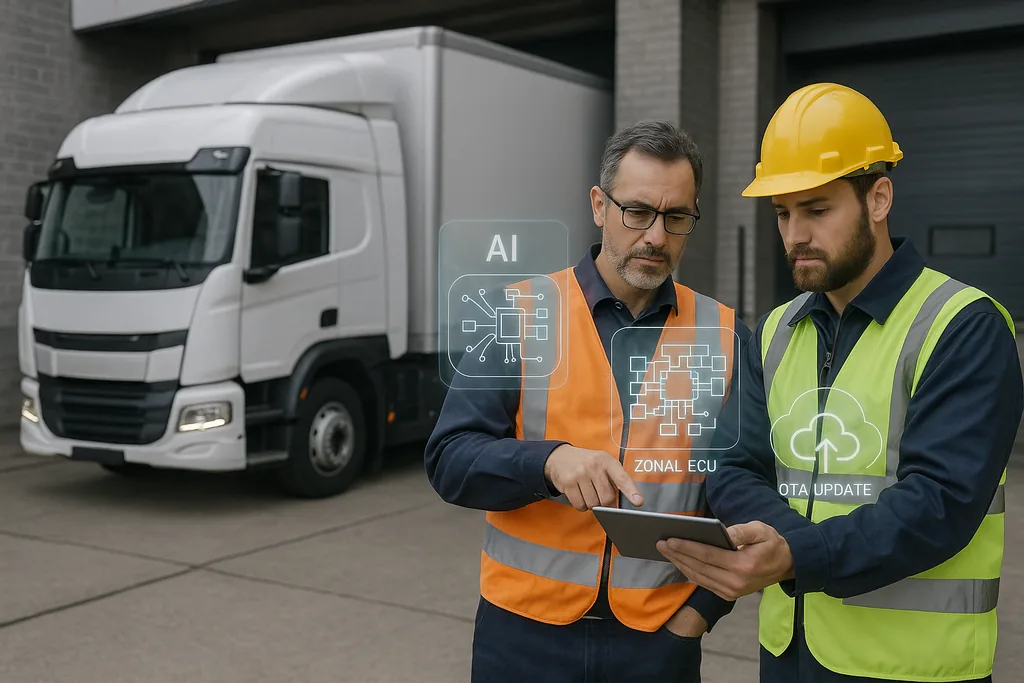
This week REE Automotive and Mitsubishi Fuso announced a memorandum of understanding to convert Mitsubishi Fuso's eCanter electric light truck into a software-defined vehicle (SDV). The deal puts together REE's zonal architecture, x-by-wire (XBW) control units and AI-enabled software with Mitsubishi Fuso's electric and autonomous vehicle know-how — an experiment in turning ordinary commercial fleets into upgradable, cloud-connected platforms.
Software-defined commercial trucks
SDVs are not simply increasingly complex electronics grafted onto a chassis. They are a different engineering model: zonal electronic architectures replace countless bespoke electronic control units (ECUs) with fewer, standardized modules that simplify wiring, reduce weight and make software the main path for functionality. REE's approach packages core vehicle functions behind a simplified electric control unit and an XBW stack, so steering, braking and throttle signals are handled electronically rather than through mechanical linkages.
That design is important because it changes the product lifecycle. Instead of hardware obsolescence dictating when a truck gets retired, software — delivered securely over the air (OTA) — can add features, improve safety and refine energy management during the vehicle's operational life. For fleet operators, this promises lower total cost of ownership, faster feature rollouts and the possibility of new service revenue based on data and software.
Operations, autonomy and sustainability
On the ground, the announcement connects two industry trends. First, fleets are electrifying: Mitsubishi Fuso's eCanter is already a zero-emission, inner-city workhorse. Second, operators want smarter vehicles that reduce downtime and fuel (or battery) consumption. AI supports both ambitions: predictive maintenance models can spot failing dampers or chillers in logistics hubs; route-optimisation software conserves energy; and sensor fusion enables progressive driver assistance and, potentially, later-stage autonomy.
These features are closely tied to decarbonisation goals. International agreements and national pledges — including recent transport initiatives discussed at COP30 — are pushing manufacturers and fleet owners toward zero-emission medium and heavy vehicles. Software-driven controls and continuous AI tuning make it easier to squeeze efficiency from electric drivetrains and charging infrastructure, helping fleets meet interim 2030 targets and the longer-term shift to net-zero operations.
Data, edge computing and sovereign control
The REE–Mitsubishi Fuso project is an industry-scale example of a broader infrastructure shift: intelligence is moving to where the data lives. Enterprises and vehicle OEMs are increasingly treating data gravity as an architectural constraint — and an opportunity. Running AI models at the edge or in a controlled cloud close to vehicle fleets reduces latency for safety-critical tasks, keeps raw telemetry local for compliance, and cuts ongoing cloud costs.
Industry players have been explicit about this direction: turnkey stacks that combine databases, GPU acceleration and containerised inference services make it feasible to deploy AI in data centres, at the edge or in mixed architectures while preserving sovereignty and control. For commercial vehicles this means on‑board agents that can reason over fresh sensor feeds, retrain or personalise behaviour locally, and synchronise distilled telemetry back to central operations for fleet-wide learning.
New business models — and new responsibilities
When trucks become platforms, OEMs and fleet operators can monetise software features: premium safety suites, advanced telematics, predictive maintenance subscriptions and vertical logistics optimisation. OTA updates also let manufacturers push safety patches and performance improvements without workshop visits, which shortens reaction time when issues are discovered in the field.
Technical bottlenecks and industry challenges
Several practical constraints remain. Supply-chain limits for compute-grade silicon, the need for standardised interfaces across OEMs, and gaps in charging and telematics infrastructure are all blockers to rapid scale. There is also a human factor: driver shortages and operations teams must be retrained to manage software-first fleets. And while OTA and cloud connectivity enable capabilities, they also increase dependence on network coverage and robust remote‑management tooling.
From a data governance perspective, operators must balance usefulness with privacy and sovereignty. Governments and enterprise customers increasingly insist that sensitive telemetry remain under local control — a dynamic that pushes deployments toward hybrid models combining local inference with aggregated cloud learning.
Putting governance and safety at the centre
Adapting AI responsibly in commercial vehicles requires cross-disciplinary governance. Formal MLOps and software lifecycle practices are needed to trace model provenance, test edge deployments and roll back updates safely. Explainability and performance metrics must be part of regulatory submissions so auditors can verify that an AI feature behaves as intended across edge cases. Finally, transparent customer contracts should clarify who is accountable when an over-the-air update changes vehicle behaviour.
Where this leads next
The REE–Mitsubishi Fuso MoU is a practical pilot in a larger industry transition. It demonstrates how modular hardware, AI-driven services and OTA distribution can be combined to upgrade existing electric platforms into evolving, upgradable machines. If the trial succeeds at scale, expect a wave of retrofit programmes for fleets, tighter partnerships between OEMs and software providers, and new service-oriented business models for logistics operators.
Two critical inflection points will determine pace: first, how regulators adapt certification pathways for vehicles that can change behaviour after sale; second, whether operators and suppliers can standardise interfaces so software ecosystems grow without fragmenting into incompatible silos. The outcome will shape not only the economics of trucking but the environmental and safety performance of the global logistics system.
Sources
- REE Automotive & Mitsubishi Fuso memorandum of understanding (company technical announcement)
- EDB / NVIDIA / Supermicro industry technical briefing on sovereign AI and edge AI infrastructure
- AWS re:Invent technical presentation on AI-driven building operations and energy optimisation
- Global memorandum on zero-emission medium- and heavy-duty vehicles (COP30 policy declaration)