AI Fears Push Salesforce to Historic Lows
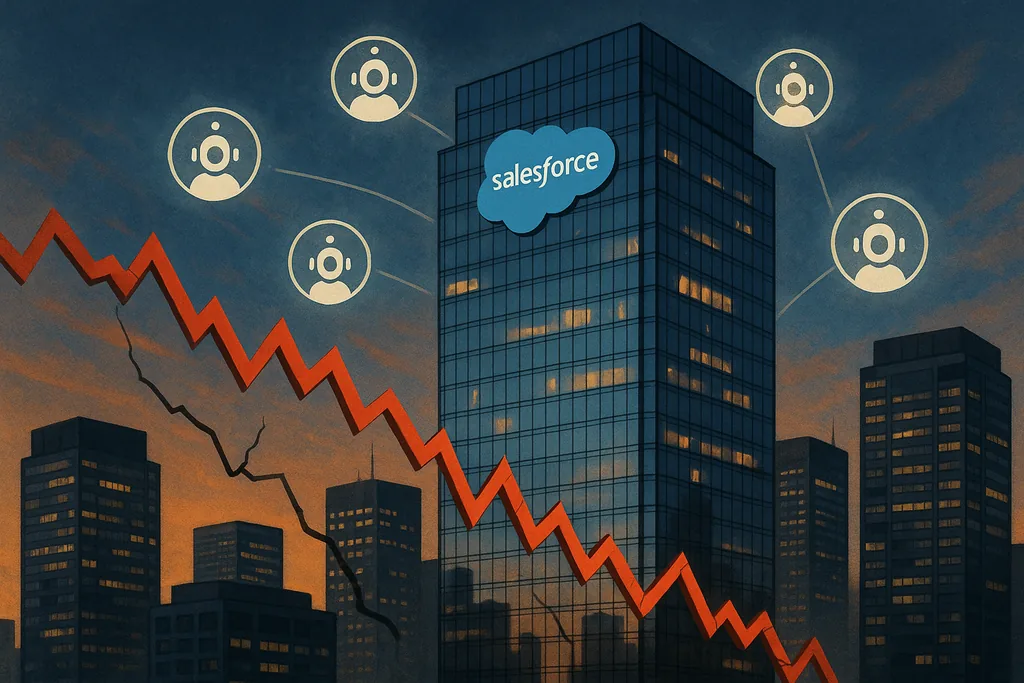
Shares slump as AI narrative collides with investor scepticism
This week Salesforce found itself pulled into the centre of a broader market question: is the AI boom already a bubble? The enterprise-software giant — which has spent the last year recasting itself as an "AI + Data + CRM" company — has seen its share price slip toward the bottom of its 52-week range after a stretch of derating that leaves the stock trading at levels that would have been unthinkable only a few years ago. Investors are no longer buying the argument that future growth alone is a clean substitute for near-term proof: they want to see AI driving revenue, attachment rates and durable margins today, not promises for later.
Salesforce's position: moves made, evidence still thin
Management has been explicit about the path it is selling. Over the past year Salesforce has launched Agentforce and pushed Data Cloud and AI subscriptions, disclosing that those business lines are growing quickly off a small base and that data-and-agent subscriptions have reached meaningful run-rates. Executives have described "agentic AI" as the next major platform wave for enterprise software and pointed to new plumbing and acquisitions intended to give those agents useful data to work on.
Yet the market has treated the company differently. Shares are down roughly 30% year-to-date, the forward price/earnings multiple has compressed into the high‑teens, and the stock is trading near roughly five times forward sales in many valuations — numbers that reflect a change in how investors model the company. Part of that re‑rating is mechanical: revenue growth has slowed from the high teens to the high single digits, and the incremental AI revenue remains a small proportion of total sales. But the deeper reason is risk re‑weighting: when investors talk about "AI risk" they mean the prospect that AI could compress software pricing, redirect budgets toward infrastructure providers, or enable new entrants to build cheaper alternatives to incumbent suites.
That tension made Salesforce's quarterly report and guidance after the bell a significant moment. Analysts entered the call expecting roughly $10.27 billion of revenue and non‑GAAP earnings in the mid‑to‑high single digits per share, but the real question was whether management could point to measurable attach rates or widening adoption of Agentforce and Data Cloud — concrete signs that AI is already material, not just aspirational.
The wider backdrop: why bubble talk matters
Salesforce's share move cannot be read in isolation. Across markets, investors and central bankers have flagged elevated valuations in AI-related names, and parts of the tech build‑out have aged into two distinct camps: the infrastructure and hardware winners, and the software incumbents whose business models could be reshaped — or disrupted — by AI. A handful of firms remain perceived as the arms dealers of AI: chip makers, cloud providers and data‑centre operators. Those names have absorbed a large share of investor capital. At the same time some traditional software companies are being marked down on the view that AI may alter pricing and contract dynamics in ways that disadvantage multi‑module incumbents.
Macro forces add fuel to the debate. Analysts have noted record debt issuance tied to cloud and AI expansion, and some research houses warn of over‑investment in capacity. Valuation metrics across the index are elevated by historical standards: forward P/E measures and cyclically adjusted valuation indicators sit well above long‑term averages, and market concentration has increased — the biggest handful of stocks now make up a far larger share of market value than in many prior cycles. Those are the ingredients that make calls about a bubble sound plausible.
Concrete signals investors are watching
- AI revenue traction: investors want to see attach rates — the share of existing customers adopting Agentforce and Data Cloud — and expanding ARPU (average revenue per user) for AI subscriptions. A flashy percentage of growth off a small base is not the same as materiality.
- Margins and monetisation: can Salesforce sell AI functionality as a differentiated, high‑margin product rather than a free or commoditised layer that customers expect to be bundled in at marginal cost?
- Evidence of displacement or price compression: is AI prompting customers to shift spend from Salesforce to infrastructure providers, third‑party agents, or open platforms? Signs of contract renegotiation or lower renewals would be a red flag.
- Guidance and near‑term beats: with the stock so discounted, investors are looking for management to use guidance and quarterly execution to change the narrative. That means organic growth acceleration not just long‑term aspirational targets.
Demand-side evidence — the paradox of AI-driven sales and scepticism
At the consumer end, AI has been shown to move money: industry trackers reported record web sales on recent shopping days where AI shopping tools and agents helped customers find deals. Companies that operate both commerce and data platforms have been quick to point to agent‑driven discovery as a real revenue lever. Those numbers are useful because they show AI influencing buying behaviour in narrow contexts. But the translation from consumer search boosts to enterprise contract wins is nontrivial. Corporate buyers replace workflows and systems slowly; procurement cycles, integration costs and regulatory concerns all temper adoption.
Possible outcomes and what they mean for investors
There are three plausible scenarios for Salesforce and the wider AI trade. First, Salesforce proves the skeptics wrong: AI attach rates and Data Cloud adoption accelerate meaningfully, margins expand and the company re‑earns premium multiples. Second, Salesforce remains a solid but slower‑growing software incumbent: AI adds revenue but is insufficient to offset secular deceleration, leaving the stock as a lower‑growth, cash‑generating name. Third, the negative scenario — broader AI market dynamics compress software pricing or redirect budgets — causes further earnings disappointments across incumbents and forces deeper valuation resets.
Which path unfolds depends largely on measurable adoption and the pace at which enterprises reengineer operations around agentic AI. For investors, the prudent approach is not binary cheerleading or blanket panic: it is to watch the metrics that separate hype from durable business transformation and to rebalance exposure between infrastructure winners, proven software franchises with clear AI monetisation, and non‑AI sectors that may act as a hedge if sentiment turns.
Where we stand now
Salesforce's recent derating is as much about market sentiment on AI as it is about the company's fundamentals. Management has built the road toward an AI‑first future; the market is demanding to be driven down that road. In the near term, the coming quarters will be a referendum on whether Agentforce and Data Cloud are revenue levers or strategic experiments. For anyone watching the intersection of AI and markets, Salesforce has become the most consequential company to scrutinise: the outcome will tell us as much about the future of enterprise software as it will about today's appetite for AI risk.
Investors should expect volatility, and look for hard evidence — not just vision statements — before concluding the AI story has materially changed the economics of enterprise software.