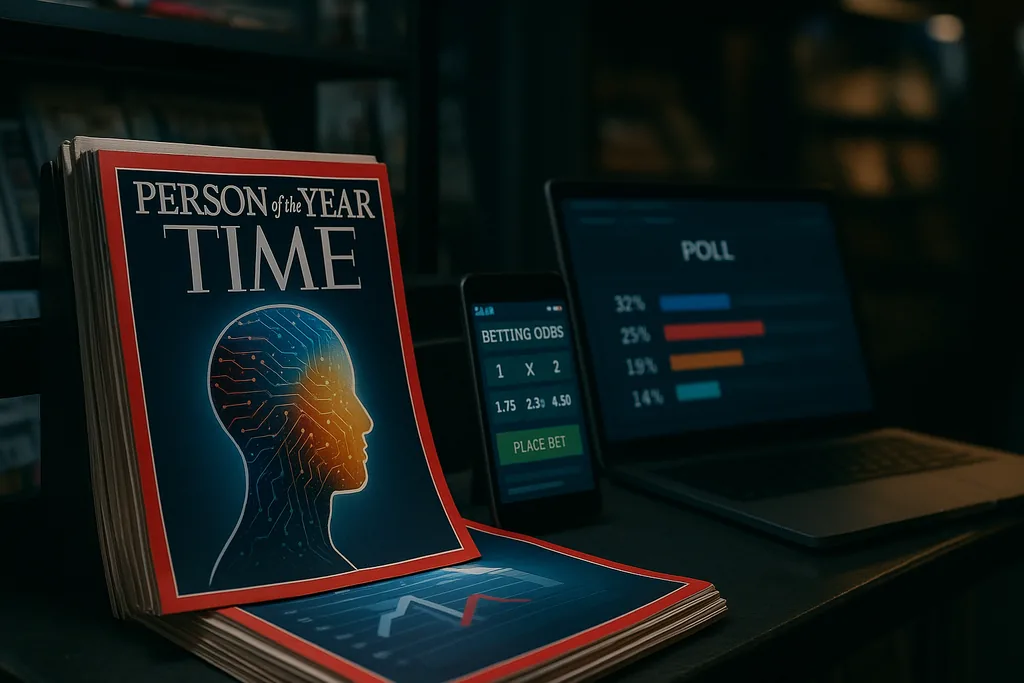
Odds, covers and a strange kind of celebrity
On the eve of Time magazine's 2025 Person of the Year announcement, betting markets and prediction platforms are treating "artificial intelligence" not as a category but as a single contender. Markets such as Polymarket have pushed AI into clear lead positions, with snapshots this week putting it well ahead of rival entries that include individual executives such as Jensen Huang and Sam Altman. The spread of odds — different platforms and times have shown anywhere from roughly 40% up toward 60% probability — captures a broader story: a technology that has saturated public life, media coverage and policy conversations is being personified for the purposes of a year-end prize.
That personification matters because Time's choice is both descriptive and performative. The magazine defines its honor as recognizing "the person or persons who most affected the news and our lives, for better or ill." Time has in the past treated nonhuman forces as the award's subjects — the personal computer was "Machine of the Year" in 1982, "Endangered Earth" featured in 1988, and the 2006 selection of "You" acknowledged a mass cultural shift — but naming AI would be different in scale and kind. AI today is not a single machine or movement; it is a sprawling set of models, tools, platforms, chips, companies and cultural practices that collectively change how information and power flow.
What the markets and polls are signaling
Prediction markets do not decide editorial choices, but they do reflect where attention and expectations lie. The platforms that have AI as the frontrunner are essentially putting a monetary value on the idea that 2025 will be remembered as a year shaped by advanced machine learning systems — by investments in chips and cloud infrastructure, by viral AI products and controversies, and by regulatory and political reactions.
At the same time, public-opinion polling shows how powerfully those conversations have moved into everyday life. Recent polling referenced alongside the betting odds finds a majority of Americans expressing serious concerns about AI's long-term risks: more than half of respondents agreed that AI could eventually pose existential dangers, and a still-larger share worried it might become difficult to control. Those anxieties sit beside an adoption divide: younger adults report much higher rates of experimenting with chatbots and generative tools than older generations, a gap that helps explain why cultural and regulatory responses are uneven and politically fraught.
Industry responses and cultural pushback
Those moves highlight tensions that cut across business models and creative practice. Music producers and artists argue about consent and likeness; radio and streaming services weigh listener trust; advertisers and rights holders contend with the legal and ethical status of synthetic voices and cloned performances. Meanwhile, chipmakers and cloud providers are reporting record demand from enterprises and governments that want more compute for models and inference, a economic reality that helps explain why industry leaders — chip-company founders, cloud executives and AI company chiefs — often appear on lists of potential honorees alongside the abstract entry "AI."
Why a nonhuman winner would matter
Picking AI as Person of the Year would be less a celebration of technology than an acknowledgement of how it has redistributed agency. The cover of a magazine cannot regulate a technology, but it can crystallize a narrative. That narrative shapes public discourse: it becomes a framing device for policymakers, journalists, investors and the public. If Time were to recognize AI, it would be casting the conversation about regulation, standards, accountability and societal effects into stark relief.
At the same time, naming AI raises questions about attribution and accountability. Who does the award criticize or praise when it spotlights a diffuse capability? Is it the companies that fund and deploy the largest models; the researchers who invent techniques; the nations that set policy; or the public that uses and contests the technology? Treating AI as a unitary actor simplifies complex networks of responsibility into a single headline-friendly figure — useful for storytelling but fragile as a basis for governance.
Limits of prediction and editorial independence
Markets and polls capture expectations and anxieties, not editorial decisions. Time's editors have the final say and have historically balanced symbolic covers with profiles of people who shaped the year. The presence of high-profile executives in the betting top ten underscores a second dynamic: even if the technology is selected, the human leaders and organizations that engineered deployment and commercial scale would still be at the center of follow-on debates.
After the cover: policy, practice and the long tail
Whether or not AI appears on this year's cover, the institutional responses will continue. Lawmakers are already drafting rules about transparency, safety testing and liability. Media companies are experimenting with disclosure and labeling. Labor markets are responding unevenly, with some roles transformed by automation and others spotlighted as uniquely human. And cultural debates about authenticity, identity and ownership will ripple outward into courts, legislatures and commercial agreements.
Ultimately, the idea of AI as Time's frontrunner matters because it forces a question: do we want a technology to be recognized as an independent actor, or do we want to keep focus on the people and structures that design, deploy and profit from it? The answer will shape not just headlines but the decisions — legal, economic and ethical — made in the months ahead.
Time's announcement will be read as a snapshot of 2025's dominant story. But whether the magazine puts a name, a company leader, or the concept of artificial intelligence on its cover, the larger argument will continue: societies will have to decide how to negotiate power with tools that look less like appliances and more like actors.
Sources
- Time (Person of the Year editorial and related coverage)
- Polymarket (prediction market event data)
- YouGov (public-opinion polling referenced in coverage)
- iHeartMedia (company statements on AI and programming policies)