AI Reads Brainwaves to Spot Early Dementia
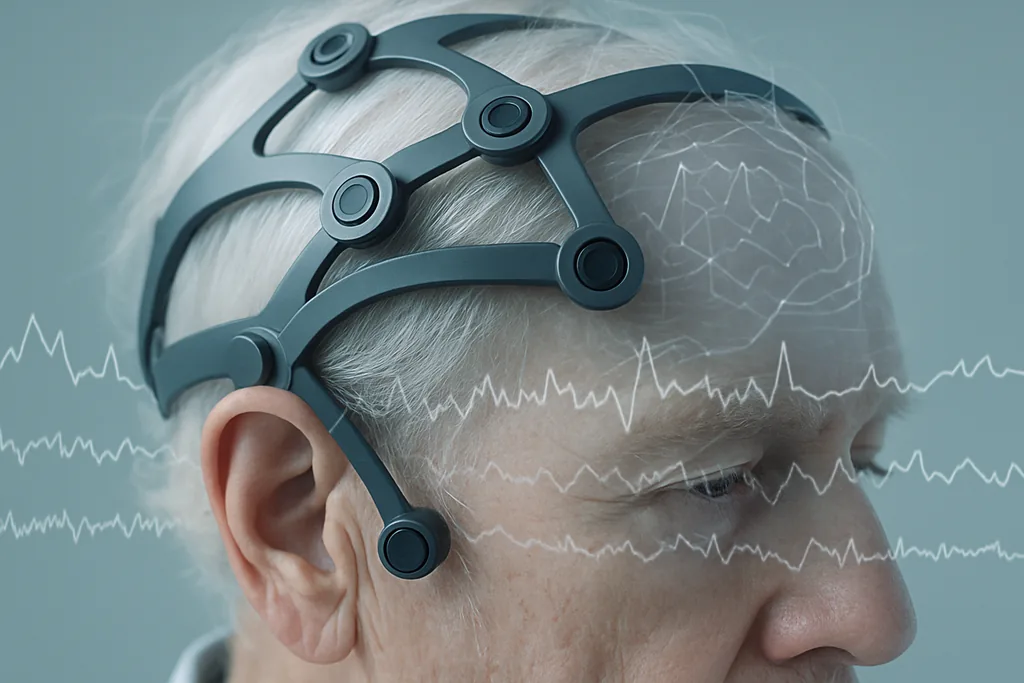
New EEG-based AI models are showing promise for earlier, cheaper detection of Alzheimer’s and frontotemporal dementia; recent studies highlight explainable, privacy-preserving classifiers that could run on wearable or edge devices, but clinical validation and diverse datasets remain essential.
Why an EEG plus AI matters now
Electroencephalography (EEG) — an old, inexpensive technique that records tiny voltage fluctuations from the scalp — is getting a modern upgrade. Over the past year research teams have published new machine‑learning systems that sift EEG recordings for patterns linked to Alzheimer’s disease and frontotemporal dementia, and some of these systems are designed to be both explainable and small enough to run on wearable or edge devices. These developments could make early screening more accessible and less costly than scans or lumbar puncture biomarkers that clinics typically use today.
Two new directions in EEG-based AI
Two independent research tracks stand out. One group built a hybrid temporal‑convolutional plus LSTM network and combined it with carefully engineered EEG frequency features; they emphasise interpretability and report very high performance on binary contrasts (disease vs healthy), while multi‑class tasks were more modest. The authors also applied SHAP, a post‑hoc explainability tool, to expose which frequency bands and derived features the network used to decide.
How these systems work, in plain language
At a technical level, both approaches share a basic pipeline: (1) preprocess raw EEG to remove noise and isolate frequency bands, (2) extract or learn spectral and topographic features that carry disease signals, and (3) feed those features into a compact neural network that classifies the recording. The explainability layer then translates model weights and feature importance scores into human‑readable cues — for example, showing that decreased power in certain mid‑frequency bands or altered frontal topographies weighed heavily in a dementia decision. This combination of spectral engineering and small, task‑tailored networks helps limit overfitting on modest datasets while keeping inference fast for real‑time applications.
Broader evidence: big datasets and sleep EEG
Work outside those two papers underlines the promise and the scale problem. One large clinical group used more than 11,000 routinely acquired EEGs to train and test algorithms that extract a handful of robust features tied to neurodegenerative disease — an effort that shows population‑scale clinical data can reveal subtle, clinically relevant EEG patterns that human readers usually miss. That study reinforces the idea that EEGs contain useful latent signals for cognitive diagnosis.
What’s new about explainability, privacy and lightweight models?
- Explainability: Using feature‑level analyses and SHAP, researchers can show which EEG bands and scalp regions drive predictions. That helps clinicians judge whether the model’s signals are physiologically plausible rather than spurious.
- Edge deployment: Models with only a few thousand parameters and sub‑megabyte footprints can run on smartphones, dedicated EEG wearables, or embedded hospital monitors — opening the door to home screening or bedside alerts.
Limits and caveats
The results are promising but not yet definitive. High reported accuracies often come from limited or imbalanced datasets, where class imbalance can inflate some metrics while reducing recall for under‑represented groups (for example, healthy controls in one study showed lower recall). Small validation cohorts, single‑site data and short recordings (single‑night sleep EEG) raise generalisability concerns. Independent, multi‑centre prospective trials and transparent benchmark datasets are required to gauge real clinical utility. Researchers also warn that very high binary accuracies can mask difficulties in telling apart multiple dementia subtypes in real patients.
Practical and ethical considerations
If EEG‑AI screening becomes widely available, clinicians and policy makers will need to decide how to act on flagged individuals. Early detection can enable lifestyle interventions and earlier access to therapies, but false positives or unclear prognostic messages risk anxiety and unnecessary procedures. Privacy practices around brain data, consent for federated training, and explainability standards that clinicians can interpret will be central to adoption.
Where this goes next
In the near term we will likely see three parallel pushes: larger, harmonised datasets to test generalisation; pragmatic trials that embed EEG‑AI into memory clinics and primary care pathways; and engineering work to embed validated models into wearables and hospital monitors. Smaller, interpretable architectures — and hybrid pipelines that combine engineered EEG features with compact neural nets — appear to be a pragmatic route that balances accuracy, transparency and deployability. Recent work on compact, interpretable EEG networks supports this direction and suggests that you don’t always need massive models to capture clinically relevant signals in EEG.
Bottom line
EEG‑based AI is emerging as a cost‑effective complement to imaging and fluid biomarkers for detecting cognitive decline. Two strands of 2025 research — explainable hybrid models and privacy‑focused, ultra‑compact networks for edge deployment — show that the field is moving from proof‑of‑concept toward practical, clinic‑friendly tools. But the technology still needs larger, diverse validation studies and careful clinical integration before it can be used for routine screening or diagnosis.
As a reporter following AI, healthcare and devices, I’ll be watching how these teams scale their work into multi‑site trials and real‑world deployments — because if researchers can deliver robust, interpretable and privacy‑protected EEG diagnostics, that would reshape how we detect and track dementia in the years ahead.