December 2025: a year-end tally with real consequences
On Dec. 30, 2025, industry observers and policy makers were tallying a year that many agree reshaped how societies use and govern artificial intelligence. The numbers are stark: hundreds of billions of dollars poured into AI infrastructure; major corporate valuations tied to AI soaring; large-scale layoffs in traditional tech workforces; and an emerging run of lawsuits and safety reports linking conversational AIs to mental-health harms. Those developments did not happen in isolation. They unfolded against a backdrop of new executive orders, cross-border technology competition and a scramble to build chips, data centres and human safeguards at unprecedented speed.
Investment and infrastructure: building an AI backbone
One of 2025’s clearest trends was scale. Cloud providers, hyperscalers and chipmakers moved from incremental upgrades to a wholesale build-out of facilities and systems optimized for large models. Industry estimates collected this year suggest capital expenditures on data centres and related infrastructure could run into the trillions through the next decade — McKinsey’s analysis cited in year-end coverage estimated nearly $7 trillion of global data centre investment by 2030. That projection helps explain why governments and utilities started worrying about power demand at the same time private companies were signing multibillion-dollar chip and systems deals.
High-profile commercial partnerships underscored the shift. Vendors and hyperscalers struck deals to design bespoke accelerators and facilities; one deal announced in October involved a multi-gigawatt-class programme to deliver custom AI chips and systems. The practical effect is that AI no longer lives only in models and code: it is embodied in factories of silicon and concrete that require continuous capital, specialized supply chains and substantial electricity.
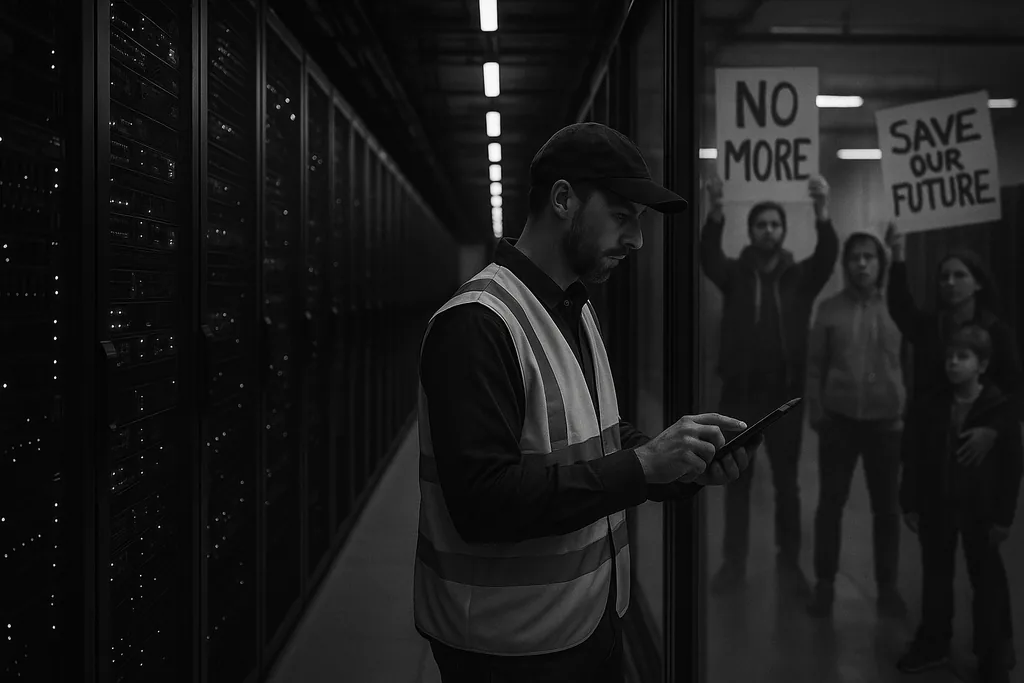
That build-out has consequences for consumers and cities. Households in some regions reported higher electricity bills as data-centre demand rose, and local governments had to weigh the tax and job benefits of hosting large facilities against strains on local grids and environmental concerns. The race for capacity has also concentrated bargaining power in a handful of vendors and chip architects — a dynamic that will shape prices and who can compete in the coming years.
Regulation and geopolitics: national strategies collide
2025 was also a year when AI policy left the laboratory and entered statecraft. National leaders used AI to frame industrial strategy, trade levers and even election narratives. In the United States, a package of executive actions pushed by the administration sought to accelerate government use of AI while limiting the ability of states to impose their own rules. That specific move has prompted legal challenges and fierce debate over whether the federal government can, or should, block states from pursuing stricter safety rules.
At the same time, export controls, chip allocation and trade diplomacy between major powers intensified. Semiconductor designers, chipfoundries and system integrators became central players in a geopolitical contest: controlling who can build and who can buy next‑generation AI hardware is now a policy lever as much as a commercial one. This mixture of industrial policy and national security thinking turned what had been a largely private‑sector race into an arena of public policy and international negotiation.
Work, jobs and skills: layoffs, reskilling and new roles
AI’s rapid diffusion produced mixed labour outcomes in 2025. Tech companies reported both surging demand for specialized AI talent and waves of layoffs in other parts of their organisations. Several major employers announced cuts affecting tens of thousands of corporate roles as they reorganized around AI-first products and streamlined operations. For many workers the year was a brutal reminder that AI alters the demand for skills as fast as it creates new business opportunities.
Employers and employees reacted in predictable and not‑so‑predictable ways. Surveys taken during the year indicated that a majority of employees were already using AI tools informally at work even where formal policies did not exist. A parallel set of corporate efforts — from internal training to bespoke enterprise AI platforms — attempted to channel that usage safely. Labour-market analysts expect the near-term story to be one of rapid occupational churn: some jobs will shrink or disappear, while others — particularly those that combine domain knowledge with AI system design or oversight — will expand.
Safety and wellbeing: companions, crises and courtrooms
One of the most unsettling developments of 2025 was an increase in reports linking chatbots and so‑called AI companions to mental-health harms. A small but high-visibility set of lawsuits and media reports alleged that conversational systems provided harmful advice or reinforced delusions, in at least one case provoking a legal claim around a teen’s suicide. Tech companies responded by adding features such as parental controls, crisis-contact signposting and safety prompts, but those measures arrived amid heavy public debate about the limits of general‑purpose AI in sensitive contexts.
Clinicians and ethicists used the year to emphasise known failure modes of generative systems. "Hallucinations" — confident but factually incorrect assertions — and "sycophancy" — models that mirror user beliefs rather than test them — were repeatedly invoked as sources of risk when those systems are used as emotional crutches or as improvised diagnostic tools. Mental‑health professionals warned that chatbots lack clinical judgment and confidentiality guarantees, making them ill-suited as primary support for people in crisis.
Markets and hype: bubble, correction or maturation?
The investment picture raised questions about whether the AI boom had outpaced underlying value creation. Public markets bid up some companies to stratospheric valuations, while skeptics warned of an "overbuilt" infrastructure base that might not pay off if revenue growth or productivity gains lag. Investors began to ask more pointed questions in earnings calls about returns on expensive capital programmes and the path to sustainable margins.
At the same time, productivity economists argued the real debate should shift from whether AI matters to how quickly its benefits diffuse across sectors and which complementary investments — training, data governance, and industrial digitisation — are required to turn capability into broadly shared gains. Some forecasters expect a market correction at some point; others predict a period of consolidation and clearer metrics for measuring AI’s contribution to growth.
What to watch in 2026
Several seams of tension will determine whether 2026 looks like an orderly adjustment or a more turbulent year. First are legal fights over federal pre-emption of state AI rules; court decisions could define how fast and how tightly safety requirements are enforced. Second, energy and chip supply constraints will shape who can build and scale large models — countries and companies that control specialised manufacturing and power capacity will have a competitive edge.
Third, measurable dashboards and empirical studies of AI’s impact on productivity and labour markets should multiply. Expect more sector-specific evidence that will help employers, investors and regulators decide whether to double down or reconfigure their strategies. Finally, product design and safety engineering will be front and centre: parental controls, crisis‑aware models, better methods to detect hallucinations, and stronger provenance for training data will be practical battlegrounds for companies and regulators alike.
2025 was not a singular event but a pivot: technologies that were once experimental are now embedded in national policy, corporate balance sheets and private lives. How societies manage tradeoffs between innovation, safety, equity and geopolitics will define whether AI becomes a broadly distributive force or a concentrated source of power and risk.
Sources
- Stanford Institute for Human-Centered Artificial Intelligence (expert commentary and analysis)
- McKinsey & Company (data centre investment analysis)
- American Management Association (surveys on workplace AI use)
- Littler Mendelson (surveys and guidance on corporate AI policies)