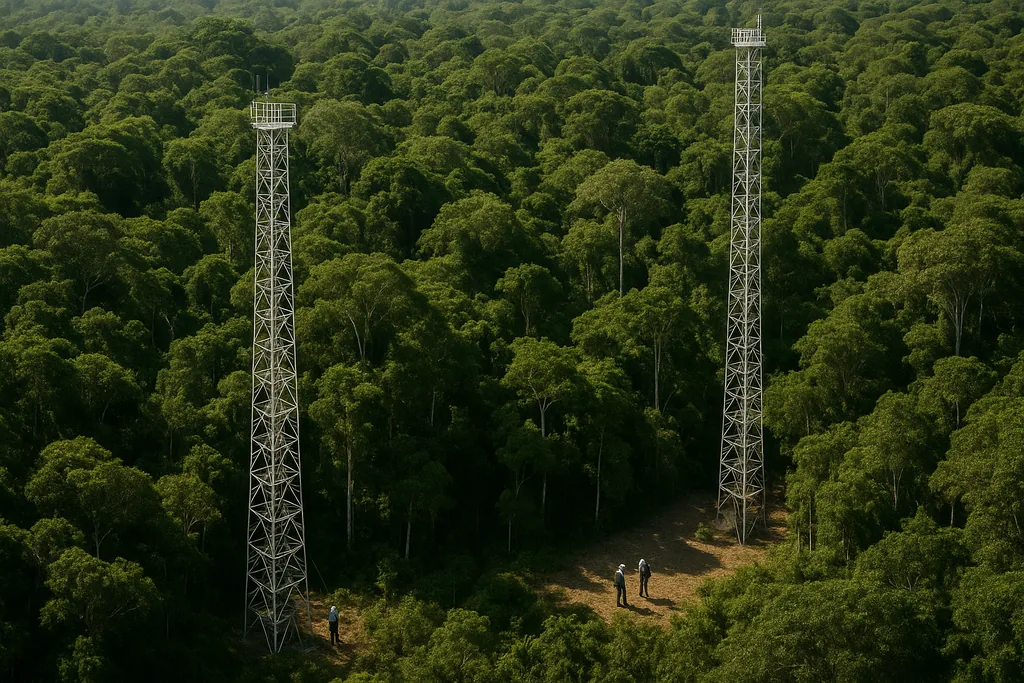
Lede: Towers, sensors and an ancient climate returning
On 10 December 2025, a large international team published evidence that the central Amazon is slipping toward a climate regime scientists have labelled “hypertropical” — a hotter, drier state with more frequent extreme droughts that has no modern analogue and last occurred tens of millions of years ago. The conclusion rests on three pillars: more than 30 years of forest demographic records from experimental plots near Manaus, physiological measurements of trees during the 2015 and 2023 El Niño droughts, and projections from contemporary climate models. Together those lines of evidence show that heat-plus-drought events are already producing conditions that dramatically elevate tree mortality and that, under high-emission trajectories, such conditions could become widespread by 2100.
What the researchers measured
The team combined long-term forest plot data with sap-flow, soil moisture and micrometeorological measurements from instrumented towers north of Manaus. In both the 2015 and 2023 El Niño droughts, sensors recorded a sudden collapse in transpiration once soil volumetric water content fell to roughly one-third of the soil’s capacity. When trees shut their leaf pores to avoid water loss they also curtail carbon uptake, producing a period of carbon starvation. Prolonged exposure to that state and to extreme heat increases the risk of hydraulic failure as air bubbles form in xylem conduits — a process analogous to embolisms that block water transport. These physiological mechanisms explain how short but severe hot droughts can translate quickly into elevated tree death.
Mortality and species shifts
Hypertropical — a new name for an ancient state
Model projections and timelines
To translate local measurements into basin-wide risk, the team used outputs from Coupled Model Intercomparison Project Phase 6 (CMIP6) simulations. Under high-emission scenarios, the models show that large areas of tropical forest — including the Amazon — will fall into hypertropical climate states by 2100. The study also isolates an interim timescale: hot-drought conditions that are today rare could become common in the dry season within roughly 20 to 40 years, and by century’s end extreme hot-drought days could occur across much of the year in some scenarios. In one widely cited projection, the authors estimate that, if warming continues unchecked, sites in the central basin could experience on the order of 150 days per year with hot-drought conditions by 2100. Those extra stress days are the mechanism that converts episodic die-off into sustained decline.
Carbon-cycle consequences
The Amazon is currently one of the planet’s largest terrestrial carbon sinks, but that role depends on a living, productive forest canopy. When trees die en masse, not only is carbon sequestration reduced, but decomposing wood and accompanying fires can convert the forest into a net source of CO2 for years. Past extreme drought years have already produced measurable pulses of atmospheric carbon linked to Amazon drought and land-use change. The physiological mechanisms identified in the new study — stomatal closure, carbon starvation, and hydraulic failure — directly reduce photosynthetic uptake and thereby weaken the basin’s ability to buffer global emissions. Projected increases in hot-drought days therefore create a positive feedback to global warming unless emissions are cut.
Drivers, interactions and uncertainties
The study is deliberately synthetic: it stitches together field physiology, long-term demographic monitoring and global climate model output. That breadth is a strength, but it also means several sources of uncertainty remain. Models differ in regional rainfall projections and in how vegetation responds to prolonged stress; the spatial heterogeneity of the Amazon — from wetter western headwaters to seasonally dry eastern fringes — means hypertropical conditions will not arrive uniformly. Human pressures such as deforestation, fragmentation and fire interact with climatic stress to amplify vulnerability, especially in secondary or degraded forests. Finally, ecological recovery depends on seed sources, dispersal and the pace of species turnover — processes that are challenging to represent in global models. The authors highlight these limits and emphasize that the timing and severity of outcomes hinge on future emissions pathways.
Policy and practical implications
The headline message is sobering but actionable: much of the future risk to Amazon forests depends on how quickly humanity reduces greenhouse-gas emissions. The models used in the study show markedly lower area in the hypertropics under lower-emission trajectories. Locally, protecting intact forest, reducing fragmentation and curbing fires would make remaining forest patches more resistant to extreme heat and drought. At the same time, the physiological thresholds identified by the research—particularly the soil moisture tipping point near one-third of volumetric water content—offer an empirical target for monitoring and early warning systems that could guide adaptive management.
What to watch next
Follow-up work will appear quickly because the study points to several tractable priorities: expanded sap-flow and soil-moisture monitoring across different forest types; integrating species-level hydraulic traits into Earth system and vegetation models; and targeted studies in secondary and fragmented forests that are likely to be most vulnerable. Policymakers and conservationists will also watch global negotiations and regional land-use policies closely, because emissions reductions and forest-protection measures are the levers that most directly alter the study’s worst-case timelines. The present-day hot droughts act as an urgent laboratory — they are rare now but show the physiological pathways that will operate more often if warming continues.
Sources
- Nature (research paper: "Hot droughts in the Amazon provide a window to a future hypertropical climate", published 10 December 2025)
- University of California, Berkeley (research and press materials summarising the study)
- Instituto Nacional de Pesquisas da Amazônia (INPA) (field collaborators and long-term monitoring sites)
- NGEE-Tropics data archive and CMIP6 model ensembles (datasets and climate model projections used in the study)