Unopened Apollo 17 Samples Reveal Exotic Isotopes and Relativistic Signatures
Unopened Apollo 17 Samples Reveal Exotic Isotopes and Relativistic Signatures
Background and sample history
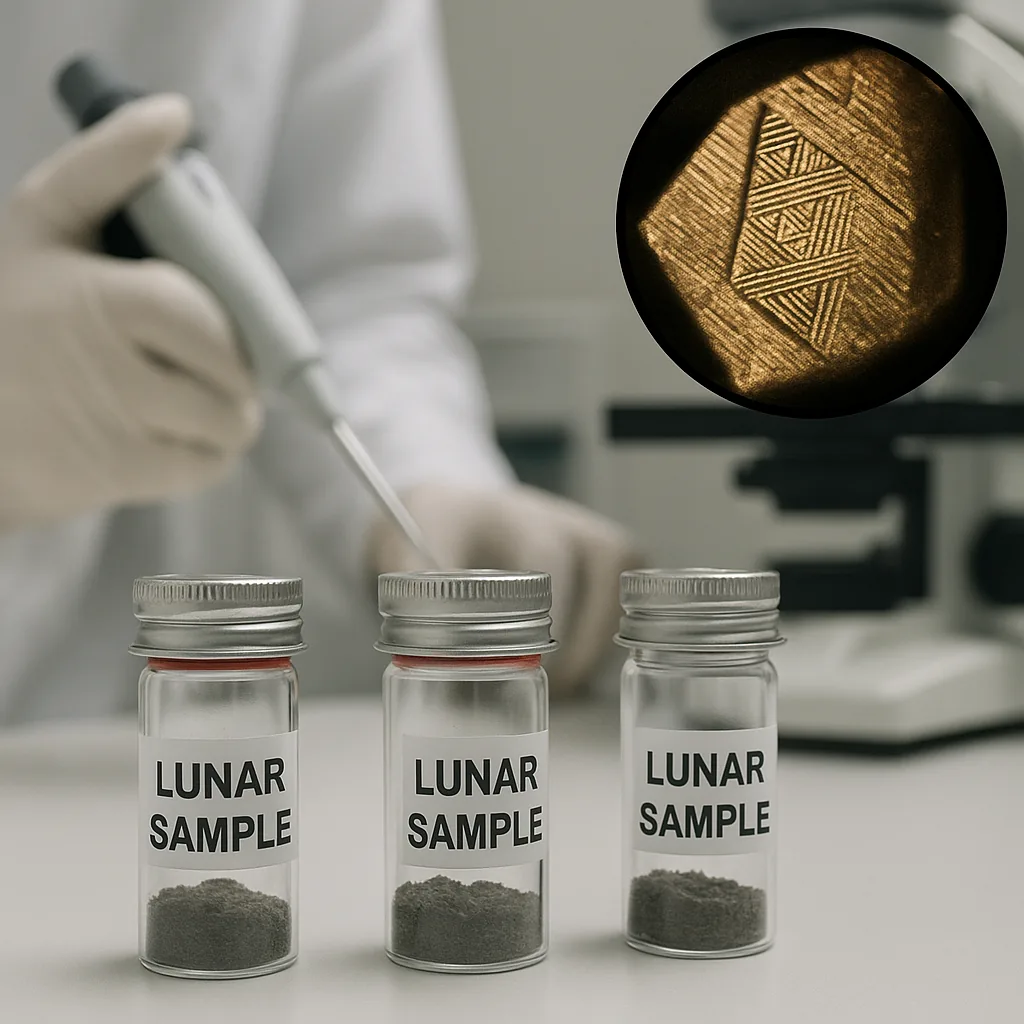
Several core tubes returned from the Taurus–Littrow Valley during the Apollo 17 mission were sealed and kept in vacuum at cryogenic temperatures for decades. Researchers opened selected tubes in 2022 for analysis using modern instrumentation.
Unexpected isotopic compositions
Spectrographic measurements identified unusual abundances and ratios of several isotopes, including helium-3, xenon-129 and titanium-50, that do not fit standard models of local solar system formation and surface processing. The isotope distributions were distinct from typical lunar basalts and from signatures attributable to solar wind implantation alone.
Microstructure and high-energy exposure indicators
Microscopic and crystallographic studies found nano-scale mineral features with lattice alignments and defect patterns interpreted as consistent with exposure to intense, relativistic energy fields. A planetary geochemist involved in the work described these structures as recording high-energy atomic events not expected from the Moon's current environment.
Comparisons with astrophysical observations
When compared with astrophysical datasets, some isotopic signatures showed correlations with subtle patterns observed in cosmic background measurements. That comparison raised the possibility that certain grains within the samples could be interstellar in origin and predate the solar system.
Laboratory tests indicating relativistic responses
Selected zircon crystals extracted from the cores were subjected to high-energy pulsed lasers in controlled experiments. Instruments recorded brief, nonlinear temporal responses in the crystals. Investigators interpreted these localized fluctuations as measurable, very small distortions in spacetime curvature under laboratory conditions, though alternative explanations have not been excluded.
Research implications and next steps
Scientists emphasize that the results are preliminary and require independent replication and theoretical development. The findings have prompted interdisciplinary collaborations among planetary scientists, condensed-matter physicists and engineers to explore whether quantum-resonant field behaviors observed in the samples can be reproduced or modeled.
Early experimental work suggests that certain atomic alignments might be induced through approaches such as superconducting lattice compression. Teams are assessing whether the materials or phenomena could inform fundamental studies of spacetime coupling or long-term research into advanced propulsion concepts, while noting substantial scientific and technical uncertainties.
Scientific and cultural significance
If confirmed, these observations would expand understanding of the Moon as a repository for ancient and possibly interstellar material and provide novel experimental pathways for probing high-energy interactions at small scales. The results also highlight the value of preserving returned extraterrestrial samples for future study as analytical capabilities improve.
Reflection
The Apollo 17 mission and its preserved samples continue to yield new scientific insights decades after their return, illustrating the long-term returns of curated planetary materials.