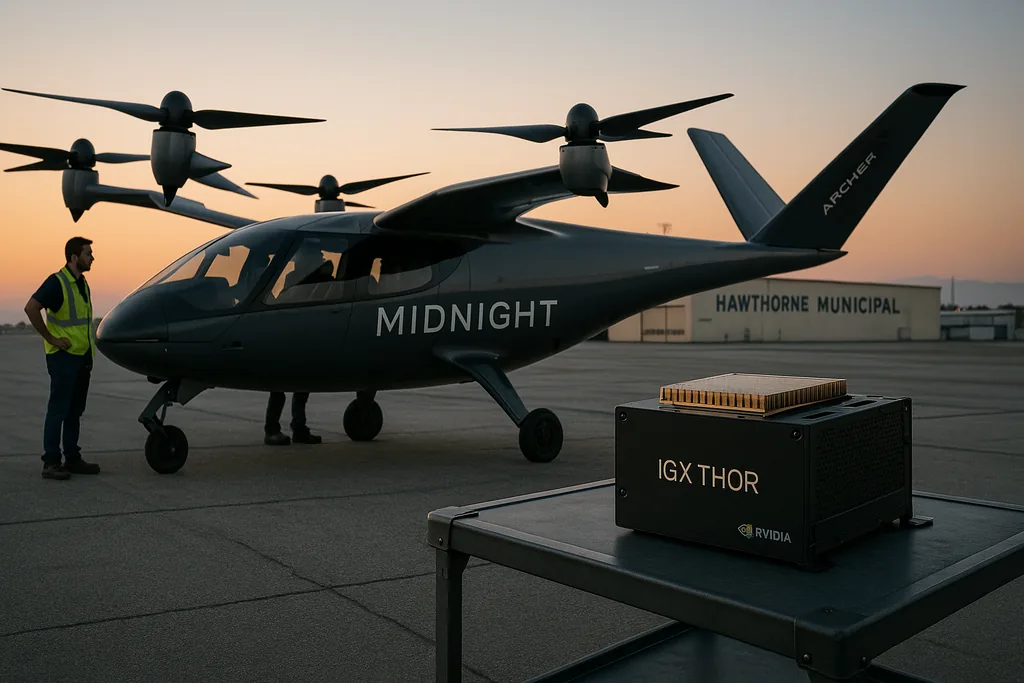
Archer adopts NVIDIA’s IGX Thor at CES to power its Midnight air taxi
At CES on January 8, 2026, Archer Aviation said it will integrate NVIDIA’s IGX Thor — the company’s most powerful safety-capable AI computing module — into future iterations of its Midnight electric vertical takeoff and landing (eVTOL) aircraft, and will use its newly controlled Hawthorne Municipal Airport as the operational hub and testbed for the work.
What the announcement actually means
The short technical shorthand is straightforward: Archer plans to bring high-throughput, safety-focused edge AI inside an aircraft so that perception, decision-making and predictive systems can run on board in real time rather than relying solely on ground links. NVIDIA describes IGX Thor as an industrial-grade, functional-safety-capable module intended for high-reliability, real-time computing at the edge — a product designed to extend robotics and autonomy into safety-critical environments. The company said the module would be available "later this month" following its CES briefing.
For Archer, the immediate use-cases the company highlighted are threefold: enhanced pilot safety and predictive awareness through faster environmental sensing and flight-path analytics; improved airspace integration with more dynamic, traffic-aware routing; and a computing architecture that is "autonomy-ready" — able to support semi-autonomous and, eventually, autonomous flight controls when regulators and certification pathways permit.
Hawthorne as a live testbed
Archer’s plan ties directly to its control of Hawthorne Municipal Airport in Los Angeles, which the company acquired control of in late 2025 and says will serve both as a commercial hub for a planned LA network and as a testbed for its AI-driven flight systems. That lease-and-testbed strategy gives Archer local infrastructure, a place to instrument aircraft and ground systems together, and a nearby urban environment for trials — but it also places the company squarely in a city with an active community and regulators to engage.
Industry trend, not an isolated bet
Archer’s move fits a broader industry pattern: several advanced air mobility and robotics firms view high-performance edge AI as an enabling technology rather than an afterthought. NVIDIA’s IGX/Jetson family is being positioned across robots, construction equipment and vehicles; other eVTOL manufacturers have also announced collaborations with NVIDIA’s IGX platform earlier or in parallel, signalling an industry-wide push to fold the same software and hardware ecosystem into aircraft. Observers have flagged similar tie-ups at large industry events and through commercial announcements.
Technical realities and certification hurdles
Turning a high‑performance AI module into an approved component of an aircraft is not only a systems-integration challenge but a regulatory and engineering one. Aviation certification regimes were built for deterministic code and traceable requirements; deep neural networks and data-driven models pose different verification problems because their behavior depends on training data and statistical properties as much as on code. Researchers and regulators are actively developing frameworks and guidance for certifying ML-enabled airborne systems, and academic work proposes approaches that combine traceability, statistical verification and selective human oversight to give regulators confidence in outputs.
Pragmatically, industry groups and specialist vendors are already building toolchains and test methods intended to make ML systems more tractable for accepted aviation processes. But those approaches are emergent rather than settled: current practical paths accept low-criticality ML functions under existing software assurance levels while standards organizations and civil authorities work toward guidance for higher-criticality use. That gap is one reason Archer and NVIDIA emphasise "autonomy-ready" capabilities rather than claiming immediate pilotless commercial operations.
What integration will involve
Integrating IGX Thor into an eVTOL means more than bolting in a compute box. It requires architectural work across avionics, sensor suites, flight-control logic and human–machine interfaces. Onboard systems must stay within tight weight, thermal and power budgets; they must interoperate with the certified flight controls and radios; and they must provide auditable behaviours for safety assessments. Archer says it will pair NVIDIA’s computing and software stack with its proprietary avionics and control software and use the Hawthorne site for iterative testing, pilot training and operational validation.
Timelines, commercial plans and market context
Archer has been testing the Midnight aircraft in multiple locales and expanded international demonstrations in 2025. The company has publicly signalled ambitions to deploy in select Middle Eastern markets in mid‑2026 and to pursue U.S. commercial service in 2027, subject to regulatory approvals — timelines that sit alongside their Hawthorne build-out and the planned integration of new onboard AI. Investors and industry watchers will judge progress against those milestone claims.
Beyond Archer, manufacturers face market, manufacturing and regulatory pressure: integrating complex compute stacks raises costs and supply-chain dependencies, while the operators must show that the net effect of AI is measurable safety benefit rather than opaque complexity. Partners such as vehicle component suppliers and manufacturing allies are part of the picture: industry reporting has noted that major automotive suppliers and vehicle manufacturers are already tied into some eVTOL industrialization plans, a reminder that the effort mixes aerospace and high-volume manufacturing cultures.
Why this matters for cities and airspace
If Archer and others succeed in deploying robust onboard AI, the most visible benefits will initially be softer: more precise situational awareness for pilots, smoother handling in congested corridors and improved predictive maintenance that reduces unscheduled downtime. On a larger scale, AI-capable aircraft could enable more dynamic airspace management where individual aircraft negotiate routes with traffic and ground systems in near real time — a change that pushes air-traffic systems and local authorities to modernise rules, communications and noise-management approaches. Regulators in Europe and the U.S., and research groups, are explicitly preparing roadmaps for integrating AI into aeronautical systems and U‑space/UTM frameworks.
Next steps and the path forward
Practically, expect three near-term lines of work from Archer and NVIDIA: hardware integration and environmental testing at Hawthorne; extensive data collection and labelling to build trustworthy perception stacks; and engagement with certification authorities to develop acceptable evidence for safety claims. The companies have been collaborating since early 2025, and Archer says initial integration is already under way; whether that work converts into certified, recurring commercial operations will depend on how quickly certification approaches mature and how testing evidence performs in real urban conditions.
The headline is simple: Archer’s CES announcement signals a shift from theoretical AI capabilities for aircraft toward concrete, hardware-coupled programmes that aim for operational use in the next two years. The real story will be whether those systems can be demonstrated, explained and certified in ways that regulators, passengers and cities accept.
Sources
- Archer Aviation press release ("Archer To Build Next Wave of Aviation AI Technology With NVIDIA IGX Thor", January 8, 2026)
- NVIDIA press release and CES briefings on IGX Thor (January 5–7, 2026)
- Aerospace research: "Formulating an Engineering Framework for Future AI Certification in Aviation" (Aerospace, 2025)
- Academic frameworks and certification discussion: arXiv preprints on certification frameworks for AI-based aerospace systems