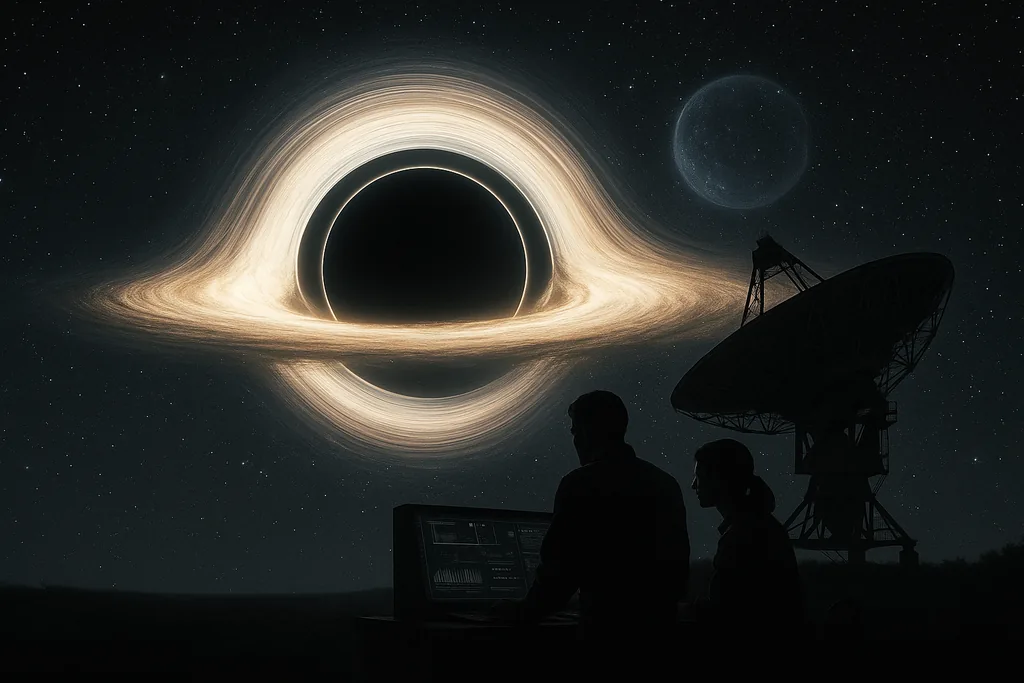
Hawking’s bold suggestion, and why we still talk about it
When Stephen Hawking first announced that black holes emit thermal radiation, he upended a century of assumptions: the objects once thought to hide all information forever could slowly evaporate. That realization created the modern information paradox — if Hawking radiation is genuinely random, the quantum details of anything that fell into a hole would be irretrievably lost, and the laws of quantum mechanics would break. Over the past few decades the paradox has been the engine behind some of theoretical physics’ liveliest developments: holography, complementarity, entanglement calculations and, most recently, the idea of entanglement "islands" that carry information out of a hole.
Why the paradox mattered
The tension is simple to state and profound in consequence. Quantum theory insists that physical processes are unitary: knowing the present, in principle, lets you reconstruct the past. General relativity, in Hawking’s semiclassical calculation, seemed to show the opposite for black holes. If information were truly lost, basic pillars of physics — statistical mechanics and quantum theory itself — would be in trouble. The result was a decades-long intellectual struggle between champions of different viewpoints: some argued the information must be destroyed, others that it is encoded in subtle correlations or at the horizon.
From paradox to working consensus: information comes out
Two threads over the last ten years pushed many theorists to a practical consensus: quantum gravity effects, however small, can modify Hawking’s original conclusion so that information is not lost; and the holographic viewpoint gives a firm framework for how that could happen. Calculations using ideas from the holographic correspondence — an exact equivalence between certain gravitational systems and lower‑dimensional quantum field theories — show that entropy of evaporating black holes follows the Page curve expected for unitary evolution. Other approaches, which examine the quantum entanglement structure of radiation, produce "islands" — regions that effectively encode interior information in the outgoing radiation.
Those results are important because they change the ledger: the information about what fell in is not destroyed. But that answer comes with a big rider. The information is typically spread across huge volumes of space and entangled in exponentially complex ways; reconstructing a fallen quantum system from the radiation would be a task so forbiddingly hard that it is effectively impossible in practice.
Holograms, complementarity and the practical invisible
Leonard Susskind and others stressed that the information is not lost in principle — unitarity is preserved — but it becomes computationally inaccessible. An outside reconstruction would require an astronomically large number of operations, effectively rendering the information unrecoverable in any realistic experiment. So the philosophical sting of Hawking’s original claim is dulled: laws remain intact, but determinism becomes a matter of practical complexity as well as principle.
Could a black hole spit matter into another universe?
The idea that falling matter might end up in another universe is older than recent technical advances. It comes in several flavors. One is the picture of black holes as "baby-universe" nucleation sites: in certain quantum gravity scenarios the interior can pinch off and become an expanding domain disconnected from our spacetime. Another route is through wormholes and nontrivial topology: quantum effects might connect regions in ways classical general relativity does not allow.
Hawking himself speculated that some of what crosses the horizon could reappear elsewhere — perhaps in a separate universe. That remains speculative. The contemporary calculations that restore information to the outside do not imply a visible physical tunnel that would carry macroscopic objects intact into another cosmos. Instead they show how quantum correlations and spacetime subtleties can encode information about interior states into outgoing radiation. For a human or a spacecraft, tidal forces and thermalization at the horizon remain fatal; the pragmatic answer to whether you could travel through a black hole and survive is still no.
The interior is the next frontier
Perhaps the most stubborn mystery is what actually happens inside an evaporating black hole. The new computations that rescue information work primarily at or just outside the horizon, or in toy models amenable to exact holographic duals. They do not yet give a detailed, generally accepted picture of the interior geometry and dynamics. Speculations have ranged from smooth interiors compatible with complementarity, to firewalls — violent zones of high-energy quanta at the horizon — to more exotic equivalences in which distinct interior configurations are secretly the same state seen from different ways of slicing spacetime.
How this ties to inflation, the multiverse and infinity
The question of what lies beyond a black hole connects naturally to broader cosmological ideas. Cosmic inflation and eternal inflation predict a landscape of causally disconnected domains; in some interpretations these are literally "other universes." Physicists have also compared the multiverse produced by eternal inflation — an exponentially proliferating collection of bubble universes — to the many‑worlds arising from quantum mechanics. A useful, if technical, point: different kinds of "infinities" arise in these pictures. The inflationary multiverse tends toward an exponential type of infinity; the many‑worlds branching structure is combinatoric and could be an even larger kind of infinity.
Reconciling those infinities tells us whether a quantum‑mechanical multiverse of all possibilities could be physically realized somewhere in a larger inflating spacetime. Current thinking suggests that unless inflation is past‑eternal or the inflating region was born infinite in spatial extent, you won't literally find every branch of quantum possibility realized as a distinct inflating pocket. Those are deep open questions that cross cosmology and quantum foundations, and they show how black hole physics, quantum gravity and cosmology are parts of the same conceptual knot.
What matters going forward
For researchers, the path forward is technical and concrete: explore the interior, sharpen the holographic dictionary, test toy models and push quantum simulation to regimes that approximate gravitational dynamics. For the curious public the lesson is subtler. Black holes taught us that paradox is a productive force in physics: apparent contradictions force us to invent new ideas — holography, complexity, quantum extremal surfaces — and those ideas often find application far beyond their original context.
Where we stand
Sources
- Nature (Stephen Hawking's 1974 paper on black hole radiation)
- Stanford Institute for Theoretical Physics (research and perspectives on black hole information)
- Institute for Advanced Study (work on holography and quantum gravity)
- University of California, Berkeley (entanglement islands and recent entropy calculations)
- Event Horizon Telescope Collaboration (observational studies of black hole environments)
- University of Sussex (reviews and commentary on quantum gravity and information)