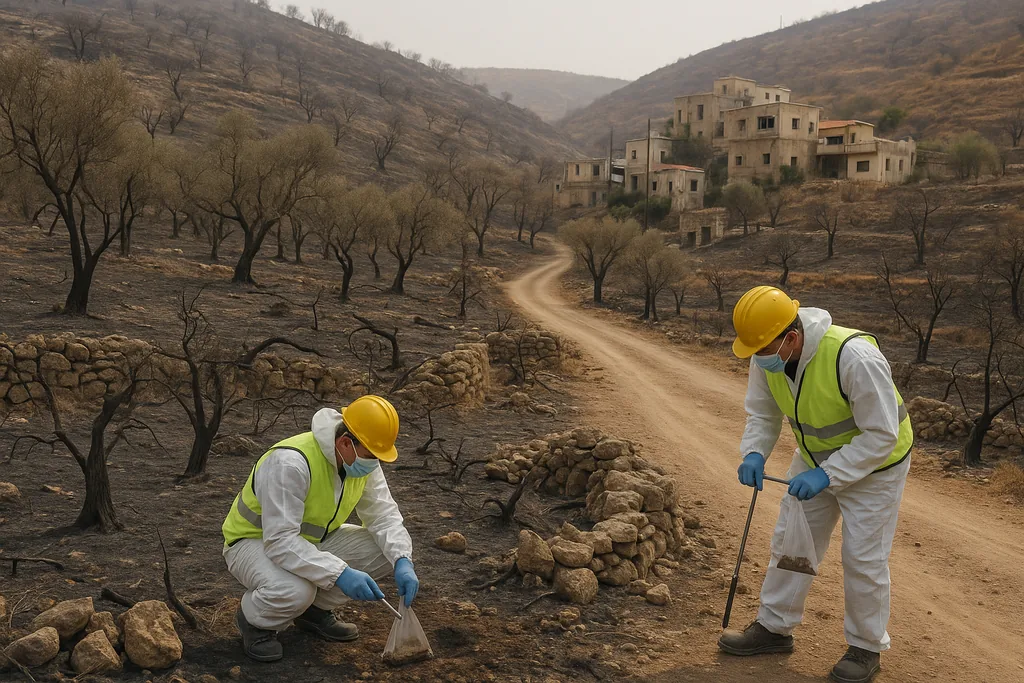
Today’s tally: fires on the ground, toxins in the soil
On 15 December 2025 a regional report highlighted a concentrated pattern of incendiary munitions used in southern Lebanon. Researcher Ahmad Baidoun documented at least 195 white‑phosphorus strikes there between October 2023 and October 2024 — a scale that raises fresh worries about immediate harm to civilians and a cascade of environmental effects that can last for decades.
White phosphorus: how a weapon becomes an environmental agent
White phosphorus is a military munition prized for its ability to produce blinding smoke and ignite materials on contact with air. Its chemistry explains why medical and ecological alarms sound after strikes: the compound ignites at ambient temperature, producing very hot fires that burn organic matter and release phosphorus oxides into the air. Those oxides quickly hydrolyze to form acidic, phosphate‑rich compounds when they contact moisture, and burning of modern urban materials — plastics, electronics, treated wood — releases a complex cocktail of particulates, heavy metals and persistent organic pollutants.
That combination — intense thermal damage plus chemically active combustion products — does three kinds of environmental damage: acute burns and inhalation hazards for people and animals; local deposition of toxic residues that contaminate soil and surface water; and long‑term alteration of ecosystems through nutrient loading, changes to soil chemistry and destruction of plant cover that normally protects against erosion.
Forests, farms and water in Lebanon
Local and regional reporting over the past two years documents exactly those harms. In Lebanon, military operations have been credited with the destruction of thousands of hectares of vegetation and farmland. Independent observers and regional scientists say fires set by explosive attacks and incendiary rounds burned natural cover and agricultural plots — a pattern that strips landscapes of their protective plant layer, exposes soils to erosion, and cuts habitat for wildlife.
When vegetation and topsoil go, the downstream consequences are immediate: more sediment in rivers and coastal waters, damaged irrigation systems, and contamination of wells and springs with ash and byproducts of combustion. Where munitions or damaged infrastructure rupture storage tanks or sewage facilities, contaminants can migrate into groundwater and coastal fisheries, compounding public‑health and food‑security crises.
Air pollution and the carbon footprint of conflict
Beyond local contamination, modern combat generates large volumes of smoke, dust and greenhouse gases. Aircraft sorties, heavy armour, and the transport and manufacture of weapons all consume fossil fuels at rates that dwarf ordinary peacetime activity. Independent analyses from conflict researchers show that sustained bombing campaigns and military logistics can add millions — sometimes hundreds of millions — of tonnes of CO2 equivalent to the atmosphere, while urban fires produce fine particulate matter that travels hundreds of kilometres and affects air quality across borders.
For communities downwind of bombardment, the direct health impacts of inhaling smoke and particulates are immediate: respiratory problems, cardiovascular stress and higher rates of hospital admissions. For the climate, the emissions from fuel use, debris burning and reconstruction are a material but often invisible part of the global greenhouse‑gas budget because reporting frameworks typically exclude or undercount military activity.
Debris, toxic legacy and food systems
War creates huge volumes of debris — collapsed buildings, industrial ruins, vehicles and ordnance — and that rubble itself is a reservoir of contaminants. When structures burn or collapse, plastics, paints, treated timbers, batteries and industrial chemicals are released into the environment. The particulate load contains heavy metals, dioxins and other toxicants that bind to soils, enter food chains and persist. Cleanup is expensive, technically demanding and dangerous to workers without proper protection.
For farmers, the risks are stark: contaminated soils reduce crop yields and raise the possibility that foodstuffs will contain harmful residues. In the absence of rapid, well‑resourced testing and remediation, fields can remain unsafe for years, and communities may face prolonged food insecurity or be forced to shift to more expensive food sources.
Health, monitoring and the challenge of accountability
Human exposure is multi‑modal: direct burns from incendiary munitions, inhalation of smoke, ingestion of contaminated water or food, and chronic exposure to contaminated dust. Clinicians and environmental health specialists stress that monitoring must be multidisciplinary — combining toxicology, geochemistry, epidemiology and community surveillance — to document exposures and guide remediation priorities.
But monitoring is uneven in active conflict zones. Field teams face security risks, basic infrastructure for sampling (labs, refrigeration, transport) is often damaged, and access to sites is contested. That means significant environmental harm can go undocumented for months or years, making upstream prevention and downstream compensation far harder to achieve.
Cross‑border pollution and cooperation
One of the harder truths of environmental damage during war is that pollution does not respect political boundaries. Untreated sewage, airborne particulates and contaminated runoff can travel across borders, creating shared environmental problems even among adversaries. Scientists and some policymakers argue that this shared vulnerability creates an opening for pragmatic cooperation on monitoring and cleanup even while other diplomatic channels remain closed.
The scale of the problem in southern Lebanon — repeated incendiary attacks, burned forests and farmland, and the likely presence of residual toxicants in soil and water — shows why those pragmatic fora matter. Without coordinated environmental assessment and remediation, the health and livelihoods of civilians will continue to carry the legacy of conflict long after the last blast.
What’s being recommended
- Rapid, protected environmental sampling and transparent publication of results so communities and health services can act;
- Immediate protection and testing of drinking‑water sources and agricultural land to prevent contaminated food and water reaching families;
- Specialized cleanup for ordnance‑impacted soils and safe disposal of contaminated debris under international guidance;
- Long‑term ecological restoration plans that prioritize native vegetation to rebuild erosion control and habitat; and
- International support for monitoring and remediation that recognizes the environmental dimensions of conflict as part of humanitarian response.
Those steps require money, technical expertise and access. They also require political will: recognition that environmental harm from warfare is a public‑health and development problem, not only a military or diplomatic one.
Sources
- Conflict and Environment Observatory (analysis of conflict impacts and military emissions)
- Brown University, Costs of War project (estimates of war‑related emissions)
- United Nations Environment Programme (reports on environment in conflict zones)
- Tel Aviv University, School of Geosciences (expert commentary on regional environmental damage)
- Ben‑Gurion University, interdisciplinary environmental research (regional contamination and health impacts)