They carry a living history — and clues
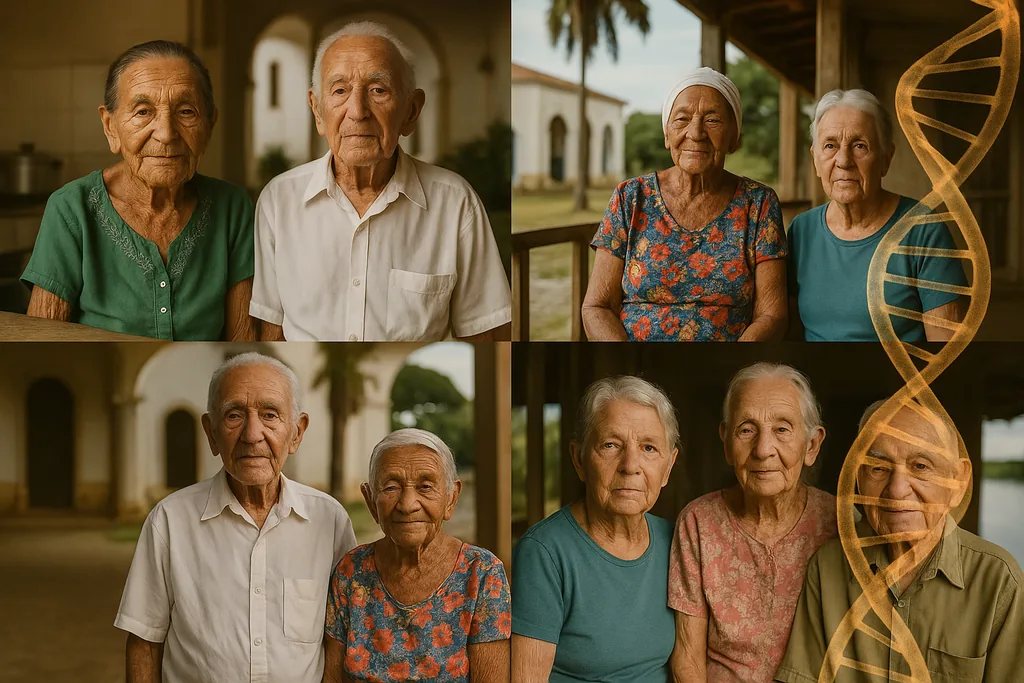
On 6 January 2026 researchers published a Viewpoint arguing that Brazil’s unusually admixed population and an extraordinary cohort of very old people together form a unique resource for studying extreme longevity. The team at the Human Genome and Stem Cell Research Center in São Paulo described a nationwide, longitudinal study of more than 160 centenarians, including 20 validated supercentenarians (people aged 110+), scattered across Brazil’s diverse regions — individuals who, in many cases, spent most of their lives with limited access to modern healthcare and yet reached exceptional ages with surprising levels of function. The paper frames these people not as curiosities but as living experiments in biological resilience.
A map of missing variation
Genetics is central to the argument. Large international genomic databases remain heavily biased toward people of European ancestry, which limits discovery of protective variants that might be common in admixed populations. Brazil’s population — shaped by Indigenous peoples, early Portuguese colonists, millions of enslaved Africans and later waves of immigrants from Europe and Asia — displays rapid, recent admixture and pockets of ancestry combinations found almost nowhere else. A major whole‑genome project known as "DNA do Brasil" sequenced high-coverage genomes from across the country and reported more than 8 million previously undescribed single‑nucleotide variants, thousands of novel mobile‑element insertions and many HLA alleles absent from global references. Those discoveries show that Brazilian genomes contain potentially medically relevant variation that global studies have missed — and they offer a richer search space for variants that might protect against age‑related disease.
What the oldest bodies reveal
The Viewpoint synthesizes genomic, cellular and immunological findings that have emerged from studies of supercentenarians worldwide and links them to the Brazilian program’s strengths. At the cellular level, single‑cell transcriptomic profiling of blood from supercentenarians has repeatedly shown an expanded population of cytotoxic CD4+ T cells — a T‑cell subtype that ordinarily plays helper roles but in these people adopts a CD8‑like cytotoxic program. Those cells appear clonally expanded and capable of producing interferon‑gamma and other effector molecules, a pattern consistent with sustained antiviral and antitumor surveillance late in life. Rather than a uniform immune decline, supercentenarian immune systems may remodel into different, functionally resilient configurations.
The Viewpoint also draws attention to molecular hallmarks that resist the usual trajectory of aging: preserved proteasomal activity in peripheral blood lymphocytes, evidence for maintained autophagy in some individuals, and metabolic and plasma‑protein signatures that diverge from those typically associated with frailty. In a striking human example cited in the paper, a 116‑year‑old individual’s multi‑omics profile contained rare or exclusive variants in immune‑related genes (HLA‑DQB1, HLA‑DRB5, IL7R) and in genes tied to proteostasis and genomic stability — a pattern that suggests layered mechanisms of protection rather than a single, dominant mutation.
Why Brazil’s cohort matters
Two features make Brazil’s cohort especially valuable. First, its genetic diversity increases the odds of finding protective variants that are rare or absent in more homogeneous populations. The DNA do Brasil resource shows how much variation had simply been invisible to prior work; the Viewpoint notes earlier studies that found millions of novel variants in older Brazilian participants alone. Second, many cohort members lived long lives without continuous access to modern medicine, which reduces the confounding influence of high‑tech healthcare on longevity and highlights biological resilience rather than medical rescue. Together those factors improve the chance of discovering mechanisms that could generalize beyond Brazil to inform biology and medicine for other populations.
Living through pandemics and still standing
From families to functional assays
The Brazilian program combines population‑scale sequencing with deep follow‑up. Researchers have identified familial clusters of exceptional longevity — for example, a 110‑year‑old woman whose nieces are 100, 104 and 106 — which can help distinguish inherited genetic contributions from lifelong environmental or behavioral effects. The team is now moving from cataloging variants to functional work: deriving cell lines from selected individuals, running multi‑omics assays, and performing immunological phenotyping to test whether candidate variants actually change cellular behavior in ways that plausibly reduce age‑related pathology. Those steps are essential: rare variant catalogs raise hypotheses, but bench experiments and longitudinal clinical data are necessary to validate causal mechanisms.
Scientific equity and the research agenda
The Viewpoint issues a clear call to the global longevity community: expand recruitment and funding to include admixed, ancestrally diverse populations such as Brazil’s. That call is both scientific and ethical. If the goal of longevity research is to discover biology that improves healthy lifespan for the world’s population, then the most genetically diverse data will produce the most generalizable insights and reduce health inequities in genomic medicine. The authors also note practical steps — building international collaborations, sharing data, and developing locally appropriate consent and benefit‑sharing frameworks for historically under‑represented communities.
Limits and cautions
Important caveats accompany the promise. Admixed genomes make statistical interpretation harder in some respects: population structure and recent selection can mimic or mask signals, and very rare variants require large sample sizes and careful functional follow‑up. The Viewpoint stresses that the discovery path will be incremental: catalogues of novel variants are a starting point, not an endpoint. Moreover, exceptional longevity is almost certainly polygenic and multifactorial, shaped by many modest genetic effects interacting with lifetime exposures, infections, nutrition and social conditions. Discoveries that lead to interventions — if they come at all — will most likely target biological pathways rather than single ‘‘longevity genes.’’
What to watch next
Near‑term milestones to follow include the release of whole‑genome data tied to deep phenotype and immune profiling from the São Paulo cohort; functional studies that test candidate protective variants in cell and animal models; and integration of DNA do Brasil’s population resource with the supercentenarian data to see whether putative protective alleles are specific to extreme old age or present more broadly in admixed subpopulations. If the field succeeds, it will not only expand understanding of why humans sometimes reach 110 and beyond, but also reveal mechanisms that keep tissues functional late into life — the central scientific objective behind efforts to extend "health span" rather than simply lifespan.
Sources
- Genomic Psychiatry (Viewpoint: "Insights from Brazilian supercentenarians", University of São Paulo research group)
- Science (DNA do Brasil: high‑coverage whole‑genome sequencing of Brazilian populations)
- Proceedings of the National Academy of Sciences (single‑cell transcriptomics of supercentenarian peripheral blood)
- Human Genome and Stem Cell Research Center, University of São Paulo
- Institute of Evolutionary Biology (IBE‑CSIC/UPF) and collaborators on the DNA do Brasil project