Lede: a year of pilots and big claims
In 2025 researchers, relief agencies and policy centres released a steady stream of demonstrations showing how artificial intelligence can change food systems. In May, a perspective in npj Science of Food sketched eight ways generative and predictive AI could speed food innovation. The World Food Programme published work showing machine learning tools that turn drone imagery into rapid damage maps and database clean-ups that saved hundreds of thousands of dollars. In university labs from Vancouver to Cape Town, prototype robots learned to read a tomato plant's electrical signals and water it autonomously. At the same time, policy teams at think-tanks held roundtables about how precision agriculture might reach the billion-plus people who depend on small farms. Those experiments and reports raise the same question: when — and under what rules — can AI move beyond pilots to meaningfully reduce hunger?
A new toolkit for food innovation
At the level of product science, AI is not a single gadget but a toolbox. Machine learning can accelerate everything from protein structure prediction that helps design plant-based meat analogues, to language models that translate recipes and consumer feedback into new formulations. In a high-profile perspective, researchers argued that foundation models trained on multimodal datasets could predict texture, flavor and mechanical properties — areas that historically required slow, hands-on iteration in a kitchen or lab.
Industry examples already illustrate the point: companies that combine large datasets, food-chemistry knowledge and automated screening can cut months from product development. But the perspective was clear about limits: subjective sensory attributes are poorly represented in open datasets, and proprietary, fragmented data are a major bottleneck. To turn AI from an accelerator into a democratizing force for innovation, the field needs shared datasets, interdisciplinary teams and a clear understanding that AI augments, rather than replaces, human culinary and nutritional expertise.
Precision agriculture: from satellites to local advice
Precision agriculture is where AI has perhaps the most immediate potential to affect production. The idea is simple: use data at field scale — satellite and drone imagery, soil sensors, weather forecasts — to apply water, fertiliser and labour exactly where they are needed, reducing waste and increasing yields. During 2025, policy analysts convened public- and private-sector participants to map how these technologies slot into a broader food-security strategy.
When AI models are trained on high-quality, local data they can synthesise disparate inputs into timely, actionable guidance: where to plant, when to irrigate, or which plots need pest treatment. For larger commercial farms in high-income countries uptake has been gradual but steady. The harder challenge is reaching smallholder farmers, who make up the majority of farms worldwide yet often lack the connectivity, digital literacy and upfront capital to buy sensors and drones. Several projects aim to bridge that gap by embedding AI into trusted extension services or lightweight tools that work offline and on basic phones.
Humanitarian deployments and logistics
In humanitarian contexts AI has already moved from concept to operational use. The World Food Programme's machine-learning tools automate the analysis of drone imagery to produce damage assessments in hours rather than weeks, and statistical tools have helped optimise sourcing and routing to reduce costs. One WFP solution for deduplicating beneficiary lists achieved near-perfect accuracy in pilots and recovered significant funds.
These applications show a particular strength of AI in crisis: rapid aggregation and triage of heterogeneous data. Where logistics, access and time are limiting factors, automating image analysis, matching beneficiaries and forecasting supply bottlenecks materially change how quickly aid reaches people. But relief agencies also emphasise the human layer: AI advises and accelerates, while human teams retain responsibility for ethical decisions and for contextual judgement in high-stakes environments.
Robotics and plant sensing: a greenhouse to field pathway
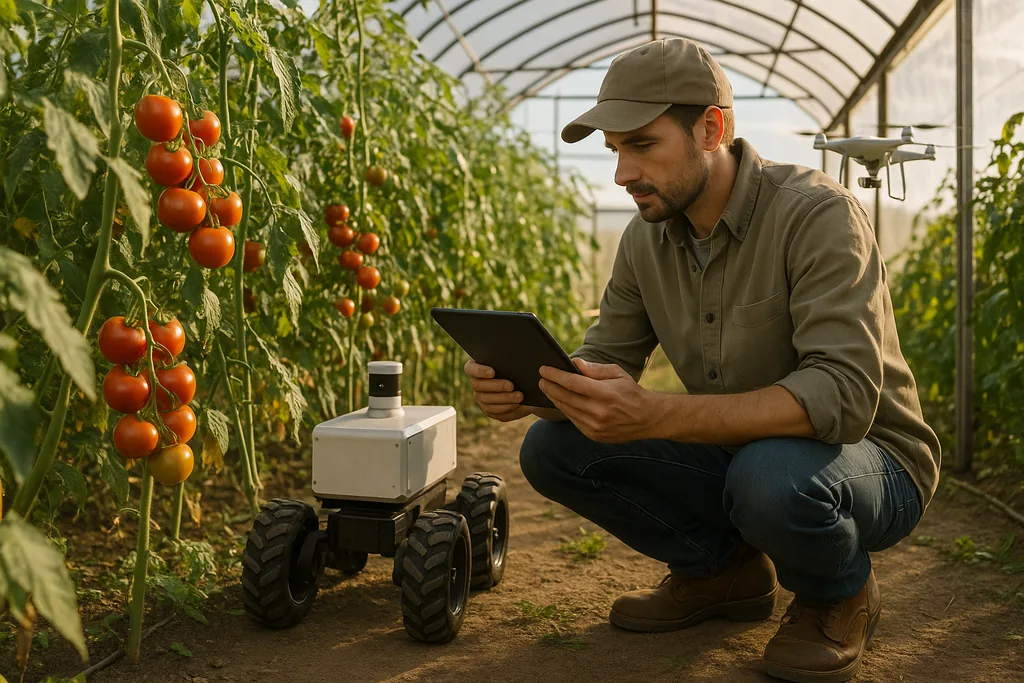
Robotics teams have demonstrated another slice of the puzzle: continuous, plant-level monitoring. A university prototype used non‑invasive electrodes to record plant electrophysiology — tiny electrical signals that correlate with hydration and stress — and coupled those signals to AI that decided when to irrigate. In a controlled greenhouse the system reduced guesswork and optimised water use, and the developers are now working on adapting sensors and models for smallholder contexts with variable infrastructure.
Scaling such systems into open fields is non-trivial. Robots and sensors must tolerate weather, be affordable and require low maintenance. Yet the concept points to a layered approach: remote-sensing and weather models provide macro guidance, while local sensors and low-cost robotics close the loop on plant health. That combination could be especially powerful where water scarcity or climate shocks make precise management the difference between harvest and failure.
Limitations: bias, data deserts and the digital divide
Across these use-cases a recurring theme is data: quality, coverage and governance. Hunger hotspots are often also data deserts. Models trained on datasets from temperate, well-instrumented farms do not generalise automatically to smallholder plots in Africa or Asia. Without deliberate data gathering and local validation, AI risks producing misleading or biased advice that entrenches inequality.
Other risks are familiar from other sectors: opacity of complex models (the so-called black box), possible hallucinations or incorrect predictions, and questions over data ownership and privacy. For farmers, mistrust is real. If a system suggests a fertiliser regime that fails and the farmer loses a season's income, trust is broken and uptake stalls. Policies and procurement must emphasise interpretable models, clear lines of accountability and incentives for farmers to share data without losing control of it.
Governance, standards and the role of partnerships
Experts and institutions point to practical policy steps that would shape whether AI becomes inclusive. Common recommendations include standards for secure and equitable data sharing, interoperable tools rather than siloed vendor stacks, and solution-agnostic procurement that focuses on outcomes for farmers and communities. Multistakeholder partnerships — combining the research capacity of universities, the reach of humanitarian agencies and the engineering resources of private firms — are central to early successes, and they are essential for scaling.
International bodies and national governments also have to invest in digital infrastructure and extension services that translate algorithms into trusted local advice. In contexts where connectivity is limited, offline or edge-based AI models and lightweight sensor systems are a practical priority.
Pathways to scale: realistic timelines and priorities
Three priorities stand out for converting pilots into systemic impact: invest in representative, high-quality datasets (especially from smallholders and the Global South); design with farmers and humanitarian practitioners from the start so solutions are usable and trusted in local contexts; and put governance and accountability mechanisms in place to protect privacy and manage bias. When those conditions are met, AI can be a force multiplier. Without them, it risks amplifying existing inequalities.
Conclusion: powerful, conditional, human-centred
AI is a powerful set of technologies that can make food systems faster, more efficient and more responsive to shocks. The experiments of 2025 — from laboratory food‑science models to drones mapping disaster zones — show potential. But the central lesson from researchers, relief agencies and policy analysts is a caution: AI is not a silver bullet. Its benefits will depend on data quality, institutional design, local participation and sensible regulation. Treated as a partner to farmers and humanitarian workers rather than a replacement for them, AI can help reshape parts of the food system. Treated as a high-tech shortcut, it could widen the gap between those who can afford precision and those who cannot.
Sources
- npj Science of Food (Perspective: "AI for food: accelerating and democratizing discovery and innovation", Ellen Kuhl, 2025)
- Center for Strategic and International Studies (CSIS) — Global Food and Water Security Program (Critical Questions on AI & precision agriculture, 2025)
- Simon Fraser University — Mechatronic Systems Engineering research on autonomous plant-sensing robots (2025)
- World Food Programme (WFP) — operational AI tools and WFP AI Strategy; DEEP and SKAI projects (2025)
- University of Cape Town — African Robotics Unit (applied digital twins and robotics for smallholder contexts)