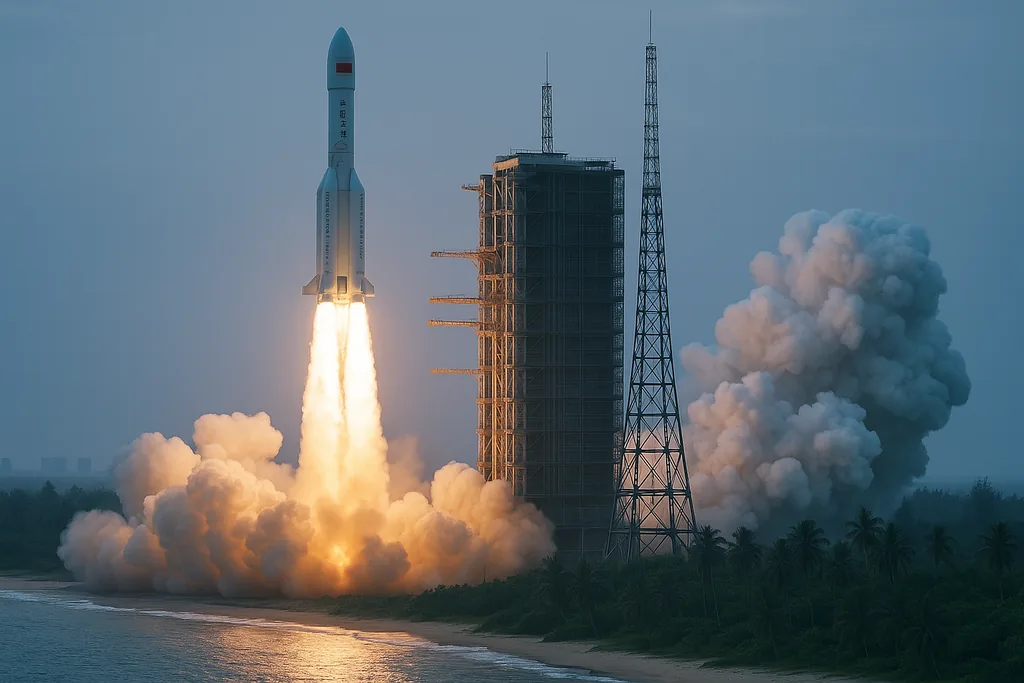
Morning launch from Wenchang put two new Shijian craft into orbit
At 06:40 Beijing time on 31 December 2025, a Long March-7A rose from the Wenchang Space Launch Site on Hainan Island and injected two satellites, Shijian-29A and Shijian-29B, into their planned orbit. Chinese state agencies reported the injection as successful and said the pair will be used for new-technology verification related to space target detection.
Launch and mission details
State media and official outlets described the flight as a routine experimental mission: the rocket was a modified Long March-7A developed under the China Aerospace Science and Technology Corporation (CASC) family of launchers, and the launch was catalogued as the 623rd mission in the Long March series. Officials emphasized the satellites' purpose as technology demonstration rather than an operational constellations rollout.
Technical context: what 'space target detection' means
Chinese reports use the phrase "space target detection" (sometimes translated as space environment monitoring or space situational awareness) to describe systems that detect, track and predict the motions of objects in orbit — from active satellites to defunct rocket stages and fragments of debris. In practice, that capability bundles sensors, tracking algorithms and on-board processing that can maintain a picture of near-Earth space. The Shijian designation traditionally denotes experimental hardware and software trials, so the immediate aim is to validate sensors and algorithms rather than to field a new operational sensor network.
Space-target detection tests can range from passive optical or radio tracking to active radar sensing or demonstration of guidance software. The public Chinese accounts do not specify which instruments or wavebands Shijian-29A/B carry; instead they frame the mission as a verification exercise — the familiar language used across many previous Shijian and Shiyan flights. That ambiguity is routine for experimental Chinese satellite announcements, which name developers and launchers but often omit payload-level technical specifics.
Program history and patterns
The Shijian family dates back decades and has long been China’s go-to label for practice and demonstration missions. Recent years have seen a steady cadence of such experimental satellites, including Shiyan-series craft and other Shijian-designated launches that have tested propulsion, rendezvous and proximity operations, and novel sensors. Independent trackers and analysts note that the Shijian/Shiyan naming convention covers a wide range of technology trials, and the series frequently overlaps in orbit types and objectives.
Observers tracking launches across 2025 flagged a cluster of experimental missions earlier in the year — sun-synchronous and low-Earth testbeds, a geostationary Shijian, and microsatellite deployments — which together built an operational picture of how China iterates hardware and software in orbit. The Shijian-29A/B launch closes out the calendar year for that development stream, according to industry trackers.
Dual-use concerns and strategic context
While Chinese sources present the mission in technical terms, Western military and space analysts have for years highlighted dual-use risks around similar experimental satellites. Washington-based analysts and military officials have publicly warned that satellites capable of unusually agile manoeuvres, close approaches, or advanced sensing can be repurposed for offensive or counter-space roles — for example by tailing, inspecting, jamming or even physically interfering with other spacecraft. Those concerns have followed past sightings of Chinese satellites executing complex coordinated moves in orbit.
That debate — whether a spacecraft used for 'space situational awareness' can also be an instrument in a broader military toolbox — is not new. Spacefaring states routinely describe such capabilities as defensive: they help operators avoid collisions, plan safe manoeuvres, and track debris. But the same sensing, propulsion and guidance building blocks can enable close-proximity operations that heighten tensions if performed near another nation’s critical assets without prior coordination. The Shijian series has sometimes been cited in this debate because its experimental nature makes intent harder to parse for outside observers.
Transparency, norms and the risk of miscalculation
Space activity increasingly blends civilian, commercial and military objectives, and that overlap is one reason calls for clearer rules of the road in orbit have multiplied. International discussions — at the United Nations and among like-minded spacefaring governments — have pushed for norms such as pre-launch notifications, deconfliction channels, and best practices for close approaches. Yet the pace of technological iteration, and the use of experimental vehicles that may not be fully described in public releases, makes it difficult for external observers to distinguish benign testing from escalatory behaviour in real time. Analysts say this ambiguity is a structural risk for major-power rivalry in space.
For now, Shijian-29A/B appear to be part of a long-running Chinese pattern: regular experimental launches that advance sensing and maneuvering capabilities while offering limited public technical disclosure. That approach accelerates learning but also sustains the strategic uncertainty that fuels diplomatic friction.
What to watch next
Short-term indicators to monitor include any telemetry or tracking updates from open-space tracking networks, statements from China’s space agencies about specific payloads or mission phases, and any unusual manoeuvres by the new satellites once they begin in-orbit testing. International partners and private trackers will likely watch for on-orbit behaviour such as station-keeping, rendezvous scenarios, or coordinated movement that could indicate the exercise of advanced guidance or proximity-capable systems. If Shijian-29A/B remain in relatively stable, routine orbits while operating sensors, they will most likely add incremental knowledge to China’s situational-awareness toolkit. If they perform close approaches to other objects, the result will be renewed scrutiny and questions about intent.
In parallel, domestic developments in China’s launch industry — including faster launch cadence and improved medium-class rockets such as the Long March-7A — underpin a strategy of frequent testing and modular iteration. For global space security, that pattern raises both technical opportunities for debris awareness and coordination, and diplomatic challenges around transparency and confidence-building.
Closing note
The Shijian-29A/B mission is a reminder that much of modern space activity sits at the intersection of engineering experimentation and geopolitics. A short, successful technological test can look very different depending on who watches it: engineers see data, developers see a validated sensor, and strategists see capability. How nations choose to explain, coordinate and constrain those activities will help determine whether the skies above Earth become safer or more contested in the years ahead.
Sources
- China Aerospace Science and Technology Corporation (CASC) press materials
- China National Space Administration (CNSA) / Wenchang Space Launch Site statements
- Shanghai Academy of Spaceflight Technology and Innovation Academy for Microsatellites (Chinese Academy of Sciences)