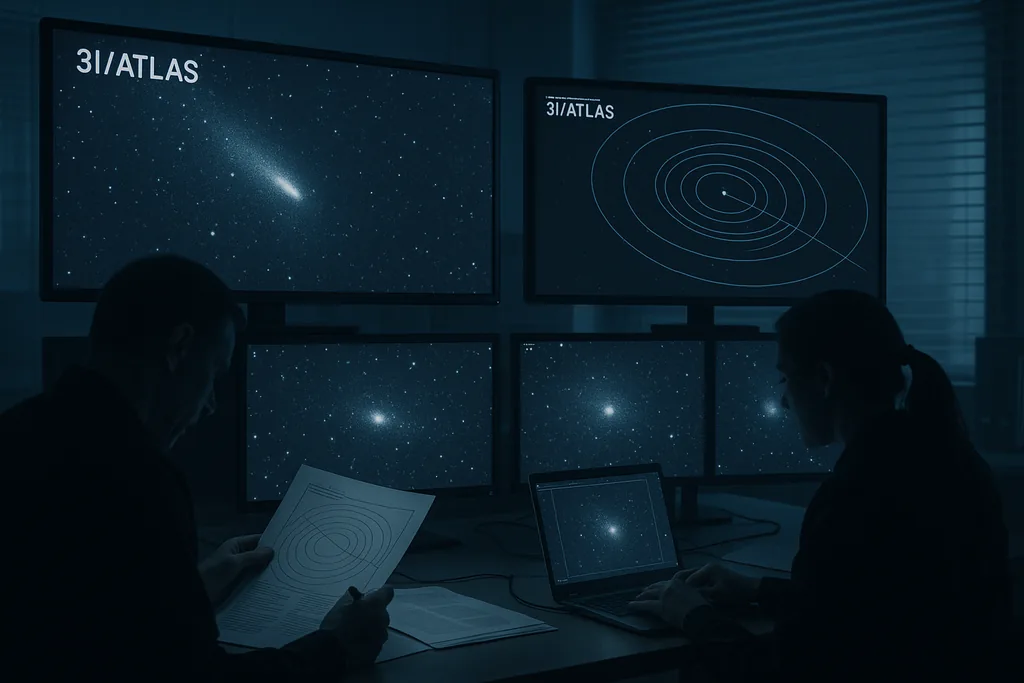
CIA's guarded reply re-frames a public science story
When a long‑running FOIA requester asked the Central Intelligence Agency whether it held any records about the interstellar visitor known as 3I/ATLAS, the agency answered not with a yes or no but with a legal posture that has become shorthand for secrecy: it would "neither confirm nor deny" the existence of any records. The reply — issued at the end of December and publicised in early January — is a textbook Glomar response, and it immediately changed the tone of a debate that many scientists thought had been settled in public view.
CIA's guarded reply
John Greenewald Jr., the operator of a large public archive of government material, filed the FOIA request asking for assessments, reports and communications referencing 3I/ATLAS. Rather than saying it held nothing or releasing documents, the CIA told him the very fact of whether records exist is classified — language that invokes protections for intelligence "sources and methods." That response is unusual in a case that, publicly at least, involves a transient object of astronomy rather than an overt national‑security incident.
Astronomy in the open
That public narrative leans heavily on multi‑wavelength datasets: optical and infrared spectroscopy, ultraviolet imaging from spacecraft like Europa Clipper and Mars orbiters when geometry allowed, and centimetre‑to‑decimetre radio observations. Taken together those data broadly match cometary behaviour — volatile outgassing, a developing coma and multiple tails — even as some observers have noted features that look unusual by the standards of most solar‑system comets.
Searches for technosignatures and what they found
Given the speculation that circulated online and in some academic corners, coordinated searches for technological signals were an obvious next step. The Breakthrough Listen programme and partners scanned 3I/ATLAS at high sensitivity shortly before its closest Earth approach. Observations using the 100‑metre Green Bank Telescope covered 1–12 GHz and reached detection thresholds that, at the comet's closest distance, were sensitive to transmitter powers in the order of 0.1–0.2 watts — roughly a consumer‑grade transmitter at that range. Those searches returned no credible technosignatures: after automated filtering and human vetting, candidate events traced to human radio interference and natural sources, not to a narrowband artificial transmitter. The Breakthrough Listen summary and a Research Notes article describe the nondetection in detail.
Why the CIA’s Glomar matters
A Glomar response does not prove the presence of a smoking gun. It is, legally and practically, a tool to keep from revealing that an agency has investigated an issue when acknowledging that investigation would itself disclose sensitive capabilities or sources. But in this case the reply has a social effect that is as important as any classified content: it allows speculation to flourish. For many observers the apparent mismatch — public science saying "comet" while an intelligence agency declines even to confirm whether it has files — opens room for alternatives, from routine risk assessments to wilder hypotheses.
Harvard astrophysicist Avi Loeb, one of the most visible scientists calling for careful consideration of non‑natural explanations for unusual interstellar objects, proposed an interpretation that helps explain why the CIA might act cautiously: multiply a vanishingly small probability of a truly novel threat by the catastrophic societal impact such a threat could have, and agencies will choose secrecy while they check their facts. Loeb set out this reasoning in a recent essay that explicitly referenced the CIA reply and argued that quiet intelligence‑level review is consistent with prudent risk management. Even so, Loeb emphasised that the balance of evidence — and the Breakthrough Listen nondetections — currently favour natural explanations.
Intelligence, science and the public square
Government organisations have different incentives. NASA’s mission and mandate are to make data and interpretation public so scientists can reproduce results and the public can understand the implications. Intelligence agencies have, by design, a mandate to protect methods. Those institutional differences can and do create friction when a subject sits at the intersection of science and potential national security interest: satellites, foreign‑built space hardware, or in very rare cases, material that might carry an engineered signature. The CIA’s reply signals where that friction exists in this instance, even if it reveals nothing about the content of any documents.
There is also precedent for intelligence interest in anomalous space events. Historical FOIA work shows intelligence agencies sometimes produce reports on comets and other celestial phenomena — in one earlier case, a DIA report about Hale‑Bopp was eventually released with heavy redactions. The Glomar response creates an asymmetry: the public sees a settled scientific conclusion, while a tightly worded intelligence posture leaves open the possibility of other, undisclosed considerations. That in turn pushes the story into media cycles and into public debate about transparency, national security and the responsibilities of both the scientific and intelligence communities.
Next steps and what to watch
From a scientific perspective the path forward is simple: continue observing the object across wavelengths, archive the data, and publish methods and results so independent teams can test alternative explanations. From an intelligence‑oversight perspective the path is procedural: Mr Greenewald has said he will appeal the CIA’s response, and FOIA appeal channels exist precisely to resolve whether a Glomar reply is justified under statute and precedent. The interplay of those routes — open scientific publication on the one hand, classified review and appeals on the other — will determine whether the public eventually sees any non‑public intelligence analysis or whether the Glomar simply marks the end of the public record for now.
Sources
- Central Intelligence Agency (FOIA response regarding 3I/ATLAS)
- NASA (press conference and spacecraft mission data on 3I/ATLAS)
- Breakthrough Listen / Green Bank Telescope (technosignature search; Research Notes of the AAS)
- Harvard University (Avi Loeb commentary and analysis)
- International Gemini Observatory / NOIRLab (ground‑based imaging and follow‑up observations)