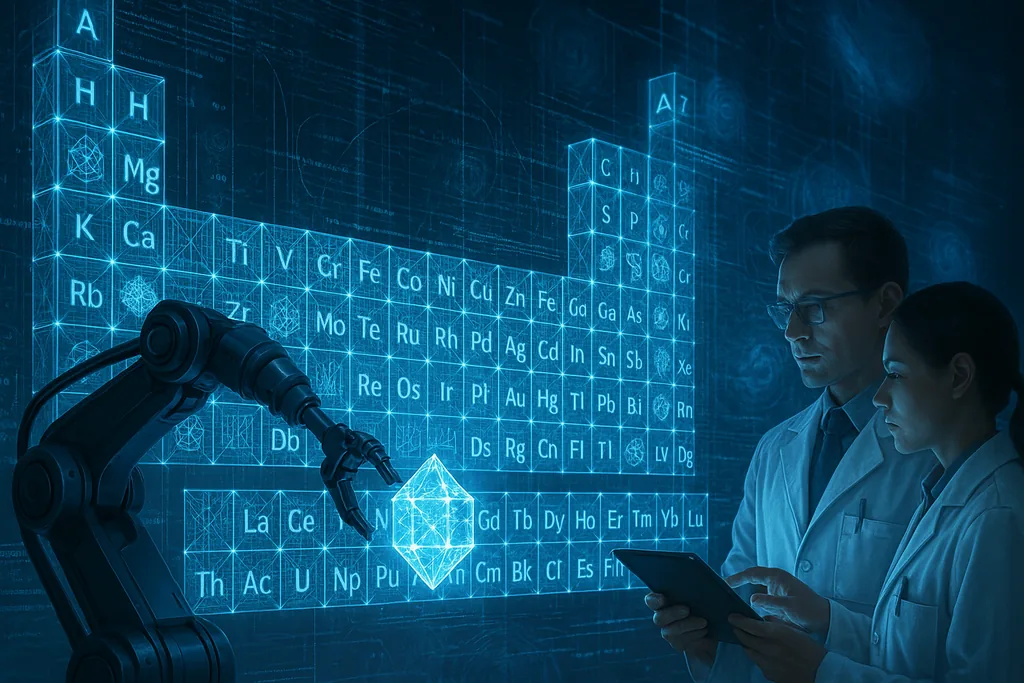
On a concrete lab bench in California and on vast GPU clusters in data centers, a new workflow is quietly remaking the periodic table. Instead of chemists slowly tweaking experimental recipes, large neural networks are proposing atomic arrangements, high‑throughput compute pipelines are checking their thermodynamic fate, and robotic labs are trying to make the winning designs in days. The result is nothing less than an industrial‑scale mapping of chemical space: millions of hypothetical crystals, hundreds of thousands flagged as thermodynamically stable, and a new vocabulary—"computational alchemy"—for turning silicon, lithium and cobalt into engineered inventions by software.
AI at the scale of matter
One of the earliest public milestones in this transformation came from Google DeepMind’s materials effort, which used a graph‑neural approach called GNoME (Graph Networks for Materials Exploration) to scan combinations of elements and lattice geometries and predict roughly 2.2 million candidate crystal structures, of which some 380,000 were identified as highly stable by conventional thermodynamic criteria. DeepMind released the top candidates and documented experimental follow‑ups that validated hundreds of predictions, illustrating how a data‑driven loop can multiply the universe of accessible materials in months what used to take centuries of incremental discovery.
Meta’s Fundamental AI Research group took a complementary route in 2025: instead of only generating crystals, it published massive atomistic datasets and pretrained interatomic models intended to act as reusable physical priors. The Open Molecules 2025 (OMol25) dataset and the Universal Model for Atoms (UMA) provide hundreds of millions of DFT‑level calculations and machine‑learned interatomic potentials that can be fine‑tuned or composed into downstream discovery pipelines. The stated goal is to supply researchers with a ready‑made computational microscope and a fast force field, so more teams—inside universities and startups—can run realistic, large‑scale simulations without owning the supercomputer that generated the training data.
Different architectures, same mission
Although the headlines bind these efforts together, the underlying AI families look different and the differences matter. DeepMind’s GNoME relies on graph neural networks optimized to predict formation energies and to propose structures by compositional and structural search. Microsoft Research has published two sibling projects—MatterGen, a generative diffusion model that proposes inorganic materials conditioned on target properties, and MatterSim, a learned simulator that predicts energies and responses across elements, temperatures and pressures. Together those models are described as a generator/emulator pair able to propose proposals and rapidly screen them in silico.
Closing the loop: robots and active learning
Predictions alone do not change the physical world; synthesis and characterization do. To reach usable inventions, labs are stitching AI models to automated experimentation and an active‑learning loop. A model proposes a candidate, high‑throughput DFT or ML surrogates estimate stability and properties, an automated or human lab attempts synthesis, and the measured outcome feeds back to the model as labeled data. DeepMind and others report collaborations with automated facilities—such as Lawrence Berkeley National Laboratory’s autonomous platforms—that have already synthesized a nontrivial set of model‑proposed materials, demonstrating the practical payoff of closed‑loop discovery. This lab‑in‑the‑loop approach is what transforms prediction into productive engineering.
That combination—generative models, fast ML simulators, and robotics—creates an accelerating "flywheel": better predictions produce easier syntheses and more training data, which in turn improves the next predictions. The consequences are palpable: what used to be a multi‑decade path from concept to prototype can, in favorable cases, shrink to months or a few years.
Politics, compute and the open science split
These capabilities reshape not only lab notebooks but policy and industrial strategy. The United States Department of Energy launched the Genesis Mission in late 2025, a national effort to combine national‑lab supercomputers, AI platforms and automated facilities into a single discovery engine for energy, materials and national security priorities. The program allocates funding and infrastructure to build shared platforms and to avoid the duplication of immense compute cost inside a handful of private labs. At the same time, firms such as Google, Meta and Microsoft continue to set their own roadmaps—some open‑sourcing code and datasets, others keeping models and infrastructure behind private clouds—creating a tension between proprietary advantage and scientific democratization.
Industrial stakes and near‑term targets
Why does any of this matter outside the labs? Better materials are the key inputs to several industrial transitions: denser and safer solid‑state batteries, perovskite or tandem solar absorbers with higher conversion efficiency, lower‑loss conductors and even new superconductors that would remake power grids and electronics. Tech companies and national programs are explicitly orienting these efforts around climate‑critical targets—grid‑scale storage, efficient photovoltaic materials, and reduced reliance on strategic minerals. The commercial race is already visible: Microsoft promotes MatterGen and MatterSim as tools for firms working on energy and semiconductors, while DeepMind, Meta and others emphasize community releases and partnerships that will funnel discoveries into industrial R&D.
Not every promising candidate will scale. The dominant technical challenge now is 'lab‑to‑fab': turning a DFT‑friendly crystal into a manufacturable material at industrial volumes, with reproducible properties and acceptable cost. Synthesis conditions, doping, grain boundaries, and environmental aging are all practical details that AI models struggle to predict perfectly. This is why experimental validation and engineering remain indispensable even as model predictions proliferate.
Where transparency and reproducibility enter
There are real scientific risks alongside the upside. Large pretrained models can appear authoritative even when their error modes are subtle; datasets and surrogate models can embed biases or approximations that lead to unreproducible claims if labs cannot replicate exactly the synthesis route. The community response has emphasized open datasets, shared benchmarks and independent synthesis efforts precisely to avoid a repetition of the reproducibility problem that has troubled other AI‑driven fields.
That effort is happening in parallel to architectural work on equivariant networks, transferable ML interatomic potentials, and active‑learning strategies that quantify uncertainty—technical steps designed to make predictions not only faster but more interpretable and reliable. The result is a blend of computer science, condensed matter physics and laboratory automation that reads more like an engineering discipline than a collection of clever hacks.
Whatever label you give it—computational alchemy, AI for science, or atomistic engineering—the wave that broke in the last two years is about scaling the discovery process. The winners will be organizations that combine excellent models, accessible datasets, reproducible experimental pipelines and fair access to compute. The next major headline could be a commercially viable solid‑state battery or an ambient‑temperature superconductor proposed by a model and realized in a factory; until then, the work will remain an interdisciplinary marathon run at GPU speed.
Sources
- Nature (GNoME research paper on AI discovery of millions of crystal structures)
- arXiv / OMol25 (Open Molecules 2025 dataset and UMA model)
- Lawrence Berkeley National Laboratory press materials (Berkeley Lab news center)
- Microsoft Research publications and blog posts (MatterGen and MatterSim)
- U.S. Department of Energy press releases and Genesis Mission documentation