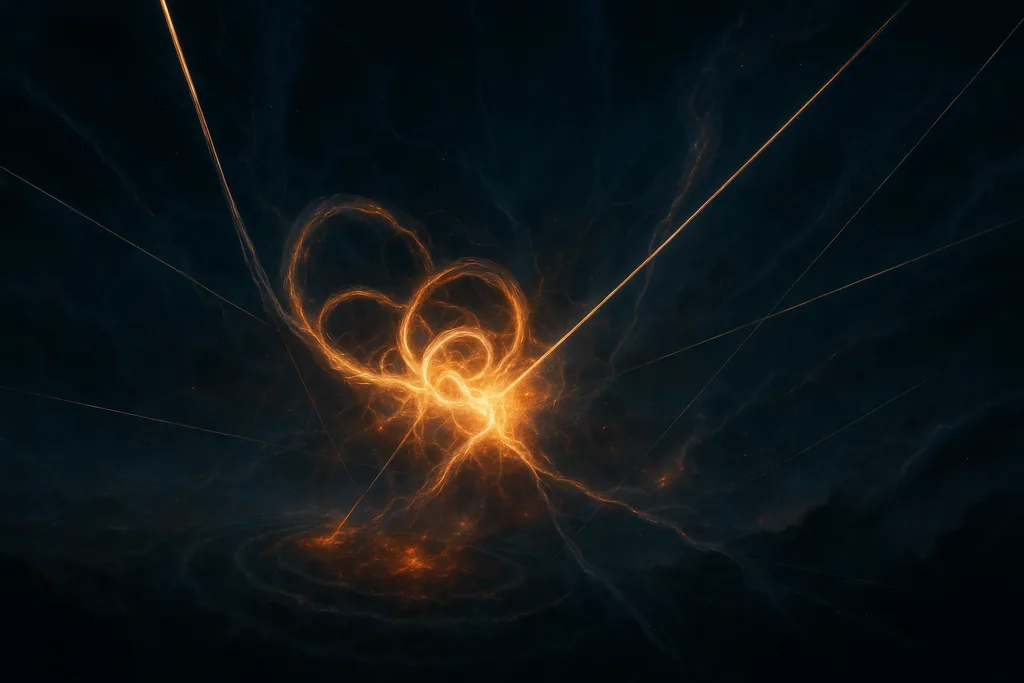
On 7 December 2025, a team of theoretical physicists published a paper in Physical Review Letters arguing that knotted field configurations — what they call "cosmic knots" — could have taken centre stage in the universe's first moments and, by unraveling, seeded the tiny excess of matter over antimatter that made stars, planets and life possible.
The proposal knits together two long‑studied extensions of the Standard Model — a gauged Baryon-minus‑Lepton (B‑L) symmetry and the Peccei–Quinn (PQ) symmetry — to produce stable, topological knots. These objects behave very differently from the usual radiation and could have dominated the young cosmos for a short period before collapsing through quantum tunnelling and creating heavy right‑handed neutrinos whose decays favour matter. Crucially, the model predicts a characteristic shift in the primordial gravitational‑wave background that upcoming observatories might detect.
Knotted symmetries in particle physics
The Standard Model leaves three big puzzles unanswered: why neutrinos have mass, why the strong nuclear force preserves a particular symmetry (the so‑called strong CP problem), and why the observable universe contains far more matter than antimatter. The new work combines two symmetry ideas that physicists have considered for decades to address these issues in one coherent picture.
One ingredient is the Peccei–Quinn symmetry, introduced to explain why experiments find essentially no CP violation in the strong interaction; its low‑energy signature is the axion, a widely discussed dark‑matter candidate. The other is a gauged B‑L symmetry, which provides a natural home for heavy right‑handed neutrinos and helps make neutrino masses understandable via seesaw mechanisms. When these two symmetries break as the universe cools, they produce different kinds of defects: PQ breaking yields superfluid vortices, while gauged B‑L breaking produces flux tubes that act like magnetic strings.
From strings to a knot‑dominated era
Topological defects are familiar in cosmology as cosmic strings — tremendously thin but massively dense tubes of energy left after symmetry breaking. In the combined PQ+B‑L setup, a web of such defects forms during phase transitions shortly after the Big Bang. Unlike radiation, whose energy density falls quickly as the universe expands, the energy bound up in massive, nonrelativistic objects drops more slowly.
The paper argues that, for a plausible range of parameters, the population of knots could come to dominate the cosmic energy budget for a limited epoch. This "knot era" is not eternal: quantum tunnelling allows the knots to unravel. When they do, the stored energy is released violently into particles — including the heavy right‑handed neutrinos that are a built‑in feature of the gauged B‑L sector.
How knots make more matter than antimatter
Baryogenesis — the creation of the observed small excess of matter over antimatter — requires three ingredients: processes that violate baryon number, violation of charge‑parity symmetry (CP), and departure from thermal equilibrium. The knot collapse supplies the last condition by producing a burst of heavy particles in a nonthermal way. The heavy right‑handed neutrinos then decay, with CP‑violating processes biasing decays slightly toward the production of matter over antimatter. Over cosmic history, that tiny bias — roughly one extra matter particle per billion annihilations — is all that is needed to yield the material cosmos we observe.
Gravitational waves as a test
One compelling aspect of the scenario is that a knot‑dominated phase and the violent collapse of macroscopic field configurations should leave an imprint on spacetime itself: a stochastic background of gravitational waves with a specific spectral shape and characteristic frequency scale. Because the knots behave like matter prior to their decay, they alter how the gravitational‑wave background redshifts as the universe expands. In the authors' estimates, reheating near 100 GeV shifts the peak to higher frequencies compared with many other early‑universe sources.
That shift opens a path to observational tests. Space‑based and next‑generation ground‑based detectors operate in complementary frequency bands: LISA will probe milli‑ to deci‑milli‑hertz, DECIGO aims at deci‑hertz frequencies, and Cosmic Explorer pushes sensitivity at higher frequencies. Detecting the predicted spectral features, or ruling them out, would directly constrain whether a knot era ever occurred.
Model virtues and open problems
There are also phenomenological knots to untie. The PQ symmetry is treated as a global symmetry in the model to preserve the axion solution to the strong CP problem; global symmetries are subtle in quantum gravity and may be broken by Planck‑scale effects. Moreover, ensuring that axion physics, heavy neutrino masses, and gauge interactions all fit observational constraints (including limits on additional particles and forces) restricts the viable parameter space. The authors explicitly call for more detailed numerical work and for connecting simulations to the gravitational‑wave signatures that detectors could seek.
Why this matters
If borne out, the knot picture would offer a unified explanation for three deep puzzles — neutrino masses, the strong CP problem, and baryogenesis — while giving experimentalists an observable target in the gravitational‑wave sky. It revives a nineteenth‑century intuition about knotted structures in a modern, field‑theoretic form and relocates a metaphoric 'grandparent' stage of cosmic history to a moment that could, in principle, be probed.
For cosmologists and particle physicists, the next steps are clear: push numerical simulations of topological defect networks in this combined symmetry framework, refine the predicted gravitational‑wave spectrum, and fold the model's particle content into existing collider and astrophysical constraints. For the experimental community, the result adds another reason to pursue a diverse gravitational‑wave observatory programme across frequency bands.
The proposal does not yet overthrow existing paradigms, but it offers a testable, intellectually economical route toward explaining why anything exists at all — and, in doing so, points gravitational‑wave astronomy toward questions traditionally thought to be the exclusive domain of particle physics.
Sources
- Physical Review Letters (research paper: "Tying Knots in Particle Physics")
- International Institute for Sustainability with Knotted Chiral Meta Matter (WPI‑SKCM2), Hiroshima University
- Deutsches Elektronen‑Synchrotron (DESY)
- Keio University
- Yamagata University