On the CES stage, a familiar robot met a new brain
At the Consumer Electronics Show in Las Vegas on January 5, 2026, Boston Dynamics unveiled a production-ready Atlas humanoid and, in the same breath, announced a formal research partnership with Google DeepMind to bring the AI lab's Gemini Robotics foundation models to the new platform. The move pairs Boston Dynamics' decades of mechanical engineering and dynamic control with DeepMind's recent push into embodied, multimodal AI — an explicit attempt to make a highly capable humanoid do useful work, not only dazzling demonstrations.
Partnership and platform
The technical intent is straightforward on paper: let Boston Dynamics provide the muscle — jointed limbs, force-capable hands, onboard sensors and real-time motion control — and give those systems a higher-level reasoning layer from DeepMind capable of perception, language grounding and task-level planning. Boston Dynamics said the research will centre on integrating "Gemini Robotics" foundation models with Atlas to enable robust, general-purpose behaviors in industrial settings; Google DeepMind executives described the program as a step toward a robot foundation model that can generalize across tasks.
That combination reflects a trend in robotics research: separating low-level locomotion and manipulation (where Boston Dynamics excels) from higher-level scene understanding and sequential decision-making (where large multimodal models and reinforcement learning have made fast progress). DeepMind's recent models are explicitly multimodal — built to combine vision, language and action — and have variants tuned for on-device operation and embodied reasoning. Integrating those capabilities with an Atlas that can walk, lift and reach could shorten the gap between laboratory demos and dependable industrial deployment.
Atlas moves from lab to production
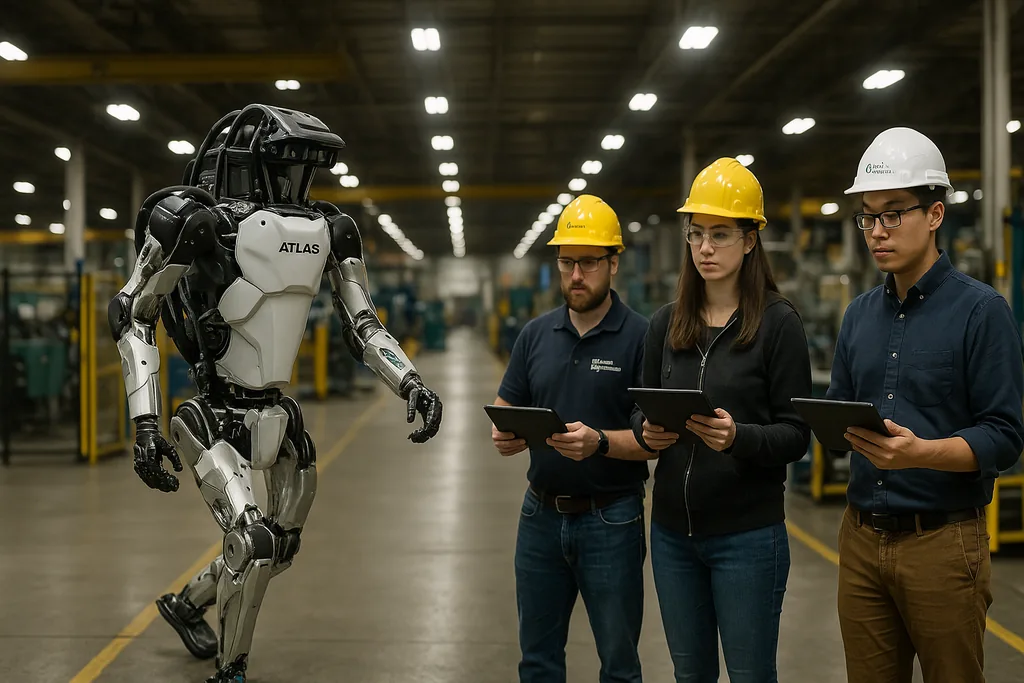
Boston Dynamics presented the Atlas shown onstage as a production-grade, fully electric humanoid. The company said it has begun manufacturing the product version of Atlas and that the first fleets are committed for 2026 shipments to Hyundai's robotics facilities and to Google DeepMind for joint research. Boston Dynamics described the enterprise robot as designed for consistency and reliability in industrial tasks and able to operate under teleoperation, tablet steering, or autonomously once trained.
Industry reporting and agency coverage filled in practical details: Hyundai Motor Group, which holds a controlling stake in Boston Dynamics, plans to deploy humanoids at its U.S. factory beginning in 2028 to handle parts sequencing and other assembly-line tasks, with broader integration expected through 2030. Boston Dynamics said Atlas can lift significant payloads and has a reach intended to match human workspaces, emphasising durability for real-world factory floors. Those commitments tie the research partnership directly to manufacturing goals rather than to research-only showpieces.
What the robots will actually do
In practical terms, companies envision Atlas handling repetitive, ergonomically demanding or safety-sensitive tasks that are still difficult to fully automate with conventional industrial robots. Boston Dynamics and Hyundai have described initial roles such as parts sequencing at an EV plant — positioning or preparing components for human technicians or automated stations. The combination of dynamic mobility and higher-level planning is meant to let humanoids work around people and changing environments rather than in tightly fenced robot cells.
Even with advanced AI in the loop, the deployment path the companies describe is incremental: staff will teleoperate or supervise robots initially; over time, software updates and model training would push behavior toward greater autonomy. That hybrid approach — human oversight with gradual hand-off — is the current industry default for reducing risk while scaling capability.
Safety, scrutiny and the public debate
The announcement did not dock the project from scrutiny. Observers and reporters at CES flagged safety and labour concerns as immediate policy issues: robots that look human and move freely raise questions about workplace safety, liability for mistakes, and how to safeguard human workers' jobs and rights. Google and Boston Dynamics say they will emphasise safety protocols, restricted testing, and careful data governance during the research and deployment phases, but critics warn regulatory gaps need attention before widespread industrial use.
Those debates are not hypothetical. Policymakers and unions have already opened conversations about automation at scale in manufacturing, and Hyundai's own sizeable investments in robotics underscore the potential for rapid change in factory staffing and workflows. Boston Dynamics and its partners will have to demonstrate not only that Atlas can work reliably, but that deployments improve safety and productivity without unfairly eroding labour standards.
Why foundation models for robots are different
Large language and vision models made striking progress in 2023–2025 largely in virtual domains: chat, image synthesis, recommendation and offline decision support. Translating those capabilities into physical action adds layers of complexity. The robot must sense accurately in noisy, variable lighting; it must time forces and contact precisely; and it must translate abstract goals into motor commands that obey the physics of a limbed body. A foundation model for robotics therefore needs not just prediction but embodied calibration, fast closed-loop control, and safe fail-safes for contact-rich operations.
DeepMind's Gemini Robotics variants are engineered with these constraints in mind: multimodal inputs, reinforcement-learning training pipelines, and on-device inference options to reduce latency. But matching the model to an Atlas robot requires extensive data collection and simulation-to-reality transfer work — time-consuming engineering even when the underlying AI shows promise. The early DeepMind–Boston Dynamics work will therefore focus on building those bridges rather than immediate, full autonomy.
Industry context and next steps
The DeepMind–Boston Dynamics announcement sits within a broader industry moment: auto makers, AI labs and robotics firms increasingly converge around the idea of "physical AI" — combining perception, planning and mechanical design to tackle real-world tasks. Hyundai's financial backing and commitment to deploy robots at scale is a signal that the automotive sector sees humanoids as a long-term strategic tool rather than a research curiosity. Meanwhile, DeepMind's involvement — and Google's history with Boston Dynamics — gives the program a high-profile technical partner and access to advanced AI tooling.
For the near term, expect the collaboration to produce datasets, benchmark tasks and incremental capability upgrades that will be shared selectively with research partners and early industrial customers. Public demonstrations and controlled pilots — like the live CES demo and upcoming factory trials — will shape public perception as much as the underlying technical progress.
In short: the partnership signals that robotics companies now see foundation models as necessary infrastructure for moving humanoids from choreography to consistent, repeatable labor. The outcome is uncertain — the engineering and social challenges remain large — but the stage is set for an intense, high-stakes test of whether modern AI can safely and productively enter the physical workplaces where most people spend their working lives.
Sources
- Boston Dynamics press materials (Atlas production announcement, partnership blog)
- Google DeepMind research and product materials (Gemini Robotics)
- Hyundai Motor Group press materials and manufacturing announcements