Discoveries that enabled quantum computers win the Nobel Prize in Physics
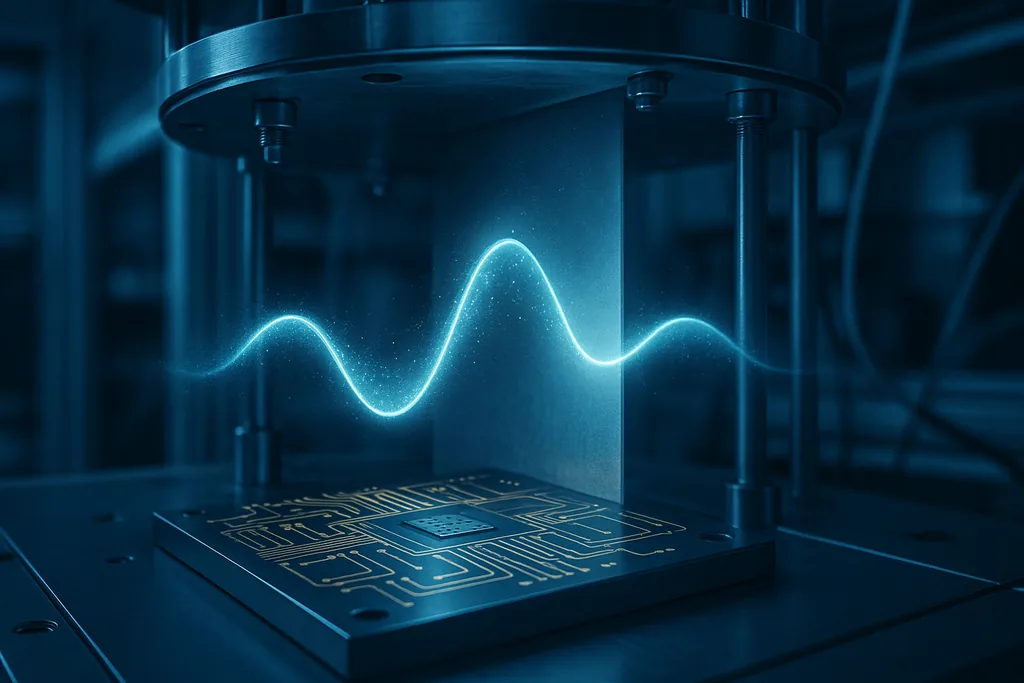
Three pioneers honoured for showing quantum effects on a chip
On 7 October 2025 the Royal Swedish Academy of Sciences awarded the Nobel Prize in Physics to John Clarke, Michel H. Devoret and John M. Martinis for experiments that brought quantum mechanics out of the atomic realm and into macroscopic electrical circuits — a breakthrough that underpins today’s superconducting qubits and much of the modern quantum computing industry. (nobelprize.org)
Why this prize matters
Quantum mechanics famously governs atoms, electrons and photons. For decades it was an open question how large a system could be and still show genuinely quantum behaviour such as tunnelling between classically forbidden states or possessing discrete, quantised energy levels. The Nobel committee recognised a set of experiments from the 1980s that demonstrated those effects in an electrical circuit that was large enough to hold in the hand — a decisive step toward making quantum phenomena usable in engineered devices. (nobelprize.org)
What the laureates actually did
The trio performed measurements on circuits built around a Josephson junction, a thin insulating layer sandwiched between superconductors. When cooled to millikelvin temperatures, these devices support collective degrees of freedom — essentially circuit variables — that behave like quantum particles. The experiments showed that the circuit could tunnel from a zero-voltage state to a finite-voltage state and that the same devices absorbed microwaves only at discrete energies, revealing quantised levels. These observations established that macroscopic electrical circuits can exhibit the same quantum rules once thought confined to atoms. (sciencenews.org)
From lab curiosity to qubits
That leap from demonstration to application is what makes the work so consequential. The same physics exploited in the Josephson-junction experiments provides the foundation for superconducting qubits, the tiny circuit-based quantum bits used by many research groups and companies. Superconducting qubits encode quantum information in collective electrical variables of a circuit; they rely on the ability to create and control discrete energy levels and to preserve coherent superpositions long enough to compute. In short, the laureates converted a conceptual possibility into practical hardware principles. (nobelprize.org)
Paths through the decades
After the initial observations, the field evolved through steady refinements: better materials, improved fabrication and ingenious circuit designs that increased coherence times and enabled two-qubit gates. John Martinis remained a central figure in the practical development of superconducting quantum processors, later leading a high-profile effort to demonstrate ‘quantum advantage’ — the point at which a quantum device performs a task out of reach of classical supercomputers. Michel Devoret continued to push the boundary between fundamental experiments and engineered quantum hardware, contributing to techniques for controlling and measuring superconducting circuits. John Clarke’s early precision experiments and detector development also influenced the field’s trajectory. Together, their contributions span from foundational physics to technologies now in commercial development. (sciencenews.org)
Where quantum computing stands today
Superconducting qubits are one of several leading hardware approaches. They have demonstrated increasingly complex algorithms, entanglement across dozens of qubits and targeted demonstrations of computational tasks that are difficult for classical machines. Yet significant obstacles remain: current devices are noisy, qubit counts need to rise by orders of magnitude, and error correction will be necessary to run many useful applications reliably. The Nobel-recognised discoveries established the hardware paradigm, but scaling that hardware into fault-tolerant, general-purpose quantum computers is an engineering and scientific challenge still in progress. (theguardian.com)
Broader impacts: sensors, cryptography and beyond
Beyond computation, the techniques born from these experiments have enabled ultra-sensitive detectors and sensors — for example, superconducting devices that detect tiny magnetic fields, with applications from fundamental physics to medical imaging. The rise of quantum processors has also prompted attention to cybersecurity: powerful quantum machines could one day threaten conventional public-key encryption, accelerating global work on quantum-resistant cryptography. The Nobel citation explicitly noted that the laureates’ discoveries opened opportunities for quantum cryptography, sensors and computing. (nobelprize.org)
What the award signals about the field
A Nobel Prize recognises not only a discovery but also its longer-term significance. Awarding the prize for macroscopic quantum tunnelling affirms that the transition from fundamental curiosity to technological platform — fruiting in labs and start-ups worldwide — is one of the defining scientific developments of the late 20th and early 21st centuries. The decision also highlights how advances in experimental control and cryogenic engineering have reshaped what is possible in quantum science. (nobelprize.org)
Remaining questions and the road ahead
Even with the Nobel recognition, the field is far from mature. Key areas of research include improving coherence times, devising scalable and efficient error-correction schemes, refining materials and fabrication to reduce loss and noise, and finding killer applications where quantum processors outperform classical alternatives in economically meaningful ways. Progress is accelerating, but translating the physics in a Josephson junction into widespread, fault-tolerant quantum computing will take sustained effort across academia, industry and national labs.
Final thoughts
The 2025 Nobel Prize in Physics celebrates a set of experiments that changed the framing of quantum mechanics from an abstract theory about the microscopic world into a technology platform that can be engineered, scaled and productised. That shift — showing quantum tunnelling and quantised energy in circuits you can hold — is one of the cornerstones of the contemporary quantum ecosystem. As researchers tackle the next set of engineering problems, the laureates’ work will remain a foundational chapter in the story of how quantum physics moved from thought experiment to device.