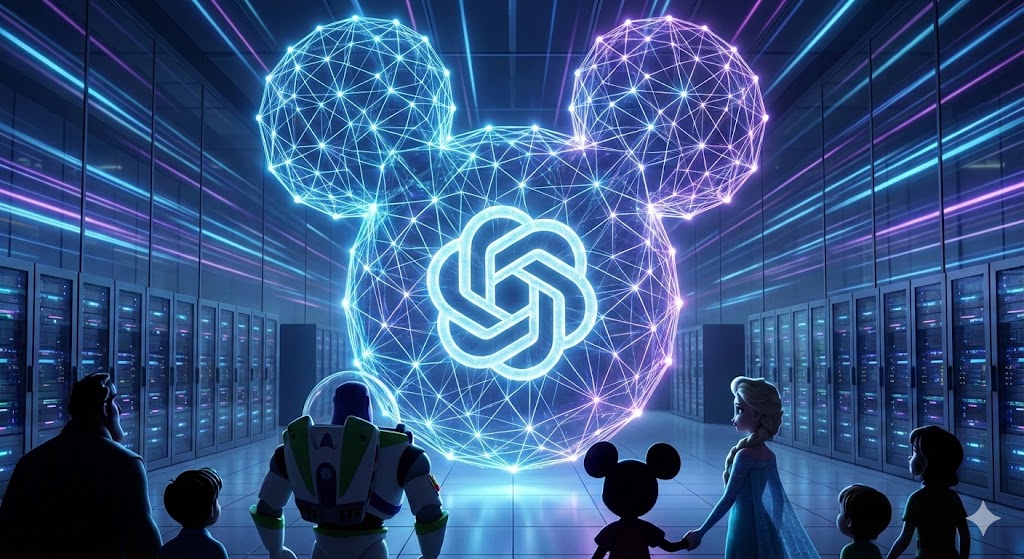
Today The Walt Disney Company and OpenAI announced a three-year agreement that will let users create short, AI-generated videos starring more than 200 of Disney's animated characters. The pact — which includes a $1 billion equity investment by Disney and warrants to buy additional shares — makes Disney the first major studio to formally license its characters to an AI video platform and signals a rapid shift in how large media companies will treat generative AI.
What the deal does
Under the agreement, fans will be able to use OpenAI's Sora short-form video tool, and related ChatGPT image features, to generate and share clips that include characters from Disney, Pixar, Marvel and Lucasfilm. The licence covers animated and illustrated depictions only; actors' likenesses and recorded voices are explicitly excluded. Disney also will surface a curated selection of user-created Sora videos on Disney+, and plans to deploy OpenAI technology internally — including ChatGPT for employees — and to use the company's APIs to build new products and tools for its platforms.
Executives from both companies framed the partnership as an attempt to extend storytelling in a controlled, commercial way. Disney's chief executive described the move as a way to "thoughtfully and responsibly extend the reach" of its stories; OpenAI's chief executive called it an example of how "AI companies and creative leaders can work together responsibly." Public statements emphasised safety, age-appropriate controls and protecting creator rights, while implementation details and final legal paperwork remain subject to definitive agreements and closing conditions.
Money, control and distribution
The agreement has a direct financial angle: Disney is not only licensing its characters but also buying into OpenAI. The $1 billion equity infusion turns Disney into a major investor and customer overnight. Market reaction was immediate — Disney's shares moved up after the announcement — and the deal gives the studio a stake in the company whose models produce the content.
Technical and creative trade-offs
Sora and other text-to-video systems can synthesize moving imagery rapidly from simple prompts. That speed and ease are precisely why studios have been wary: generative video can create convincing scenes of fictional characters — and, increasingly, of real people — in contexts they never actually appeared in. The Disney-OpenAI licence limits the legal ambiguity for animated characters, but it does not solve underlying technical problems such as model hallucination, provenance and watermarking, or the risk that AI-generated clips will be used for misinformation or harmful impersonations.
OpenAI has said it will add guardrails — access restrictions, moderation and age gates — and Disney emphasised creator protections. But engineers and policy specialists caution that any content-control system will be an imperfect compromise between openness and safety. Moderation at scale is technically hard and expensive; one reason OpenAI welcomed Disney's partnership is that it binds a major rights holder into the platform governance model rather than leaving control entirely to third-party moderation teams.
Industry precedent and legal pushback
The deal represents a notable pivot for Hollywood. Until now, many studios and rights holders have treated generative AI as a legal threat: some sued, others issued cease-and-desist letters, and some pursued private settlements. By choosing a licensing route, Disney is signalling a third path — monetise and control — that other media companies may emulate.
At the same time, the announcement came alongside a hard legal posture: Disney sent a cease-and-desist to a major technology company, demanding it stop using Disney material without permission to train or surface AI-generated content. That letter is the latest in a string of enforcement actions the company has taken against technology providers and AI creators. The approach is dual-track: negotiate commercial arrangements with some AI firms while litigating or threatening litigation against others whose behaviour it views as infringing.
Workforce, unions and children's advocates
The partnership also lands amid broader questions about labour and safety. Unions representing actors, voice talent and visual effects artists have been wary that studio deals with AI companies could undermine bargaining power or replace work. Disney's contractual carve-out for actor likenesses and voices addresses part of that concern but leaves open broader industry negotiations about compensation, residuals and the limits of machine-generated substitutes for human performance.
Children's advocates criticised the move as well. Some child-protection groups argued that licensing beloved characters to a mass-market AI tool risks hooking young users into an environment that could present unsuitable or manipulative content. Disney and OpenAI have pledged safeguards; critics say restrictions must be robust, transparent and auditable to be credible.
What this means for creators, fans and competitors
For fans and creators the licence will open new creative possibilities: hobbyists and small studios will be able to stage scenes, mash-ups and parodies that previously required animation expertise or licensing. For professional creators it will mean another competitor in the attention economy — a new stream of quick, AI-made clips that could either amplify their work or crowd it out.
Competitors face a strategic choice. Other studios could follow Disney's lead and strike licensing deals, forcing AI companies to negotiate rather than operating in a legal gray zone. Alternatively, some rights holders may continue to litigate aggressively to block unlicensed use. Either way, the deal raises the floor for formal commercialisation: large media IPs will increasingly either be licensed or expressly defended in court.
Near-term timeline and open questions
Public filings and press materials note that implementation will roll out over months: internal use of ChatGPT tools and Sora integrations are scheduled in phases, with fan-facing Sora access and Disney+ curation expected into early 2026 under the terms discussed. Several practical questions remain unanswered: how exactly will age verification work, what thresholds will trigger manual moderation, how will revenue from fan-created works be split, and what audit mechanisms will exist to demonstrate that content is properly licensed and safe?
Those details will determine whether the deal becomes a regulatory and commercial template or a single-company experiment. Either way, today's announcement marks a clear inflection point: one of the world's most protective intellectual-property owners has decided to embrace generative AI by buying in, licensing its most valuable assets and attempting to shape the rules of the road.
Sources
- The Walt Disney Company (press materials)
- OpenAI (press materials)