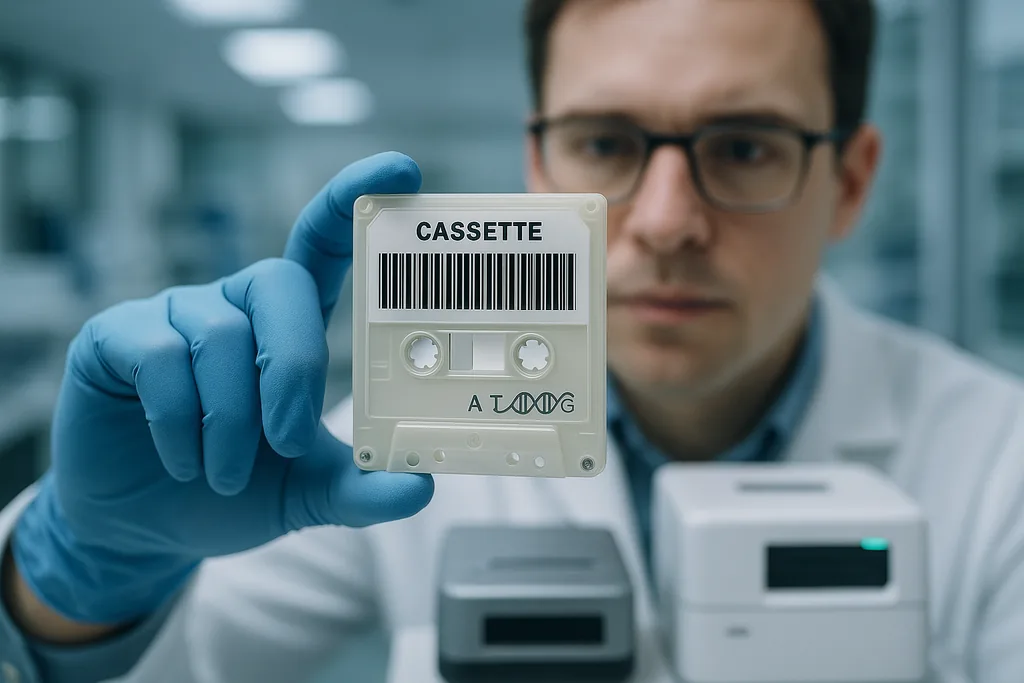
Plastic film, printed DNA and a retro drive: the new prototype
In a laboratory in China, researchers have married two very different eras of information technology: the molecular memory of DNA and the mechanical convenience of a cassette tape. The team printed short, synthetic DNA strands onto a flexible polyester‑nylon film, rolled the strip into a cartridge and built a small drive that can scan barcoded tracks, dip a spot in solution, and recover the DNA for sequencing and decoding back into files.
The result is a functioning proof‑of‑concept that the researchers describe as a “compact cassette tape for DNA‑based data storage.” The experiment demonstrates that DNA can be organized on a long, addressable medium and accessed with automated, cassette‑like motions rather than storing DNA only in tubes or vials — a step the authors say makes the medium easier to use as a file system.
How the system encodes, protects and finds files
The pipeline follows a familiar pattern from other DNA‑storage work: a digital file is translated into sequences of the four nucleotide “letters” (A, T, C and G); those synthetic sequences are deposited as tiny droplets into microscopic, barcode‑marked compartments on the strip; and a protective shell — a crystalline metal‑organic coating — preserves the fragile molecules until they are needed. To read a file, the drive locates the barcode, applies a mild chemical to release strands from that compartment, feeds them to a sequencer and translates the returned base‑calls into bits and bytes.
This architecture gives several practical benefits. Barcodes let the drive locate individual files much like a library indexing system, and the crystal coating prevents chemical degradation of the DNA, allowing the researchers to argue for long storage lifetimes. The prototype also supports overwrite and repair: enzymes can be used to remove old strands and fresh ones deposited in their place, and the team showed simple autonomous recovery and re‑deposition steps inside the drive.
Density and longevity: headline numbers
The numbers are attention‑grabbing. The team reports a theoretical storage density that, when extrapolated, could reach hundreds of petabytes per kilometre of tape — figures that translate into tens of petabytes for a 100‑metre cartridge. The authors and reporting outlets have used comparisons such as “enough to hold billions of songs” to give a visceral sense of scale. Those capacity estimates rely on dense packing of many addressable spots and multiple copies of each sequence to protect against data loss.
Protection matters because DNA chemistry decays slowly but steadily at ambient temperatures. With the zeolitic imidazolate (ZIF) or similar metal‑organic framework armor used in the prototype, the team projects lifetimes on the order of centuries at room temperature. Under cold storage — for example, near 0 °C — the decay rate slows dramatically, and some public reporting described extrapolations that imply preservation on the order of thousands to tens of thousands of years under deep‑cold conditions. Those longer figures should be read as model‑based projections rather than measured results: they come from applying standard chemical‑decay mathematics to the accelerated aging and stability tests the authors carried out.
Prototype performance: proof versus production
Important caveats separate the press‑friendly capacity and lifetime numbers from practical reality. The device is a laboratory demonstration, not a commercial product. In the team’s experiments the system wrote and recovered modest test files — on the order of a few hundred kilobytes — and each full write–read–rewrite cycle took many minutes to hours, primarily because the chemical steps that create and read DNA remain slow and costly. Independent reporting of the study summarized one early demonstration that stored a single ~156.6 KB file and described full cycles taking on the order of tens of minutes to over an hour before optimizations. Those rates mean the prototype writes data at best in the kilobytes‑per‑hour regime, far slower than any conventional hard drive or tape library.
In other words, the system currently excels at density and durability in principle, not throughput. The mechanical parts of the drive — the barcode scanner and tape handling — can seek very quickly across the strip, but the bottlenecks are molecular: synthesising bespoke DNA sequences (writes) and sequencing them back into digital bits (reads) remain orders of magnitude slower and more expensive than silicon‑based storage operations.
Where this fits into the storage ecosystem
Researchers frame the DNA cassette as a potential bridge between archival “cold” storage — files you rarely access but want to keep for decades or centuries — and “warm” storage that is occasionally read or updated. If synthesis and sequencing costs fall and speed improves, an addressable DNA tape could plausibly sit in large libraries alongside magnetic tape cartridges, offering a very low‑power, long‑term medium for the world’s cultural and scientific heritage. For now, the technology looks most relevant to institutions that value longevity above immediate access speed: museums, national archives and certain scientific data sets.
Experts not involved in the study caution that rapid progress in DNA synthesis and sequencing will be necessary before the idea becomes practical. Automating molecular workflows — the core advance here — is a big step, but it doesn't change the fundamental economics overnight. For those reasons the team and outside commentators describe the work as an important platform technology rather than a near‑term replacement for hard drives or cloud data centers.
Practical hurdles and next steps
- Speed and cost: Synthetic DNA remains expensive to make and slow to produce at large scale. Until that changes, the medium will be suited to archival use rather than high‑volume daily storage.
- Standardisation: Widespread use will require agreed formats and cross‑compatible drives so a DNA cartridge made today can be read decades from now.
- Validation of longevity: Claims of millennia‑scale preservation depend on decay models and accelerated tests; longer real‑time experiments and standardised accelerated ageing protocols are needed to be confident about multi‑millennial retention.
- Policy and biosecurity: Storing arbitrary data as DNA raises obvious governance questions about oversight, provenance and the line between benign synthetic strands and biological agents; those conversations will need to happen in parallel with technical development.
The DNA cassette project is representative of a larger trend: engineers are increasingly borrowing biological solutions to solve information‑technology problems. DNA’s native density and energy‑free stability (once written and sealed) make it an attractive candidate for long‑lived archives; the cassette format supplies a familiar, low‑power mechanical interface that could one day slot into library‑like ecosystems for data custodianship.
For now, the new device is best read as a striking demonstration with clear strengths and clear limits. It shows that printed, addressable DNA on a portable strip can be found, read, modified and resealed — a molecular file system in miniature — but it also highlights the hard, rate‑limiting chemistry that must be solved before DNA storage moves from laboratory curiosity to infrastructure. The coming years will determine whether faster synthesis, cheaper sequencing and robust standards make the idea a practical option for storing humanity’s most valuable archives.
Sources
- Science Advances (research paper: "A compact cassette tape for DNA‑based data storage", DOI: 10.1126/sciadv.ady3406)
- Southern University of Science and Technology (research group lead: Xingyu Jiang; corresponding institutions)
- Shanghai Jiao Tong University (collaborating laboratory)