DNA Claim Reopens Jack the Ripper Case
After 137 years, a familiar mystery returns
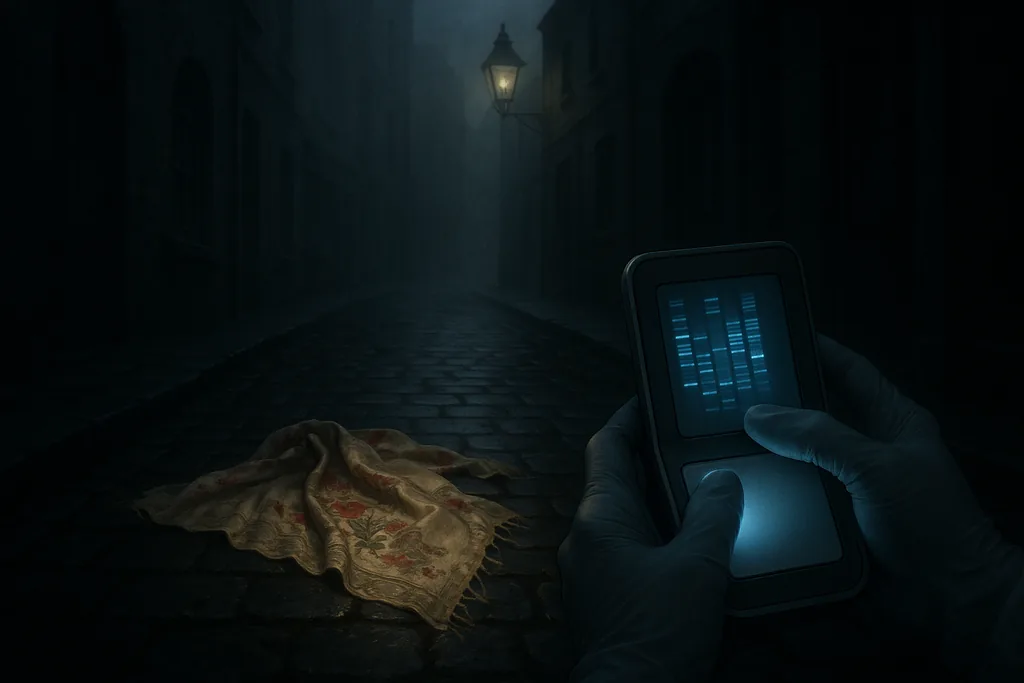
In early 2025 a high-profile claim landed on the desk of an old case that has fascinated generations: a small team working with a privately held silk shawl says genetic material extracted from the fabric links the garment both to Catherine Eddowes, one of the 1888 victims, and to Aaron Kosminski, a Polish immigrant once named among the prime suspects. The announcement revived the long-running story that the notorious Whitechapel murders finally have a scientific answer — and with it, an intense debate about what forensic genetics can legitimately prove in century-old cases.
What the researchers say they found
The claim rests on two elements. First, analysts report that bloodstains on the shawl contained mitochondrial DNA (mtDNA) consistent with the maternal line of Eddowes’ descendants, a finding the team presents as evidence the cloth was at the murder scene. Second, a semen stain on the same piece of fabric was reported to share mtDNA markers with descendants of Aaron Kosminski’s female relatives, which the researchers interpret as a link between the suspect and the garment. Those conclusions were publicised by the historian who owns the shawl and by the scientists involved.
Why many geneticists and historians remain unconvinced
Forensic specialists have been quick to point out limitations in both the evidence and the interpretation. Mitochondrial DNA is inherited down the maternal line and lacks the individualising power of nuclear DNA; it can exclude suspects but rarely proves identity on its own because many unrelated people can share the same mtDNA profile. Investigators also caution that the shawl’s provenance is uncertain: it does not appear in contemporaneous police inventories and has been handled by multiple people over many decades, increasing the risk of modern contamination. Those and other methodological concerns mean the matches reported to the public do not, on their own, constitute definitive proof.
A published paper — and a formal warning
Chain of custody and contamination: the weak link
Two practical problems drive much of the scepticism. First, historical provenance matters: if the shawl cannot be firmly shown to have been at the crime scene on the night in question, DNA matches to people associated with the case could be meaningless. Second, contamination is a real hazard in old textiles — even small amounts of modern DNA can swamp or mimic historic signals. Critics note the shawl was handled casually for years, sometimes by descendants who later provided DNA for comparison, which complicates any claim that a match reflects a 19th‑century transfer rather than more recent contact. In short, you need both a secure chain of custody and incontrovertible molecular records to make a reliable link; that combination is currently lacking.
Legal push and the plea for closure
Beyond academic arguements, the claim has sparked calls from descendants to reopen legal processes. Relatives of Eddowes and supporters of the research have asked authorities to consider a new inquest and to formally identify Kosminski as the killer — partly on humanitarian grounds, to deliver symbolic closure to the families. Politically and legally, however, exhumation, inquests and retroactive identifications require a high threshold of admissible evidence, and prosecutors historically decline to act when new material is contested or when the evidential chain is incomplete.
What the evidence would need to show
If the case is ever to move beyond contested headlines, three things would strengthen the claim dramatically: transparent release of raw sequence data and laboratory records so other teams can reproduce the results; independent testing of any material taken from the shawl using methods designed to detect and quantify contamination; and corroborating historical documentation placing the shawl at the scene under reliable, contemporaneous records. Absent those elements, mtDNA matches remain suggestive but not decisive.
Why this debate matters
At first glance this is a niche argument about an artifact and a century-old murder. In reality it illuminates how forensic science, public history and journalism interact: advances in DNA analysis empower new possibilities for cold-case work, but they also create legitimate temptations to over-interpret ambiguous signals. The Ripper case carries intense cultural weight, and that media gravity can amplify claims before the technical checks are complete. This episode is a reminder that forensics must meet both scientific transparency and historical rigour before old mysteries can be said to be solved.
Bottom line
The recent announcements have given renewed attention to the Aaron Kosminski hypothesis, and supporters argue the mtDNA links on the shawl point to the long-suspected barber. However, mitochondrial matches, unresolved provenance and a journal expression of concern mean mainstream forensic and historical opinion remains cautious. For now, the claim is an intriguing development rather than an established fact — a prompt to push for open data, rigorous retesting and a careful separation of hopeful storytelling from what the molecules demonstrably show.
Mattias Risberg is a Cologne-based reporter covering science and technology for Dark Matter. He has an MSc in Physics and a background in data-driven reporting on forensic methods, space policy and semiconductor supply chains.