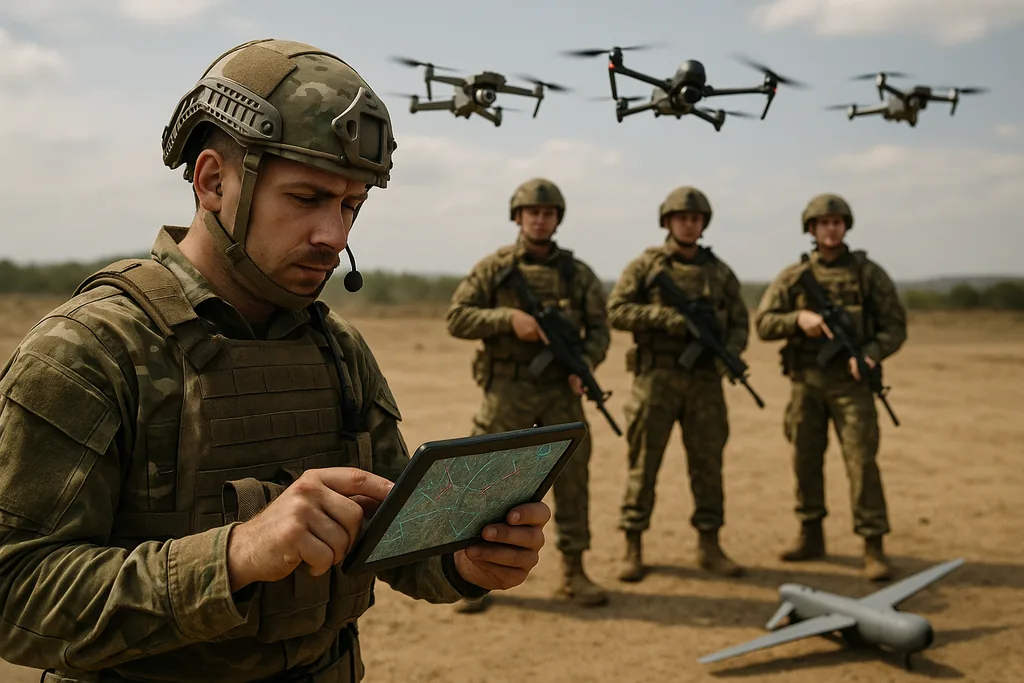
A field tour, a warning and a lesson for armed forces
On January 5, 2026, former UK chief of the defence staff Sir Nick Carter argued that the buzz about drones, swarms and AI risks becoming a technological fetish unless it is paired with doctrine, culture and long, gritty experimentation. His point is simple and stark: technology on its own does not create a new way of war — people, organisations and learning systems do.
What battlefield improvisation has taught us
The fighting in Ukraine has supplied a brutal, real-time laboratory for how low-cost unmanned systems and mass-produced electronics can change tactical outcomes. Frontline units have improvised networks that link cheap reconnaissance and attack drones to artillery and loitering munitions, producing effects that were unthinkable two decades ago. Those effects — attrition of expensive platforms, remote strikes on logistics hubs, and the elevation of small-unit sensing — have forced militaries to reckon with new operational risks and opportunities.
From demonstrations to doctrine: what experimentation looks like
Modern militaries are not blind to the gap between concept and capability. The U.S. Army's Project Convergence series is explicitly designed to move ideas out of white papers and into noisy, joint experiments that test sensors, shooters and command systems together in the field. Recent capstone events have focused on Next‑Generation Command and Control (NGC2), integrated sensor architectures, and cross‑domain fires — the sort of problems that decide whether a swarm or an AI assistant is a tactical curiosity or an operational multiplier. Those exercises are intended to reveal not just technical failures but shortfalls in training, logistics and doctrine.
Experimentation matters because past transformations were never simply about buying new equipment. The AirLand Battle revolution of the 1980s, for example, succeeded when new platforms, revised command concepts, mission command culture and joint training matured together — not when a single weapon system arrived on the parade ground. Sir Nick Carter invoked that lineage to remind readers that cultural change and iterative testing are the engines of lasting transformation.
Integration is the advantage, not the gadget
One recurring technical hurdle is interoperability. Demonstrations during 2025 showed that swarms lose much of their promise if every node speaks a different language. A December demonstration in Munich that linked drones from multiple manufacturers under a unified architecture illustrated a key step: shared interfaces let forces mix low-cost FPV craft, fixed-wing loiterers and legacy ISR assets into coordinated formations. But fielding that capability across an army or alliance requires more than a laboratory demo — it requires procurement choices, standards, and career paths that reward engineers and tacticians who can operate at the intersection of software and operations.
Those procurement and standards choices are where institutional friction shows up. Technology procurement cycles and the rhythms of training, doctrine updates and logistics are often on different calendars. The UK’s mnemonic for capability lines — TEPIDOIL (Training, Equipment, People, Infrastructure, Doctrine, Organisation, Information and Logistics) — and the U.S. DOTMLPF‑P model (which adds Policy) exist precisely because capability is not just kit: it is the entire ecosystem that makes kit useful. Change that focuses on one element and ignores the others will routinely disappoint.
Cultural friction and the human factor
Beyond processes and procurement, the harder problem is cultural. Doctrine that empowers lower‑level initiative — mission command, decentralized decision making — is often uncomfortable for hierarchies built around centralized control, career paths defined by desk tours, and training that prizes procedural certainty. But modern software and autonomy compress decision cycles, increasing the value of delegated judgement and tolerance for controlled failure in training. The history of military innovation shows leaders who explicitly accept risk in training and reward experimentation create the mental space needed for new formations to emerge.
Different theatres, different recipes
Not every theatre will benefit equally from the same mix of drones, autonomy and doctrine. The close, attritional battles of Eastern Europe — where the air littoral is contested and distances are shorter — favour certain classes of inexpensive, swarming loitering munitions and massed reconnaissance. By contrast, operations against advanced anti‑access/area denial networks in the Indo‑Pacific will demand hardened comms, long‑range effects and survivable distributed command nodes; the same cheap swarm that is decisive in one place could be tactically irrelevant or suicidally exposed in another. That means allies must resist simplistic templates and instead invest in theater‑specific concepts built from experimentation and realistic wargaming.
Policy implications and practical trade-offs
The policy conversation has to move beyond 'buy more drones' to include workforce development, industrial base strategy, and international standard‑setting. Allies planning to integrate autonomy and software‑defined weapons at scale must decide how to certify software updates in operational contexts, how to secure supply chains for critical components, and how to maintain resilient logistics under attrition. Those are bureaucratic, technical and ethical problems at once: they require policymakers to fund people and institutions as much as platforms.
How to make a new way of war
The lesson that emerges from battlefield improvisation, demonstrations and doctrine debates is modest but demanding: build systems that can be learned and changed. That requires honest experimentation at scale, procurement that accepts composability and interoperability as first‑order requirements, training that rewards initiative and tolerates controlled failure, and a logistics and career system built to support the new technological ecosystem. If those pieces come together, software‑defined systems and autonomy could offer more than attrition‑by‑mass — they could restore maneuver, tempo and operational surprise to contested battlefields. If they do not, they will simply add another expensive layer to an already lethal attrition fight.
The point Sir Nick Carter makes — and that recent experiments and battlefield accounts reinforce — is not a rejection of new technology. Rather, it is a reminder that transformative military change is an organisational achievement as much as a technical one. The rising cheapness of effectors, the growth of autonomy, and the promise of AI create opportunities that will be squandered unless armed forces treat doctrine, people and logistics as equally strategic investments.
Sources
- U.S. Army Futures Command (Project Convergence Capstone 5 experimental reports)
- British Ministry of Defence capability doctrine (TEPIDOIL / Defence Lines of Development)
- Royal United Services Institute (capability management and defence analysis)
- NATO and allied doctrinal publications on combined arms and multi‑domain operations