Ultraviolet eyes on an interstellar visitor
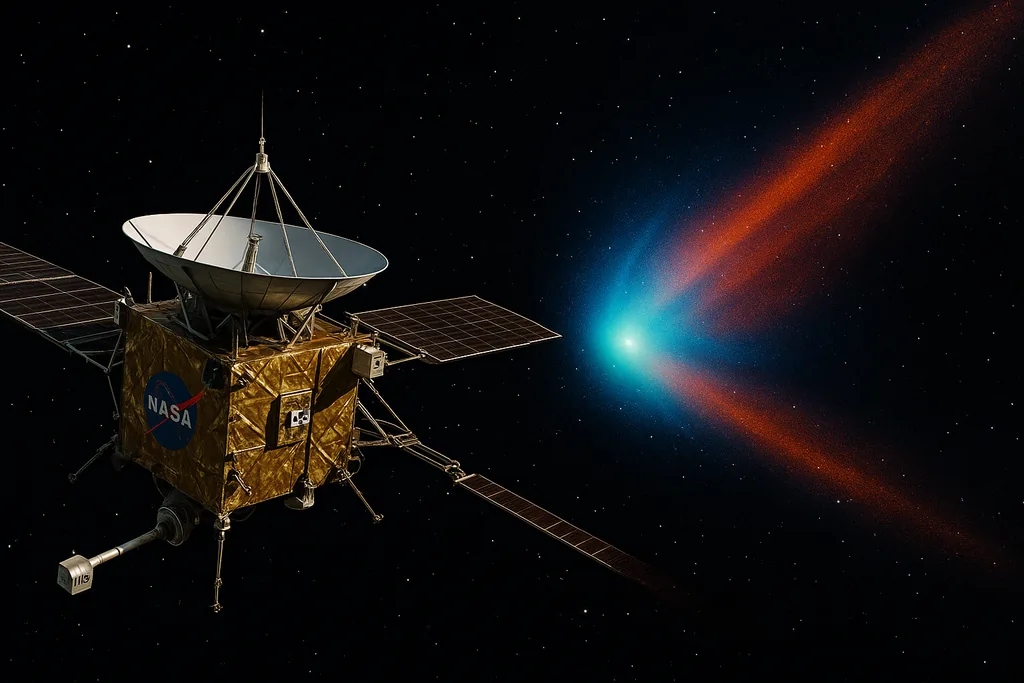
On Nov. 6, 2025, the Europa Clipper spacecraft trained its ultraviolet spectrograph on 3I/ATLAS from about 102 million miles away and recorded a seven‑hour sequence that produced a false‑color composite showing a bright, gas‑rich coma and extended dust and ion tails. The image — released by mission teams in the months that followed — highlights hydrogen and other UV‑bright species in the comet’s surrounding cloud and gives scientists a multiwavelength snapshot of an object that originated beyond our solar system.
Many instruments, one story
NASA has marshalled a fleet of spacecraft to view 3I/ATLAS from different vantage points. Orbiters and probes that normally study Mars, the Sun and other targets pivoted their instruments to capture ultraviolet, optical and infrared signatures as the interstellar visitor swept through the inner solar system. Those coordinated observations let researchers compare how the comet’s gases and dust behave under a range of solar illumination angles and distances — data that are unusually rich precisely because so many missions were available to take a look.
What the ultraviolet data reveal
The Europa Ultraviolet Spectrograph (Europa‑UVS) composite shows a dense region of gas surrounding the nucleus and extended streaks aligned with dust and ion tails; in the mission image these components are mapped in different false‑color bands so hydrogen and other UV‑emitting atoms stand out. Complementary UV observations from Mars‑orbiting assets detected hydrogen flowing off the nucleus — a classic signature of sunlight splitting water ice into hydrogen and oxygen — and ground‑based radio arrays measured hydroxyl molecules produced by that same photochemical process. Taken together, the measurements point to behaviour consistent with active cometary sublimation rather than an inert rock or engineered object.
Instrument checks during cruise matter
Radio silence: the technosignature search
While ultraviolet and optical cameras described the comet’s physical behaviour, a separate campaign looked for radio technosignatures — narrowband transmissions that would betray onboard electronics or an artificial emitter. The Breakthrough Listen collaboration used the 100‑metre Green Bank Telescope to sweep 1–12 GHz during the object’s close approach to Earth in mid‑December 2025, achieving sensitivity down to the 0.1‑watt equivalent‑isotropic radiated power level in the best bands. After visual inspection and cross‑checks with off‑target scans, the team found no signals that could be attributed to the comet itself. That nondetection is the most sensitive radio technosignature search yet made on an interstellar object.
How astronomers rule out false positives
High‑sensitivity radio searches generate many candidate events because Earth is saturated with radio interference from satellites, radar, mobile networks and other human sources. The Breakthrough Listen analysis produced a set of events that initially flagged attention, but each of the candidates matched known bands or showed up again in off‑target control scans — a telltale sign of terrestrial radio‑frequency interference. The team therefore rejected those events and concluded there was no plausible artificial emission localized to 3I/ATLAS. That careful triage is standard in technosignature work: sensitivity is only meaningful when coupled with robust identification of background contamination.
Composition, chemistry and context
Beyond the technosignature question, the combined dataset — UV spectra, radio detections of hydroxyl from large arrays, and optical imaging — paints a picture of a volatile‑rich interstellar comet whose composition resembles what we expect when sunlight drives off water‑ice and generates daughter species such as OH and hydrogen. Those products dominate ultraviolet and radio diagnostics and help teams estimate the comet’s production rates and dust‑to‑gas ratio, parameters that feed models of interstellar small bodies and comparisons with 1I/‘Oumuamua and 2I/Borisov. So far, the signatures look more like an ordinary comet from another star than an engineered probe.
What this means for space technology and industry
The unexpected bonus of a bright, well‑observed target while a flagship spacecraft is in cruise is practical for industry. In‑flight validation reduces the risk of later anomalies, and mission teams can deliver stronger performance data to prime contractors and suppliers. For companies building optics, ultraviolet gratings, coatings and radiation‑hardened detectors, a clean set of calibration checks on a real target strengthens future bids and may short‑circuit some redundant validation steps in later missions. In short, opportunistic science of this kind turns a passing comet into a testbed for flight hardware and software across the supply chain.
Close approach to Jupiter and next opportunities
The comet’s path will carry it outward again, with a predicted close approach to Jupiter in mid‑March 2026 that several teams have highlighted as another chance to watch how solar heating and giant‑planet perturbations affect its trajectory and activity. Proposals have even been published exploring whether an existing spacecraft could alter its course to intercept or closely study the comet near Jupiter; such plans are technically demanding but demonstrate the scientific appetite for a closer look. Continued monitoring as 3I/ATLAS moves through the giant‑planet environment will sharpen estimates of non‑gravitational forces and refine models of interstellar small bodies.
Why astronomers care
Interstellar visitors are rare: 3I/ATLAS is the third confirmed object of its kind and offers a once‑in‑a‑generation chance to test instruments, exercise observational networks and compare chemistry across star systems. The latest ultraviolet images and coordinated radio searches together show how a modern, multi‑platform observational strategy can do dual duty — delivering both science about origin and composition and a practical demonstration that hones the instruments we will rely on for future, riskier encounters. That combination of discovery and engineering payoff is why teams rushed to point everything they had at a single, fast‑moving target.
As the data continue to be mined, teams will publish detailed line lists, production‑rate estimates and tighter constraints on any anomalous behaviour. For now, the picture is one of a busy campaign that used ultraviolet eyes and radio silence in complementary ways — mapping the comet’s chemistry while checking the limits of what our instruments can and cannot detect.
Sources
- NASA Jet Propulsion Laboratory (Europa Ultraviolet Spectrograph images and caption)
- NASA Science / Goddard Laboratory for Atmospheric and Space Physics (MAVEN imaging and multi‑asset observation campaign)
- Breakthrough Listen / SETI Institute (Green Bank Telescope observations and program summary)
- ArXiv preprint: Ben Jacobson‑Bell et al., "Breakthrough Listen Observations of 3I/ATLAS with the Green Bank Telescope at 1–12 GHz"
- Peer‑reviewed trajectory and mission planning literature on 3I/ATLAS (Aerospace / Loeb et al.)