Europe Passes Record Space Budget; NASA Cuts
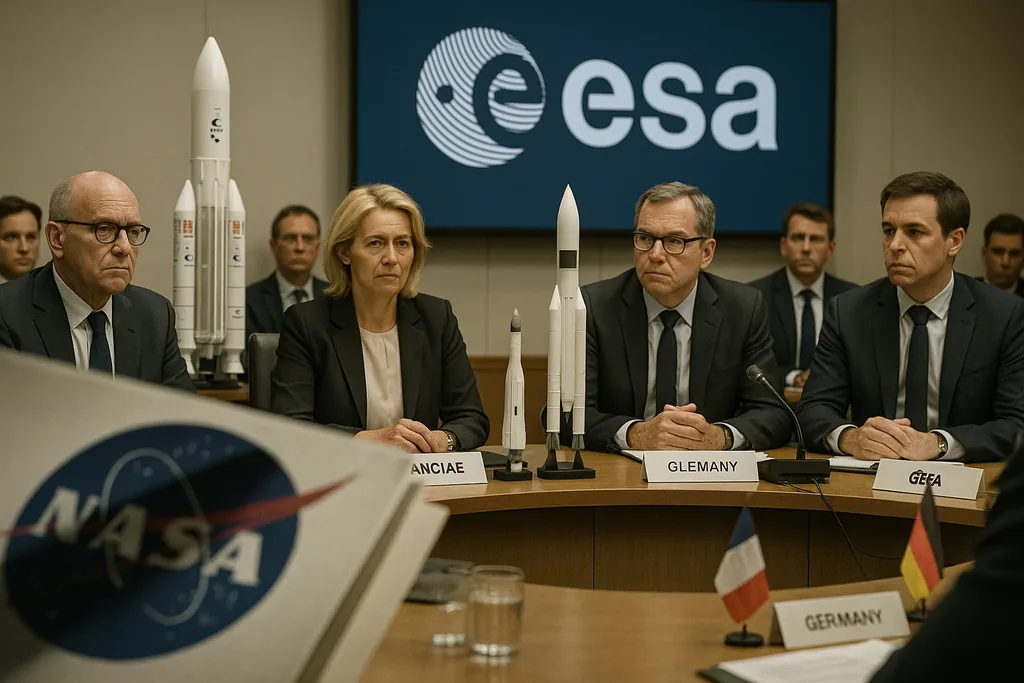
Big spending in Bremen as Washington tightens its belt
BREMEN, Germany — Delegations from European Space Agency member states gathered in Bremen this week and approved what officials described as a record-breaking budget for the agency's next three‑year cycle, prioritising science and exploration. The decision arrives against a sharply different backdrop in Washington, where funding pressures have left NASA confronting deep cuts that could reshape cooperation on high-profile programs including lunar exploration.
For European ministers and industry leaders the outcome in Bremen is a statement of intent: more money for missions, research and technology development at a time when international partnerships and commercial launch capacity are changing rapidly. For NASA, the picture is more constrained — Washington's budget choices have tightened the agency's roadmap and injected fresh political uncertainty into decisions about staffing, missions and long-term commitments.
What Europe approved
The ministerial in Bremen formalised a multi‑year financing package that member states say lifts investment in science and exploration. While individual line items were negotiated behind closed doors, the overall message from the meeting was clear: Europe will spend more on space research, satellites and programmes that underpin both scientific discovery and industrial capacity.
The extra funds are intended to accelerate robotic science missions, sustain the continent's fleet of Earth-observation satellites and strengthen Europe’s role in international human spaceflight. European ministers also signalled that they want to expand support for emerging commercial players — a bid to translate public spending into a competitive industrial base able to deliver spacecraft, instruments and launch services.
That vote has practical consequences. A larger ESA budget increases the resources available for mission design, technology maturation and procurement contracts that lock in work for national space industries across Europe. It also provides room for new science proposals to move from studies into construction, and for ambitious projects — from planetary probes to stronger Earth-observation constellations — to survive the multiyear cadence of planning and development.
NASA's contraction and the political backdrop
In recent days, discussion around the agency's leadership and strategic direction has intensified. Political appointees and nominees have signalled priorities that differ from previous administrations, and lawmakers have pushed proposals — some controversial — that would reshape how heritage hardware and public exhibits are handled. Those signals, combined with the fiscal squeeze, make Washington a less predictable partner in multinational projects that require stable, long-term funding.
Program-level winners and losers
For NASA, the cuts complicate already tight trade-offs between human exploration, planetary science and Earth science. Projects that rely on steady, multi-year budgets — such as certain flagship missions or contributions to international programmes — are particularly vulnerable. When one major partner tightens spending, international collaborations must either find compensating partners, delay schedules or re-scope missions to fit smaller budgets.
One practical example is lunar exploration. European investment strengthens the continent's ability to contribute hardware, logistics and astronauts to multinational lunar architectures. That matters because ESA provides critical elements to some international lunar initiatives and has nominated European astronauts for future lunar flights. In Washington, funding pressure means NASA may need to recalibrate how it partners with other agencies, the private sector and international allies to sustain an ambitious Artemis-era tempo.
Industry, science and strategic positioning
The divergence in spending trajectories will reverberate across industrial supply chains. A larger European budget creates opportunities for manufacturers, small high-tech suppliers and ground-segment providers to secure contracts and invest for growth. It also strengthens Europe's negotiating position in trade-offs over who builds what on multinational missions, from spacecraft subsystems to science payloads.
At the science level, stable or increased budgets translate directly into more missions, more instruments and more researchers being funded. That multiplies publications, strengthens university programmes and keeps technical skills in the workforce; these are the intangible returns that pay off over decades.
Strategically, Europe's stronger public investment signals a desire to be an equal and independent player in space. That does not mean confrontation with other space powers, but it does mean Europe will be in a better position to set terms in collaborations, lead major scientific initiatives, and sustain capabilities — such as launch services, satellite manufacturing and autonomous mission control — that are less dependent on single foreign suppliers.
Transatlantic implications and the path ahead
Where funding gaps appear, agencies typically negotiate compensations — a partner might cover more work, in exchange for data rights or flight opportunities for its personnel. If the U.S. role shrinks in specific programmes, Europe can step into some of that space, but only with strategic choices. That could deliver new leadership roles for European industry and science, but also requires political will to accept longer-term obligations.
On the diplomatic side, the budgetary divergence will feed into discussions at upcoming bilateral and multilateral meetings. Agencies will need to re-examine partnership frameworks, clarify which missions remain priorities, and develop contingency plans for critical capabilities that are not easily substituted.
Signals and next steps
The ministerial vote in Bremen was a clear expression of confidence from European governments: they are willing to back space with sustained public investment. The decision will fund scientists, engineers and companies, and it will shape the landscape of projects and partnerships for the next three years.
In Washington, the coming budget negotiations and political decisions will determine how NASA adapts. Agency leaders and programme managers now face hard choices about which missions to protect, where to seek efficiencies, and how to maintain international commitments under tighter fiscal constraints.
For observers of space policy and the industries that depend on it, the key things to watch are forthcoming details of ESA's budget allocations, the U.S. Congress's response to NASA’s funding pressures, and how both sides reconfigure cooperative programmes such as lunar exploration and major science missions. Those outcomes will define not only where rockets are launched and which instruments fly, but who sets the scientific and strategic agenda in the decade ahead.