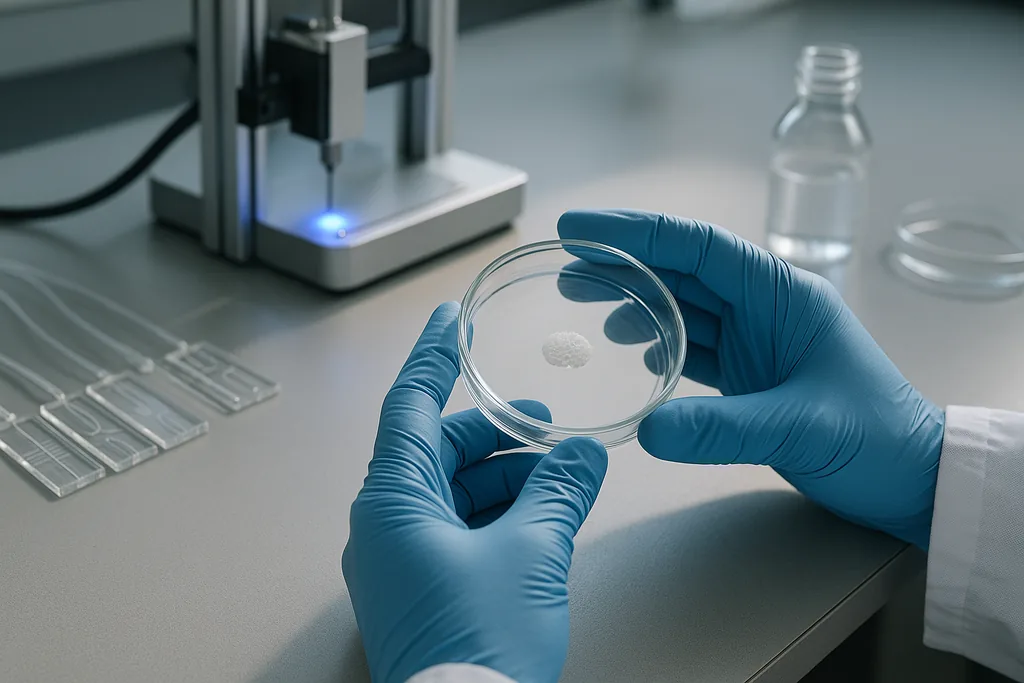
Small scaffold, big questions
On 11 December 2025 a team at the University of California, Riverside unveiled a laboratory platform they call BIPORES: a two‑millimetre block of synthetic tissue built from a chemically neutral polymer that, for the first time according to the researchers, supports human neural stem cells without any animal‑derived components. The structure is intentionally porous and bicontinuous so oxygen and nutrients can flow through microchannels — a technical detail that turns a handful of neural cells into a living network capable of forming active connections. The work is modest in physical scale but large in implication: it offers a new, animal‑free route to model parts of the developing human brain and to test drugs, while also reviving familiar ethical and cultural imagery about what it means to make brain‑like systems in the lab.
Materials and method: PEG, bijel inspiration and light
The scaffold starts with polyethylene glycol (PEG), a widely used, biologically inert polymer. PEG on its own does not present the biochemical cues that cells typically use to attach and organise. The UCR researchers overcame that by borrowing a geometry rather than a biology: they modelled the material on "bijels" — bicontinuous gels whose internal architecture forms interwoven but continuous channels. By pushing a water–ethanol–PEG mixture through glass microtubes and solidifying it with a flash of light, the team made filamentary strands with internal, undulating channels. A 3D printing system then deposits layers of those filaments to build a stable block in which oxygen and nutrients can circulate freely.
That perfusable, bicontinuous geometry is key. In real tissues, blood vessels and the extracellular matrix create routes for gas exchange and for signalling molecules; in BIPORES the continuous channels mimic those roles and avoid the diffusion limits that plague dense synthetic gels. The design gives neural stem cells a hospitable, three‑dimensional environment where they can adhere, proliferate and — crucially — form active connections, the researchers report.
What the model does — and what it does not
In the current experiments the scaffold is two millimetres in diameter. Neural stem cells seeded into that block not only survived but showed signs of network formation and electrophysiological activity consistent with early brain tissue. Those are the milestones that matter for researchers who want models that behave like human tissue for toxicology, developmental biology and early‑stage drug screening.
But the work is not a shortcut to a sentient machine. The model is small, lacks the layered cytoarchitecture of a cortex, and does not reproduce the full complement of cell types, long‑range wiring or metabolic complexity of a living brain. In short: it is a tissue model — an engineered, limited piece of brain‑like material — not an organ or an organism. The team themselves emphasise the platform’s immediate uses in research and drug development, and its promise in reducing dependence on animal‑derived scaffolds that add variability and ethical cost to experiments.
Why researchers turned away from animal components
For decades, investigators building tissues in the lab have relied on matrices derived from animals — for example collagen or Matrigel — because those materials contain biochemical signals that tell cells how to behave. Animal‑derived materials work, but they introduce variability, regulatory headaches and ethical issues, and they can complicate translation to human therapies or drug approval. A fully synthetic matrix that affords the same physical and transport properties, while being chemically defined and reproducible, is therefore attractive for both basic research and industry applications.
Applications on the horizon
Near‑term uses are practical. Pharmaceutical companies and academic labs need human‑relevant tissue models for early‑stage testing of neuroactive compounds, to prioritise candidates and to reduce failed translation from animals to people. A chemically defined platform could make results more consistent and regulatory review more straightforward.
Ethical, legal and cultural ripples
Even with the cautions above, a lab‑grown piece of human brain tissue invites ethical scrutiny. The scientific community has debated organoids — miniature, self‑organising clusters of brain cells — for several years, particularly about where to draw lines around complexity and potential for experience. BIPORES is different in being architected rather than self‑organised, and in being intentionally small, but it nonetheless contributes to a continuum of technologies that bring laboratory systems closer to aspects of human brain function.
That proximity has practical consequences. Institutional review boards, funding agencies and regulators will need to consider whether new oversight is required as engineered brain models become more physiologically realistic. Questions include how to assess welfare for human‑derived tissues, how to regulate translational uses, and how to ensure public trust — concerns that go beyond technical merit to the social license for working with human neural material.
Scaling, standards and the next experiments
The technical challenges are straightforward but nontrivial: enlarging the blocks without creating necrotic cores, integrating vascular or immune components where needed, and proving reproducibility across batches. The UCR team says they are working both on scaling up and on adapting the method to other organs. For researchers in industry, the critical test will be whether the platform reduces variability and predicts human outcomes better than existing options.
At the same time, the broader field is moving toward standards for evidence: reproducible metrics of electrophysiological maturity, agreed tests for synaptic connectivity and shared reporting formats for engineered tissues. If BIPORES and similar platforms can be validated against human clinical endpoints, they will move rapidly from curiosity to tool.
A cultural frame
Stories about lab‑grown brains quickly attract sci‑fi metaphors — Blade Runner, Ex Machina — but that vocabulary can obscure what is technically real and what is sensational. The model reported at UCR is an enabling piece of laboratory infrastructure, not a path to consciousness. Its value lies in controllable architecture and transport — the engineering problems solved — and in practical applications that could reduce animal use and improve early‑stage drug evaluation.
The right response from science and policy is neither technophilia nor panic: it is careful assessment, transparent reporting and the development of proportionate governance that can keep research responsible while allowing useful tools to advance medicine.
Sources
- University of California, Riverside (BIPORES research team and institutional materials)
- UCR lab preprint / research report (BIPORES platform)
- Nature (materials and biomaterials research on bijels and tissue engineering)