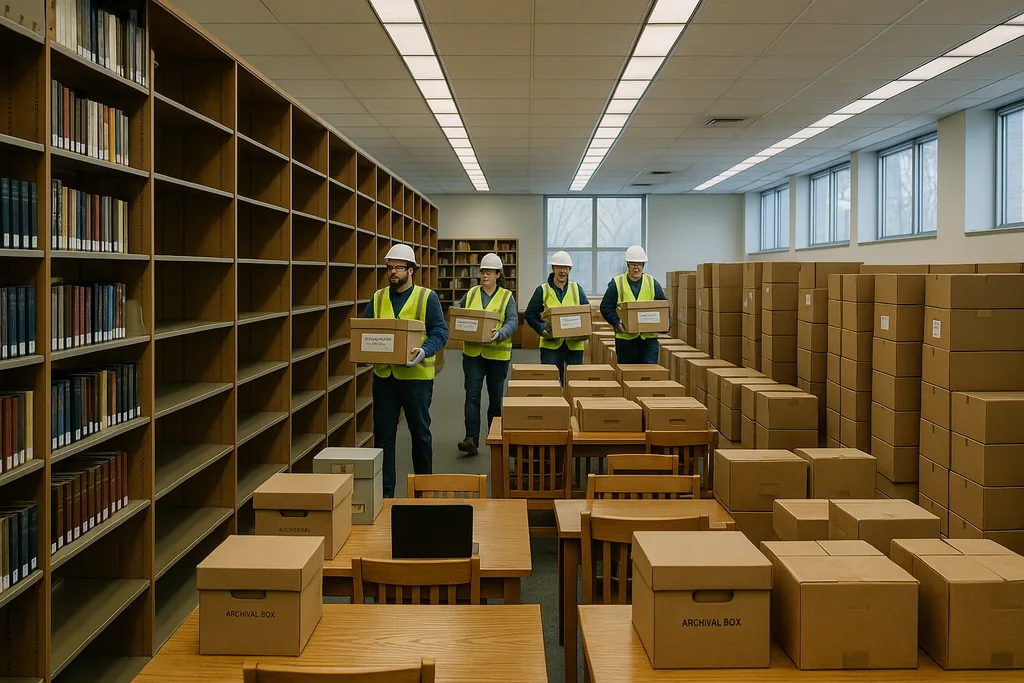
Goddard library closure on January 2, 2026
On January 2, 2026, the research library in Building 21 at NASA’s Goddard Space Flight Center in Greenbelt, Maryland — the agency’s largest onsite collection of technical reports, mission files and historical journals — was closed as part of a campus consolidation plan that agency officials say began under a 2022 facilities master plan. NASA has told staff the library’s holdings will be reviewed over the next 60 days; some items will be transferred to government storage while others could be discarded, a process the agency describes as routine property disposal. The announcement immediately drew concern from scientists, local lawmakers and the union that represents many Goddard employees.
What’s in the stacks
The Goddard information and collaboration centre housed an estimated 100,000 volumes and decades of mission records that engineers and researchers say are not fully digitised. Users have described finding esoteric but practical sources there: translated Soviet technical reports from the 1960s and 1970s, handwritten mission notes, and back issues of engineering journals whose paywalled digital copies can be difficult for outside investigators to access. For many long-serving staff, the library functioned less like an archival vault than a practical workshop — a place to browse adjacent shelves and stumble on obscure but mission‑critical details.
Official rationale: consolidation, cost savings and deferred maintenance
NASA spokespeople and the agency’s administrator framed the move as a practical consolidation intended to reduce operating costs and address deferred maintenance across Goddard’s sprawling 1,270‑acre campus. Agency statements point to a plan adopted in 2022 that called for shuttering outdated buildings and consolidating services; the library pause on in‑person services began on December 9, 2025. NASA says digital services such as an “Ask a Librarian” line and inter‑library loans will remain available to staff. Officials estimate the campus reconfiguration will save roughly $10 million a year and avoid millions more in maintenance backlogs.
Scientists warn of lost institutional memory
Researchers who rely on physical collections warned that discarding older materials risks erasing institutional memory that can be crucial for troubleshooting and designing spacecraft. Former and current Goddard staff described cases where decades‑old papers explained an unexpected instrument behaviour or documented a test procedure that prevented repeat mistakes. The Space Science Data Coordinated Archive has been partly offline in recent months, raising the stakes for physical holdings while staff fear gaps in access will grow if unique records are moved offsite or destroyed.
Union and employee accounts: equipment and haste
The Goddard Engineers, Scientists and Technicians Association (GESTA), which represents many federal employees at Goddard, has published a running log of building closures and relocation activity. The union alleges specialised test equipment and electronics used to qualify spacecraft hardware were removed from buildings and thrown out during accelerated clearouts that took place while the campus was lightly staffed during a federal shutdown. GESTA and several staffers said management provided little written detail about timelines or future space for laboratory or library collections, and that decisions appeared hurried. Those claims have been echoed by members of Congress representing the region.
Agency pushback and messaging
NASA Administrator Jared Isaacman and agency spokespeople pushed back against headlines suggesting indiscriminate destruction. The administrator said agency guidance ensures important scientific and historical materials will be preserved, emphasising that at no point would the agency "toss out" critical documentation. NASA reiterated that the library pause and the broader Goddard reorganisation are intended to maintain research access while reducing overhead, and that the closures flow from prior planning rather than a sudden policy reversal. Those assurances have done little to allay the concerns of staff who recall hard‑won institutional knowledge residing only in physical holdings.
Political and budget context
The library closure is unfolding against a backdrop of steep proposed science budget cuts and a campus restructuring that will see at least 13 buildings and more than 100 science and engineering laboratories closed by March 2026 under the current plan. The administration’s budget requests earlier in 2025 proposed significant reductions to parts of NASA’s science portfolio, a move that prompted an unusually public backlash from agency scientists and congressional allies. Critics say the combination of budget pressure and rapid physical consolidation creates a real risk that expertise and irreplaceable records — not just underused furniture — will be lost. Supporters of the consolidation argue that many buildings are functionally obsolete and that the agency must prioritise a smaller, efficient footprint to fund future missions.
Practical implications for upcoming missions
Engineers pointed out that loss of context — the supplemental notes, calibration records and test reports that often sit in lab libraries — can have practical consequences for designing and integrating instruments. Goddard has been central to a string of flagship projects, from Hubble and Webb to the Nancy Grace Roman Space Telescope; staff worry that teams building the next generation of spacecraft will face avoidable delays or replicate past mistakes if pieces of the archive vanish. The agency says mission teams will retain access to what they need, but independent researchers who previously relied on open access to Goddard’s collections are likely to find it harder to consult source material that remains in physical form only.
How preservation decisions are supposed to work
Federal property rules allow agencies to dispose of excess material but require documentation and review. NASA says the current review will identify items for digitisation, transfer to other federal repositories, or long‑term storage. Where the line is drawn between dispensable office copies, outdated technical manuals and single‑of‑a‑kind historical artifacts is partly a curatorial judgement and partly a policy decision tied to budgets and storage capacity. That judgement is precisely what has made the current process controversial: critics fear decisions driven by near‑term cost‑saving targets will override the long‑term needs of science and engineering.
What to watch next
Over the next 60 days, NASA’s announced review window will be the immediate test. The outcome — which materials are sent to warehouse storage, which are digitised, which are redistributed to remaining libraries, and which are slated for disposal — will determine the practical impact on research continuity. Congressional oversight may follow: elected officials from Maryland have already signalled close interest in the Goddard reorganisation and in any destruction of government property with scientific or historical value. Union tracking of removals and the public record of what is archived or discarded will be a central evidence trail if oversight or litigation emerges.
The debate at Goddard is not purely symbolic. It raises a sharper question about the stewardship of technical knowledge at a time when space systems are growing more complex and more reliant on decades of iterative engineering. Whether that stewardship will be defined by cost‑cutting and consolidation or by careful archival triage that preserves hard‑won institutional memory remains an open and consequential policy choice.
Sources
- NASA (agency statements and Goddard Space Flight Center planning documents)
- Goddard Engineers, Scientists and Technicians Association (union statements and building‑closure updates)
- Goddard master plan (2022 campus facilities plan)
- NASA Space Science Data Coordinated Archive (institutional archive referenced in coverage)