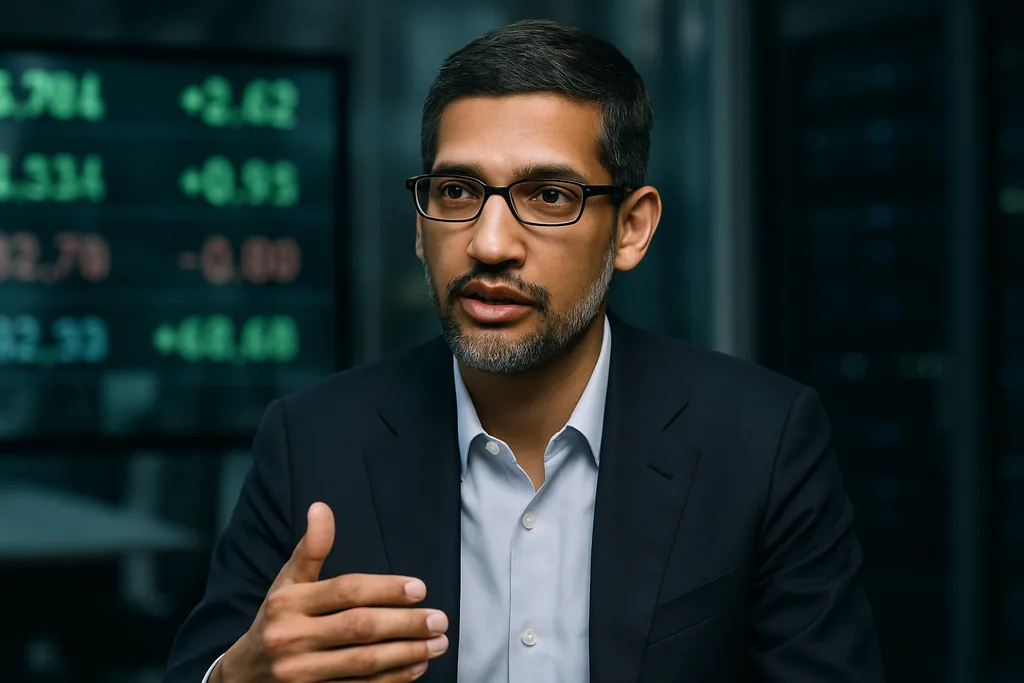
"No company is going to be immune," Sundar Pichai warned
In a recent interview with the BBC, Alphabet CEO Sundar Pichai delivered a blunt assessment: if an AI-driven market bubble bursts, even the giants at the top of the tech pyramid will not be spared. "I think no company is going to be immune, including us," he said, invoking comparisons to the dot‑com boom and its messy aftermath. The remark crystallises a growing anxiety across Silicon Valley and Wall Street: rapid investor enthusiasm, spectacular valuations and a heavy reliance on a handful of infrastructure suppliers have created conditions that resemble past bubbles.
Pichai’s warning in context
Pichai framed his comment as a paradox. He argued that AI is fundamentally transformative—the internet analogy recurs in conversations about the technology—but that the current frenzy contains "elements of irrationality." That view is echoed by other leaders in the field. OpenAI CEO Sam Altman has also said that the sector shows classic bubble signs even as he maintains that AI represents one of the most important technological shifts in decades.
Those competing truths—real, lasting technical value and overheated short-term expectations—are visible in the numbers. Alphabet recently reached market capitalisation levels in the trillion‑dollar range; OpenAI is reported to have reached a headline valuation in the hundreds of billions; and NVIDIA, the dominant designer of GPUs used to train and run large models, has rocketed to valuations in the multiple‑trillion‑dollar bracket after a string of blockbuster earnings quarters. The market's fascination with a narrow set of winners has elevated those companies to levels that, if the narrative changes, could be vulnerable to rapid valuation resets.
The compute bottleneck and the trillion‑dollar bet
Underpinning much of the euphoria is a hard, physical constraint: compute. Modern foundation models are ravenous for specialised chips, power and cooling, so access to GPUs and the capacity to run them at scale are strategic bottlenecks. Sam Altman has been explicit about that constraint—he has signalled plans to pour vast sums into data‑center construction to secure more compute. Industry observers and Altman himself have even used the word "trillions" to describe future capital needs, a scale that would tilt infrastructure economics and potentially reshape where and how AI services are supplied.
But the compute market is also changing. Big cloud providers and hyperscalers are investing in alternative hardware—Google’s recent top model, Gemini 3, was trained on Google's own Tensor Processing Units (TPUs), not NVIDIA GPUs. If more players follow that path, competition could drive down prices for large‑scale training and inference, easing one pressure point in the system. At the same time, cheaper compute could lengthen the runway for many AI startups and services to find business models; lower prices will not, however, automatically translate into sustainable revenue growth for every company chasing the AI promise.
Market signals: investor rotations and bets
Markets have already begun to show signs of nervousness. Some prominent investors have trimmed or exited sizeable positions in chip makers and AI suppliers. Hedge funds and public investors that profited from the early wave of AI enthusiasm are now taking chips off the table, and a handful of savvy, contrarian bets—most famously those by Michael Burry—have drawn headlines for their scepticism about whether current prices are justified.
What a correction could look like
If the market re‑rates AI businesses, the impacts would be uneven. Startups that depend on relentless funding rounds to subsidise rapid growth would be most exposed—they could face valuation markdowns, hiring freezes and, in some cases, insolvency. Public companies with limited revenue diversification might see faster market share declines if investor patience evaporates. Even established suppliers of compute infrastructure would feel the shockwaves: a dramatic slowdown in data‑center spending would ripple down the supply chain, affecting chipmakers, equipment vendors and construction partners.
Yet a contraction need not negate the core usefulness of AI. The internet’s post‑bubble decade did not erase the web’s long‑term importance; instead it weeded out weaker business models and forced firms to focus on sustainable monetisation. A similar recalibration could ultimately strengthen the sector, though the human cost—lost jobs, failed companies and disrupted projects—would be real and immediate.
Balancing fundamentals and hype
Assessing whether the current phase is a speculative bubble or a healthy boom requires distinguishing hype from fundamentals. Key fundamentals to watch include: consistent, repeatable revenue growth tied to AI products and services; gross margins that validate the economics of providing large‑scale inference; and diversification of compute supply so no single vendor becomes a choke point. If those signals align, much of the present enthusiasm will have a durable basis. If not, the market is probably pricing expectations that assume near‑perfect execution across countless companies.
Policymakers and institutional investors have a role, too. Better disclosure about how AI revenues are recognised, clearer metrics on compute utilisation and more thorough stress‑testing of AI business models could reduce the information asymmetry that fuels speculative cycles. For corporate boards and executives, Pichai’s point is pragmatic: even dominant firms must avoid complacency when valuations depend on sectoral exuberance rather than predictable cash flows.
Why this matters beyond finance
The stakes are not only financial. AI is already changing labour markets, media ecosystems and national strategies for technological leadership. If a sharp correction occurs, the immediate victims will be investors and employees—yet the strategic consequences could reverberate through research investments, product roadmaps and national competitiveness. Conversely, a gradual market cooling that prunes overambitious ventures could produce a healthier long‑run industry focused on delivering measurable value.
For now, the industry sits in an uncomfortable middle: powerful, demonstrably useful technology coexisting with frothy asset prices and concentrated supply chains. Pichai’s warning is a reminder that custodians of the tech economy—CEOs, investors, and regulators—must steward growth responsibly. The likely outcome is neither a complete bust nor a guaranteed nirvana: more plausibly, the next few years will be a test of which companies can turn AI’s technical promise into resilient, revenue‑driven businesses while the market resets its expectations.