Greening Cities to Close the Equity Gap
Greening for justice
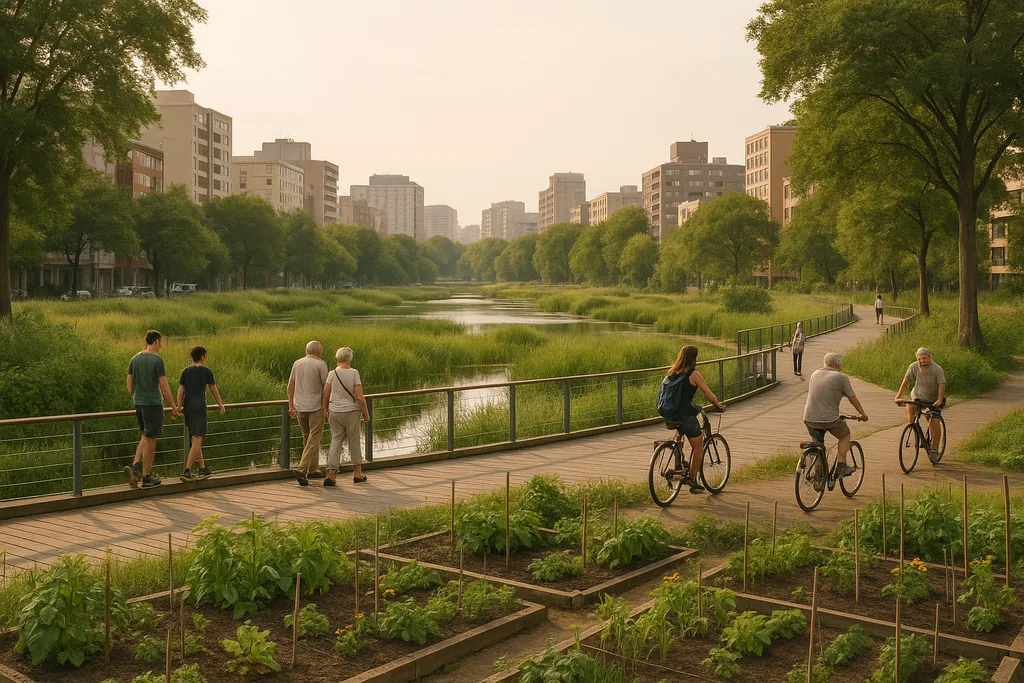
On a reclaimed factory precinct in Bangkok a low‑maintenance wetland now tucks a boardwalk and playground beneath a line of reedbeds while a glassy skyline looms behind it. The park collects stormwater, cools the air, supports birds and gives families a place to walk — a compact example of an idea that is suddenly travelling fast among city planners: use nature not as ornament but as infrastructure to protect the people most exposed to climate hazards.
This week a new Global Roadmap from a large urban nature network pushed that view into the centre of the policy conversation, arguing that greener cities can reduce flood and heat risk, restore biodiversity and improve public health — and that those benefits must be distributed by design so they reach low‑income and otherwise disadvantaged neighborhoods first. That aspiration is backed by two parallel trends in recent research: a flood of evidence showing the multiple co‑benefits of parks, trees and wetlands, and new spatial data and modelling techniques capable of identifying precisely which blocks and buildings are being left behind.
From global roadmap to local action
The roadmap frames nature‑based solutions as a practical alternative to expensive, single‑purpose grey infrastructure. Restored marshes and street canopies can blunt flooding, cut urban heat, filter air and make places safer and healthier at a fraction of the capital outlay of massive seawalls or buried pipes — and they produce recreational and habitat benefits that single‑purpose projects cannot.
But the roadmap stresses one lesson again and again: implementation is local. Case studies from cities around the globe show that the same tool — a park, a restored stream, a tree‑planting program — will produce very different outcomes depending on who is involved, how land is priced and who manages the space over decades. In short, nature can be a lever for equity or a vector of displacement; the difference is the surrounding policy architecture and who sits at the planning table.
Mapping inequality at building scale
That is where new data work becomes decisive. Researchers have demonstrated methods to compute sustainability and equity scores at the scale of individual buildings, combining census records, facility locations, and shortest‑path street distances to essential services into a single Building‑Level Sustainability Score. Those scores can be aggregated up — to blocks, districts and regions — and used to calculate inequality metrics such as Gini coefficients for each Sustainable Development Goal.
What this enables is precise targeting. Scenario modelling shows that installing an integrated facility — for example a combined childcare and elderly‑care centre — within a neighbourhood can lift multiple SDG sub‑scores simultaneously. Planners can simulate different facility mixes, test the effect of a new park on nearby buildings' scores, and prioritise investments where they will narrow the largest gaps rather than widen them.
Barriers and unintended effects
Still, several recent syntheses and reviews warn that cities are not yet realising the full potential of nature‑based solutions. Barriers run across four domains: technical (fragmented regulation, maintenance costs and conflicting climate targets), social (public acceptance, safety and cultural fit), ecological (wrong species choice, poorly designed wetlands that emit greenhouse gases or boost allergenic pollen) and governance (siloed departments, short funding cycles).
One stark unintended effect is green gentrification. Tree‑planting and parks can raise local property values and rents, pushing out the very residents the projects were meant to help unless anti‑displacement measures are layered into project design from the start. Another is that a badly planned wetland can become a methane source; a green roof that is never maintained becomes a management burden. The technical and social dimensions cannot be separated.
Financing, partnerships and standards
To scale nature where it matters most, cities and their partners are experimenting with a mix of tools. Public investment — for transit, floodplain restoration, green corridors — continues to be the leverage that unlocks private development and philanthropic capital. Corporations are increasingly signing city‑level pledges to fund urban greening and restoration, aligning climate and biodiversity commitments with local priorities such as tree cover in heat‑vulnerable neighbourhoods.
But money alone is not enough. Experts argue for three practical reforms: (1) use building‑ and neighbourhood‑level metrics to prioritise investment toward the lowest‑scoring, highest‑risk places; (2) adopt financing models that fund both capital and long‑term operations and maintenance (for example blended finance with maintenance endowments or community land trusts); and (3) pair greening with housing protections — inclusionary zoning, community land trusts, lease‑stability measures — to prevent displacement.
Design and governance: participation matters
Research and practitioner experience both underline that equitable outcomes require meaningful participation from people who live in targeted places. That means starting projects with neighbourhood priorities — cooling, play space, stormwater control, pollinator habitat — and incorporating local and Indigenous ecological knowledge into species selection and stewardship models.
Participation also changes what success looks like. Instead of counting only canopy acres planted, a city can track 'healthy years' of life, reduced emergency room visits in a heatwave, or changes in access to green space inside a 15‑minute walk. When planning embeds these broader social metrics, funding and design choices tend to shift toward interventions that deliver measurable equity gains.
What good looks like in practice
Several emerging exemplars show how the pieces fit together. Car‑free neighbourhoods and reclaimed linear parks demonstrate how removing highway footprints and prioritising walking and cycling anchor broader greening. Mixed‑use transit‑oriented projects that combine affordable housing, community facilities and parks create density that supports both social services and biodiversity. Corporate partners can offer capital and volunteers, but lasting stewardship needs community ownership — and long‑term budgets.
Crucially, cities that are making nature a tool for equity treat design and policy as two halves of the same project. They use high‑resolution assessments to find where heat, flood and service shortfalls overlap with low incomes; they sequence investments to protect affordability; and they establish maintenance streams and participatory governance so that green assets remain safe, functional and welcoming decades after the ribbon is cut.
Where this leads
Integrating nature into cities is no longer an abstract ideal: it is a toolbox of proven techniques, a growing set of data and modelling methods that tell planners where to invest for maximum equity, and a pragmatic set of governance and finance changes that can prevent green benefits from turning into displacement. The work ahead is political and technical: aligning budgets, updating regulations, and rethinking who sits at the table.
If planners and partners take that double step — deploy nature‑based infrastructure where the risk and need are greatest, and pair it with affordability and stewardship measures — greening can become one of the most powerful levers to reshape who benefits from urban life as climate hazards intensify. The wetland in Bangkok, the neighbourhood tree canopy and the reclaimed urban park are not just nicer places to be; they are a practical route to safer, healthier and fairer cities.