How a 200‑Year Whale Outwits Aging
One of nature’s longest lives
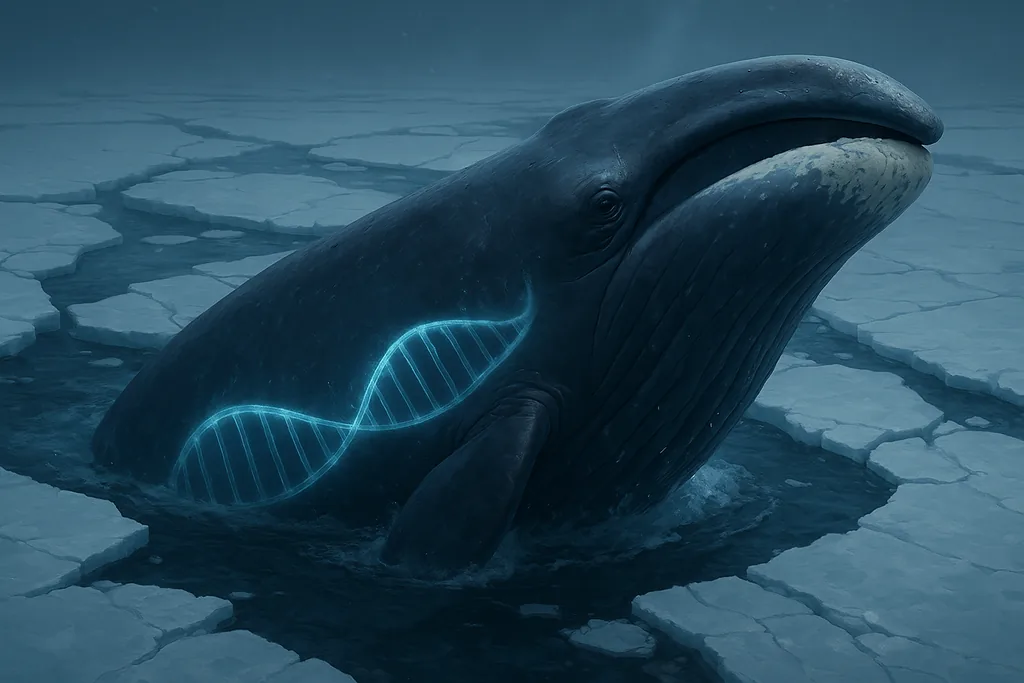
The bowhead whale is an outlier. Living in frigid Arctic seas, this 80‑ton baleen whale routinely reaches ages that can exceed 200 years — far longer than any other mammal. That longevity has puzzled biologists for decades: large bodies with huge numbers of cells should, in theory, accumulate more mutations and develop cancer more often, a contradiction known as Peto’s paradox.
What the new study found
A multidisciplinary team examined bowhead cells and tissues and uncovered a striking pattern: these whales appear exceptionally good at repairing double‑strand breaks in DNA, a particularly dangerous form of genetic damage. Rather than eliminating damaged cells en masse, bowhead cells favour high‑fidelity repair that leaves fewer mutations behind — a tactic that could reduce cancer risk and slow age‑related decline.
The study highlights one protein in particular: Cold‑Inducible RNA‑Binding Protein, or CIRBP. Bowheads express CIRBP at levels far higher than those seen in humans, and the protein helps coordinate precise repair of broken DNA ends. When the research team boosted CIRBP activity experimentally — inserting the whale variant into human cells and overexpressing it in fruit flies — the results were clear: human cells repaired double‑strand breaks more efficiently, and flies lived longer and resisted radiation better.
From Arctic hunts to the lab bench
Studying an endangered, ice‑dwelling species presents logistical and ethical challenges. The researchers obtained small tissue samples through collaboration with Indigenous hunters who continue to take bowheads under traditional subsistence rights; those samples were transported quickly and used to establish cell cultures for laboratory experiments. That cooperation was essential to accessing living whale material without harming wild populations.
Why CIRBP matters
CIRBP is not a wholly alien molecule — humans also make it — but in bowheads it is abundant and apparently tuned for long‑term genome maintenance. The protein becomes more active at lower temperatures, which aligns with the whales’ cold lifestyle; cooling cells by a few degrees was enough in the lab to boost CIRBP production. This cold responsiveness hints at both a proximate trigger for the whale’s adaptation and a potential lever that could be explored experimentally in other animals.
Could humans borrow the trick?
Translating a whale’s molecular strategy into human therapies is a long, uncertain road. The researchers are taking careful steps: next‑stage experiments include testing CIRBP enhancement in mice to see whether improved DNA repair actually extends mammalian lifespan and, crucially, whether it does so safely. There are trade‑offs to consider — for example, more robust repair could conceivably allow damaged cells to survive when elimination would be safer, or interfere with other cellular balances.
Why this matters beyond lifespan
Improving DNA repair is not just about adding years to life; it’s about preserving function. Enhanced genome maintenance could reduce the mutation burden that underpins cancers, neurodegeneration and organ failure, and it might make tissues more resilient during surgery, radiation therapy or transplantation. In that sense, the whale’s molecular toolkit could inform interventions that boost human healthspan even if lifespan gains are modest.
Conservation, ethics and hype
It’s important to resist simplistic narratives. The bowhead’s longevity arose in a specific ecological and evolutionary context — millennia of cold seas, slow life history and distinct selective pressures. Any ambition to "steal" the whale’s secret must be accompanied by ethical sourcing of samples, respect for Indigenous partners, and careful evaluation of ecological and cultural impacts. There is also a temptation in popular reporting to leap from a molecular discovery to grand claims about human immortality; scientists and clinicians caution that such leaps are premature.
The next chapter
For now, the finding reframes how we think about longevity strategies in large, long‑lived animals: a focus on faithful repair rather than on wholesale cell elimination. The immediate path forward is experimental and measured — tests in mice, assays of CIRBP regulation in people, and work to separate possible benefits from unintended harms. If the protein does prove beneficial in controlled models, it could open a new class of approaches to bolster genome maintenance in aging tissues.
Ultimately, the bowhead offers more than a single molecular clue. It reminds us that extreme life histories can evolve elegant biochemical solutions, and that careful, respectful study of nature remains one of our most productive research strategies. The secret is not a silver bullet, but a new thread to follow in the complex tapestry of ageing biology — and following it will take both years of research and steady ethical judgment.
James Lawson is an investigative science and technology reporter for Dark Matter based in the UK. He covers AI, space, and breakthroughs in biology.