How black holes might - one day power warp-speed travel
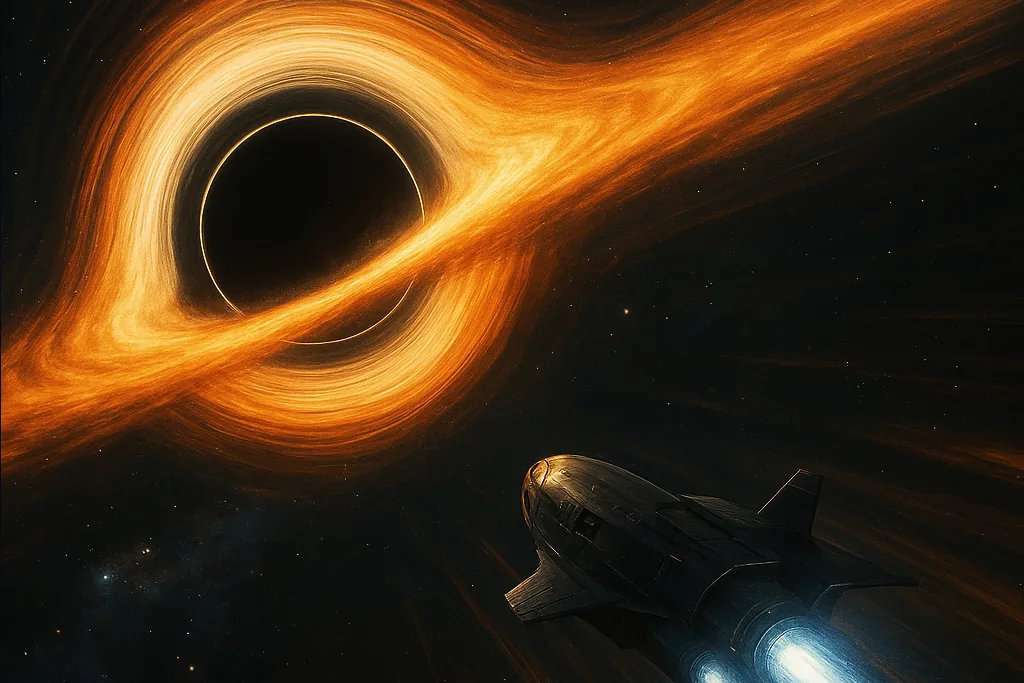
Humanity’s greatest ambitions: traveling faster than light.
For decades, black holes have been known as the universe’s ultimate destroyers, regions where gravity overwhelms everything, even light itself. But as our understanding deepens, a paradox emerges: the same objects that consume all matter may also be the universe’s most efficient engines of creation and acceleration.
Recent observations and simulations are revealing that the relativistic jets erupting from supermassive black holes may hold the key to one of humanity’s greatest ambitions: traveling faster than light.
The Paradox of Creation in Destruction
When matter spirals toward a black hole, it forms an accretion disk - a whirling storm of plasma heated to billions of degrees as it approaches the event horizon. Incredibly, instead of simply vanishing into oblivion, some of that matter is redirected and blasted outward at near-light speeds, forming relativistic jets that stretch for thousands of light-years across galaxies.
For years, scientists have wondered: How does a black hole, the very symbol of inescapable gravity, launch something outward so violently?
Recent data from the Event Horizon Telescope (EHT) and NASA’s Chandra X-ray Observatory point toward a complex interplay between magnetism, rotation, and spacetime itself - specifically, the Blandford–Znajek process, in which magnetic fields extract energy from the black hole’s rotation.
Dr. Valentina Cortés, an astrophysicist at the Harvard-Smithsonian Center for Astrophysics, describes it as:
“A black hole doesn’t simply devour matter; it recycles energy. The twisting of spacetime around its spinning core acts like a cosmic dynamo, converting gravitational energy into kinetic and electromagnetic force.”
In essence, black holes are natural particle accelerators, producing energies trillions of times greater than any device humanity has ever built.
The Power of Relativistic Jets
Relativistic jets are composed of charged particles - mostly electrons and positrons - accelerated to velocities close to the speed of light. These streams of plasma are guided and collimated by magnetic fields so intense they can bend light and twist space itself.
In galaxies like Messier 87 (M87) and Centaurus A, these jets extend for tens of thousands of light-years, carrying enough energy to outshine entire galaxies.
Researchers have discovered that the jets’ structure exhibits helical magnetic fields that remain stable over enormous distances - a feature that, intriguingly, mimics some of the theoretical models proposed for warp field geometries in advanced propulsion physics.
Dr. Eric Nakamura of the European Southern Observatory notes:
“If you look at the magnetic field topology in a jet, it’s like nature’s own warp bubble - a region where plasma, energy, and space are coherently organized. It’s not far-fetched to imagine that if we could understand and replicate that structure, we might be able to manipulate spacetime in a similar way.”
A Blueprint for Warp-Speed Physics
Modern theories of faster-than-light (FTL) travel, such as the Alcubierre warp drive, rely on bending spacetime - compressing it ahead of a vessel and expanding it behind. The problem is that such models demand exotic forms of negative energy or mass, something that has yet to be observed in nature.
But the new insights from relativistic jet physics suggest that extreme magnetic fields and plasma interactions could create localized spacetime distortions that mimic the effects of negative energy — not through exotic matter, but through energy geometry.
Computer simulations run at NASA’s Goddard Space Flight Center have shown that in specific jet configurations, frame-dragging effects - where space itself is pulled along by rotation — can lead to stable pockets of warped spacetime around the jet’s core.
These simulations are still speculative, but if verified, they might represent the first natural example of a warp-like phenomenon - one that exists not in science fiction, but in the heart of quasars.
Harnessing the Power of the Cosmos
Turning this cosmic spectacle into a practical propulsion system remains the greatest challenge of all. The energies involved are astronomical - equivalent to converting entire planets into energy - but the mechanisms are what matter most.
If scientists can understand how magnetic reconnection and relativistic turbulence maintain the coherence of these jets, they might one day build miniature analogs in laboratory plasmas. Experiments at facilities like the National Ignition Facility (NIF) and the Extreme Light Infrastructure (ELI) in Europe are already attempting to replicate some of these conditions.
Dr. Cortés puts it succinctly:
“We’re trying to learn from the universe’s own engineering. Black holes have figured out how to move matter and energy at relativistic speeds - sustainably, coherently, and over vast distances. That’s the ultimate propulsion system.”
The Future of Relativistic Engineering
The emerging field of relativistic plasma dynamics could redefine the limits of space travel. Concepts like magneto-spacetime coupling and vacuum polarization - once purely theoretical — are now being re-examined through the lens of real astronomical data.
If a civilization could control the same kind of field configurations that naturally occur around black holes, it might be able to create stable spacetime gradients - the essential ingredient for warp-speed travel.
Even partial mastery of such physics could revolutionize propulsion: ships traveling at significant fractions of the speed of light, using plasma vortices as spacetime sails.
A Universe That Teaches Itself
The beauty of the universe is that its extremes are not just mysteries - they are instruction manuals written in energy and gravity.
Black holes, long seen as the endpoints of matter, might in fact be gateways of knowledge about how energy, spacetime, and motion intertwine at their deepest levels.
As Dr. Nakamura concludes:
“If we ever do achieve warp-speed travel, it won’t come from escaping the laws of physics - it will come from finally understanding them as the universe does.”
Perhaps, then, the road to faster-than-light exploration does not lie in defying black holes - but in learning from their power.