A new picture of motion
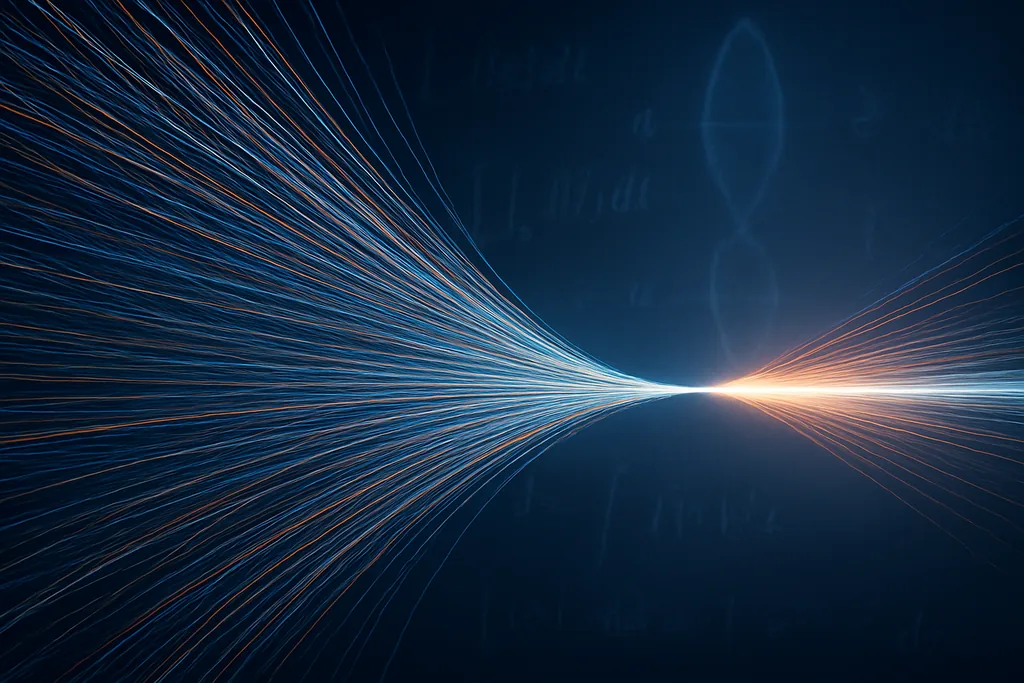
The image is simple: a tennis ball arcing through sunlight, a planet tracing an orbit, a laser beam cutting a straight line. Classical physics has long treated those motions as single, well-defined paths. In a paper published on 22 May 2023, a team led by researchers at South China Normal University reported that, at the level of single photons, those tidy trajectories can be reconstructed from a wildly different reality — one in which the particle first explores a vast cloud of conceivable ways to get from A to B, and the classical path appears only after the many alternatives interfere with each other.
Feynman introduced this space–time approach as a fundamentally different formulation of quantum mechanics, in which each path contributes a complex phase proportional to its classical action; the usual wave function and Schrödinger evolution fall out of the sum.
Motion as interference: the basic mechanism
Put another way, nature doesn’t "choose" a path in the classical sense; it suppresses nearly all quantum alternatives through destructive interference and amplifies a narrow set of histories where phases align. This is the quantum underpinning of the principle of least action that appears in classical mechanics. Expositions and reviews tie the classical limit directly to the stationary-phase behaviour of Feynman's sum-over-paths.
Making the invisible visible with single photons
The experimental leap reported in Nature Photonics was to measure the propagator — the kernel of the path integral that encodes how amplitudes flow from one space–time point to another — for single photons. Historically the propagator was a formal object used in calculations; it had not been directly observed. The Chinese team developed optical techniques to reconstruct single-photon wave functions and from those data extract the propagators in both free space and an engineered harmonic trap. From extremal properties of the measured propagators they recovered classical trajectories for the photons, a direct experimental realisation of the quantum principle of least action.
The upshot is both elegant and practical. Instead of inferring that classical motion must somehow emerge from quantum rules, the experiment shows how the emergence can be read out in the lab: measure the quantum propagator, find where constructive interference concentrates, and the classical path appears. The work used single photons and carefully tailored optics to map amplitudes across space and time; extending the method to matter waves, electrons or interacting many-body systems remains an open challenge but a clearly defined programme.
From foundational clarity to applied outlooks
Why does this matter beyond a neat demonstration? First, it reframes the ontology of motion. The variational principles — least action, Fermat’s least time — have long been cast in teleological or philosophical terms, as though nature were "choosing" a minimal route. Feynman’s formulation and the recent measurements recast those principles as emergent interference phenomena, removing the need for purpose-language and grounding the variational rules in quantum amplitudes.
Second, the path-integral viewpoint is central across physics — from condensed matter to quantum field theory and the diagrams used to compute particle interactions — so methods that let us probe propagators experimentally open new diagnostic tools. Researchers can imagine using measured propagators to characterise complex optical media, test semiclassical approximations, or validate engineered quantum dynamics in photonic simulators. Reviews marking the path integral’s cultural and technical role underscore its continuing influence and the significance of making its core objects observable.
Open questions and the next experiments
Important caveats remain. The Nature Photonics demonstration worked with non-interacting photons in well-controlled optical setups. For massive particles, or for systems with decoherence, the measurement and interpretation become harder: interactions with an environment rapidly suppress coherent sums and force quasi-classical behaviour by another route. Pushing the approach into regimes where the action is small compared with ℏ, where quantum weirdness is strongest, will be both technically demanding and conceptually revealing.
Another frontier is many-body dynamics and chaotic systems, where the sheer combinatorics of paths is enormous. There, semiclassical trace formulas and periodic-orbit theories link classical chaos to quantum spectra via path sums; having experimental access to propagators could provide a new bridge between theory and laboratory tests of quantum chaos and thermalisation. Finally, there are potential cross-pollinations with computing and optimisation: the idea that a system explores many alternatives in parallel and selects extremal paths resonates with optimisation paradigms in machine learning and with quantum algorithms that exploit interference to amplify correct answers.
A different way to picture reality
Feynman’s contribution was not a small technical innovation. It provided a new language: instead of trajectories and forces alone, we can speak of amplitudes, interference and action as the grammar of motion. The 2023 experiment did more than confirm a textbook correspondence; it turned a formal kernel into a measurable object and let researchers watch, in effect, the emergence of classical paths from quantum fog.
For students, researchers and curious readers, the takeaway is clarifying rather than mystical. Motion — the apple falling, the planet orbiting, the photon streaming — is best understood as the macroscopic echo of billions upon billions of quantum possibilities canceling and cohering. That picture changes the metaphors we use for reality: not one true route hidden beneath appearances, but a chorus of potentialities whose chorus lines align to make the familiar tune.
Sources
- Reviews of Modern Physics (R. P. Feynman, "Space–Time Approach to Non‑Relativistic Quantum Mechanics", 1948)
- Nature Photonics (Y.-L. Wen et al., "Demonstration of the quantum principle of least action with single photons", 2023)
- arXiv preprint of the Wen et al. experiment (Demonstration of the quantum principle of least action with single photons)
- Nature Reviews Physics ("75 years of the path integral formulation", review, 2023)
- South China Normal University (research team and press materials related to the 2023 experiment)