How Pixar’s Render Engine Helped Weaponise Drones
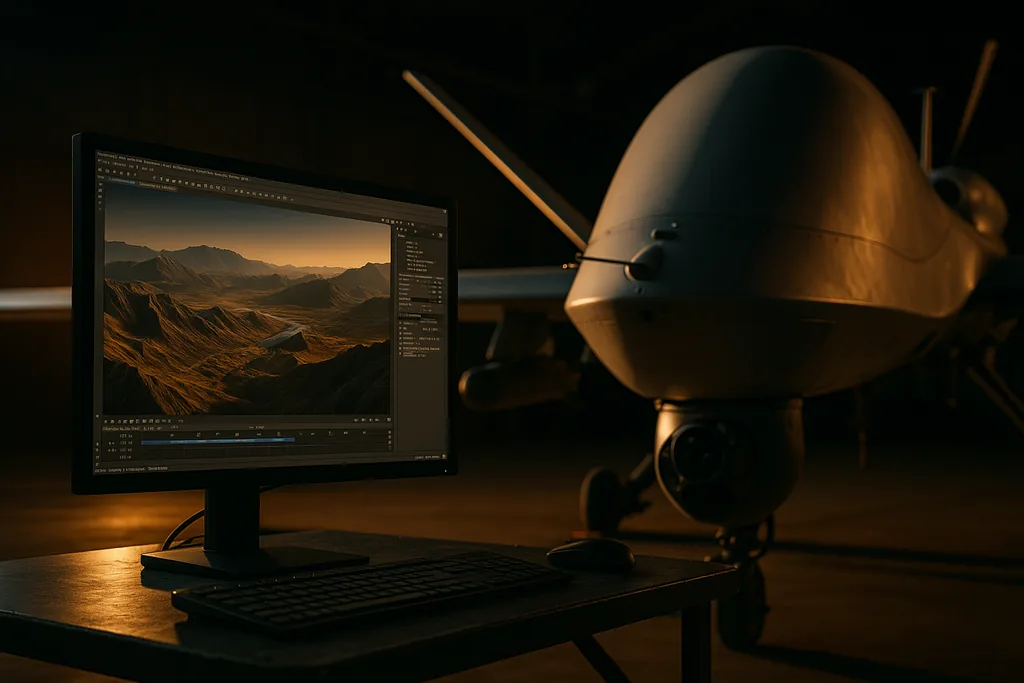
Rendering childhood toys, building machine vision
On 2 December 2025 an investigative report pulled a thread that ties two very different worlds together: the software that gave Toy Story its warm, plastic sheen and the systems that help modern unmanned aerial vehicles see and aim. At the centre of that story is a family of 3D rendering and object‑modelling techniques — pioneered in university labs, refined at an animation studio, and later adapted into simulation and perception tools for defence. The same algorithms that taught computers how light plays on a curved surface also help machines build fast, three‑dimensional maps of the world around them.
From university labs to Hollywood tools
The technical lineage is familiar to anyone who follows computer graphics. Research into shading, lighting and realistic image synthesis began decades ago in academic departments; those ideas became practical software in the 1990s with tools such as RenderMan. Render engines solve an inverse problem: given a mathematical description of objects, materials and light, they produce a photoreal image. For filmmakers, the payoff is aesthetic — believable skin, convincing hair, realistic reflections. For engineers, the payoff is different: the same mathematical models can create synthetic environments, generate labelled training data and run physics‑aware visual simulations at scale.
How rendering improves machine perception
It helps to separate two uses of rendering in modern autonomy. The first is synthetic data and simulation: photoreal renderers create enormous, precisely labelled virtual datasets that train computer‑vision networks without the time and expense of field data collection. The second is geometric and semantic modelling: tools that turn raw sensor input into a three‑dimensional, object‑aware map of the scene. Both are relevant to drones.
Unmanned aircraft rely on a suite of sensors — cameras, lidar, radar — and software that must fuse their streams into an internal model of the environment. Rendering algorithms improve that internal model by providing better priors for how surfaces look under different lighting and motion, and by enabling large‑scale simulation of edge cases. The result is navigation and targeting stacks that can recognise vehicles, human figures and infrastructure at greater ranges and with fewer false positives. That increase in precision is exactly what militaries are buying.
Real‑world consequences and contested battlefields
For some observers the arc from animation studios to battlefield sensors is jarring: the code that makes a child’s toy look tactile has been folded into systems that can identify and engage human targets. Artists and engineers who spent careers making expressive on‑screen characters have begun to ask whether the tools they built are now being repurposed in ways they never intended.
Voices from graphics, ethics and animation
Scholars who study the history of graphics note that the transfer of ideas between entertainment and defence is hardly accidental. Much of the early work on rendering and real‑time simulation was funded by military research programmes; flight simulators and virtual training were attractive defence use cases for researchers who needed compute and experimental platforms. Film‑industry innovators later commercialised and productised the techniques, and companies sold tools into broader markets.
Practitioners in animation express mixed feelings. Some argue the connection is a classic example of dual use: a benign creative tool becomes a component in an application with harmful outcomes. Others point out that the engineering techniques in question — geometry, physics‑based lighting, procedural modelling — are general purpose. The debate sharpens when the downstream consequences are lives lost on a battlefield rather than pixels on a screen.
Policy, responsibility and the limits of corporate silence
The story raises a familiar governance problem: when a technology has easy, valuable civilian applications and hard‑to‑predict military uses, how should responsibility be allocated? Studios and vendors that invent powerful tools typically license software to a wide ecosystem of users. Once a tool is public, preventing misuse is difficult. Companies can, however, tighten export controls, add restricted‑use licensing terms, and increase transparency about defence contracts and partnerships.
On the policy side, dual‑use software and the datasets that power machine perception fall into a regulatory grey area. Hardware export controls increasingly target high‑performance accelerators and chips; software is harder to pin down. Lawmakers and regulators are only beginning to consider whether realistic simulators, synthetic‑data pipelines and high‑fidelity renderers should be treated like controlled items when they materially improve weapon‑sensing systems.
Where the debate goes from here
There are no simple technical fixes. The same advances that make autonomous systems safer in a civil context — better perception, more robust simulation — also make them more capable in combat. That duality calls for a nuanced response: clearer disclosure of defence work, stronger ethics governance inside firms that build low‑level tools, and international norms about the military use of perception‑enhancing software. Public oversight of defence R&D budgets and clearer lines between academic funding and weaponisation would also reduce opacity.
Technologists and policymakers face an uncomfortable but necessary conversation: the industrial pathways that turned computer graphics into a cultural art form are the same pathways that make modern autonomy more precise. Stopping the transfer of ideas is neither feasible nor desirable in the abstract; the question is how to manage it so that the creative and economic benefits do not translate into unchecked lethal force on contested ground.
The debate is no longer hypothetical. An investigation published on 2 December 2025 has made that linkage explicit and urgent. For engineers, artists and regulators alike, the task now is to translate concern into governance — to decide which parts of our digital toolchain belong to culture and commerce, and which demand public control when repurposed for war.