IAWN Campaign to Monitor 3I/ATLAS Prompts Planetary‑Defense Speculation
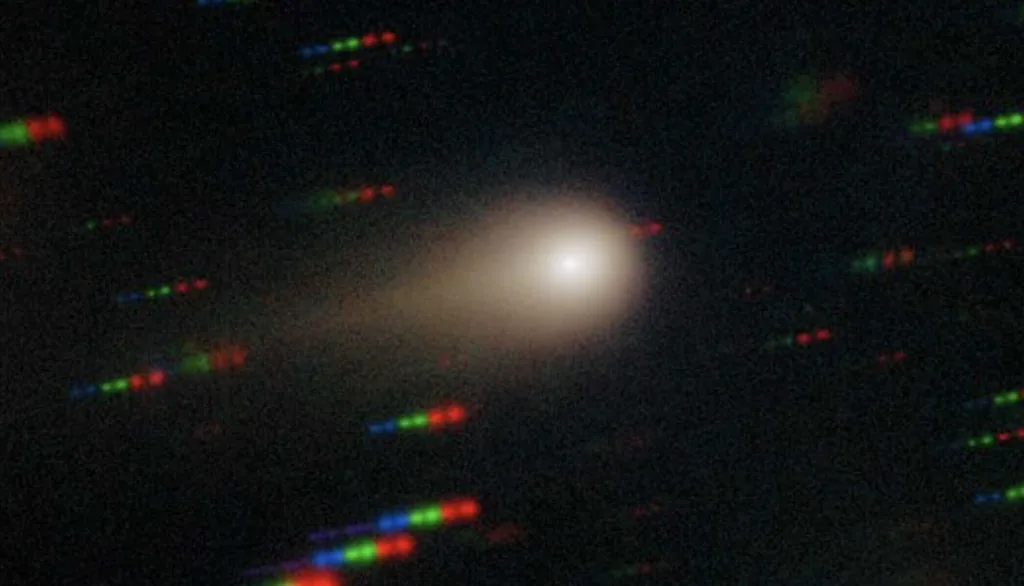
The International Asteroid Warning Network (IAWN) has announced a coordinated observing campaign aimed at improving astrometric measurements of the interstellar comet known as 3I/ATLAS. The campaign, described in an electronic circular from the Minor Planet Center issued on October 21, 2025, is scheduled to begin in late November 2025 and run through January 27, 2026.
Purpose of the Campaign
IAWN’s stated objective is to collect accurate astrometry for 3I/ATLAS. Precise position measurements help refine orbital models, improve predictions of an object's trajectory, and support follow‑up characterization by ground and space telescopes. The interstellar object has attracted attention because it displays unusual features that differ from many native solar‑system comets, making it a high‑priority target for coordinated observations.
Online Speculation and Planetary‑Defense Claims
NASA’s Role and the Impact of the U.S. Shutdown
NASA has played an important role historically in the creation and coordination of IAWN, including convening steering meetings and leading periodic observation campaigns. At the same time, the agency’s ability to contribute to this particular campaign has been constrained by the U.S. federal government shutdown that began on October 1, 2025. During the shutdown, many agency operations were suspended and public communications were minimal, complicating participation in time‑sensitive observing opportunities.
The timing of the shutdown coincided with a key phase in 3I/ATLAS’s passage through the inner solar system. Approximately two days after the lapse in federal funding began, the object made a close approach to Mars. Observers noted that instruments such as the HiRISE camera aboard the Mars Reconnaissance Orbiter were well placed to collect high‑resolution imagery during that window, but it remains unclear whether imagery from those platforms was obtained or will be released.
Potential Encounters and Scientific Value
Technosignature Discussion and Low‑Probability, High‑Impact Scenarios
Some researchers have argued for systematic searches of interstellar objects for signs of nonnatural origin or technosignatures. A paper posted to the preprint archive in August 2025 recommended structured searches while noting the bulk of available observations favor a cometary interpretation for 3I/ATLAS. Prominent scientists have also warned that, even if unlikely, low‑probability events that could have large consequences merit consideration in risk assessments and observational planning.
Outlook
For now, the immediate scientific priority is improving positional measurements and collecting as much observational data as possible while 3I/ATLAS remains accessible. The IAWN campaign aims to address that need. Observers and mission teams have emphasized that accurate astrometry and coordinated observations are the best path to avoid turning a rare interstellar encounter into a missed scientific opportunity.