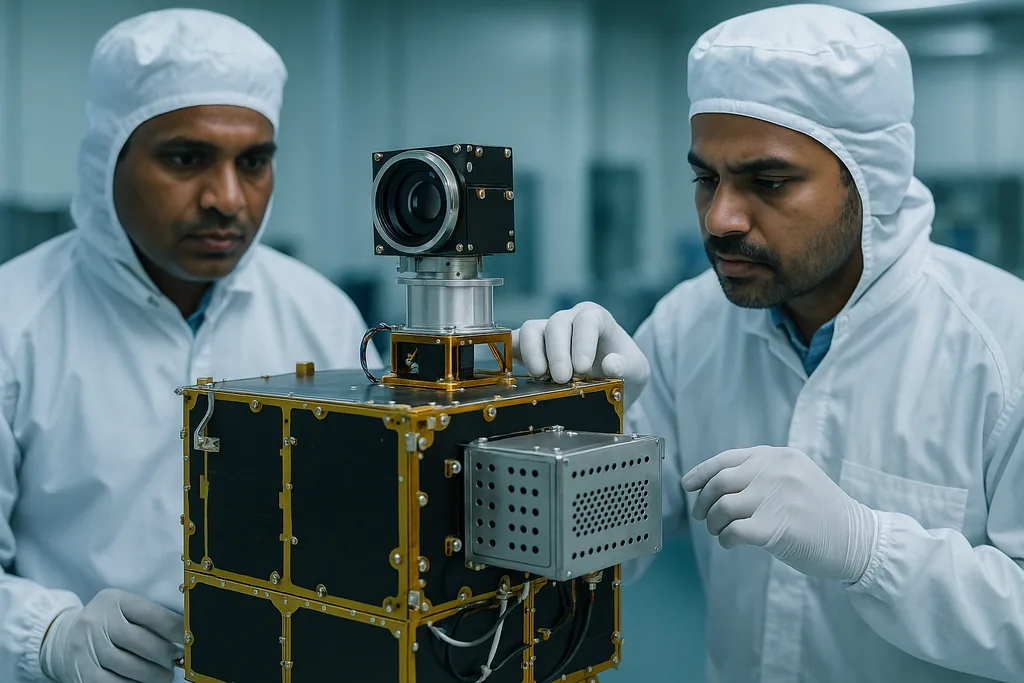
New satellites, new rules for secrecy
In the months after officials warned that powerful quantum computers could one day crack conventional encryption, Indian space and defence organisations have pushed the issue into orbit: the country is planning a wave of satellites designed from the ground up to survive the era of quantum-enabled cyberattacks. The effort spans government-led research, industry partnerships and demonstrations of quantum communication techniques, and officials say at least some surveillance and communications spacecraft will be built with quantum-resilient hardware and protocols in the coming years.
A strategic sprint
The concern driving the push is straightforward. General-purpose quantum computers, once scaled, threaten to break large classes of public-key cryptography that protect satellite command links, telemetry and ground-station backbones today. That prospect has prompted the Department of Space, the Defence Research and Development Organisation, national research programmes and private firms to rework satellite architectures so that their secrets survive a future quantum adversary. Officials and industry partners have described plans for a sovereign, "quantum-secure" stack that combines space-capable quantum key distribution (QKD), post-quantum cryptographic algorithms and hardened onboard hardware.
How 'quantum-safe' satellites work
The emerging blueprint for quantum-resilient satellites uses two complementary approaches. Quantum key distribution uses properties of single photons to share random encryption keys in a way that reveals eavesdropping; post-quantum cryptography replaces susceptible public-key algorithms with mathematically hard problems believed to resist quantum attacks. In practice, a satellite might carry an optical terminal for QKD to refresh symmetric keys and also implement post-quantum algorithms in its onboard secure processor so that routine authentication and signing remain safe even if an adversary later captures recorded traffic and runs it through a quantum machine. These layers together aim to limit both real-time interception and future retrospective decryption.
From prototypes to constellations
India has not been starting from scratch. Over the past few years research groups and government labs have demonstrated free-space quantum links and tested QKD hardware in laboratory and campus settings. Those demonstrations have been followed by formal partnerships between space systems companies and quantum-security firms to design space-hardened implementations suitable for the harsh thermal, radiation and operational constraints of satellites. In July 2025 a collaboration between an Indian spacecraft integrator and a post-quantum cybersecurity company specifically set out to produce India’s first indigenous quantum-secure satellite and related infrastructure. Separate government planning documents and briefings have also signalled an ambition to make new surveillance satellites and strategic constellations quantum-resilient within a tight multi-year window.
Industry and supply-chain realities
Engineering quantum-resilient spacecraft is not merely a software update; it changes supply chains, design cycles and mission operations. Optical QKD terminals demand precision optics, photon sources and single-photon detectors; post-quantum cryptography requires secure, certified hardware modules and often more silicon resource than legacy algorithms; both need trusted manufacturing and secure key provisioning procedures. Companies involved in semiconductors, spacecraft bus manufacture and secure-element production are engaging to localise critical components and prevent weak links in a system that is only as strong as its least-secure part. A handful of private firms, some international vendors and Indian system integrators are already in discussions or signed memoranda to accelerate that industrial base.
Operational trade-offs and technical limits
Designers must balance security benefits against cost, mass, power and complexity. QKD performs well over line-of-sight optical channels but needs narrow-beam pointing, clear weather for ground links and exquisitely stable platforms for long-distance links — constraints that complicate use on small satellites or in low-cost constellations. Post-quantum algorithms mitigate many of QKD’s operational limitations because they run on classical processors and can be retrofitted in software or secure firmware, but they bring a different set of verification and performance challenges, including a need for standards and hardware validation. Both approaches demand rigorous in-orbit testing to expose practical vulnerabilities that laboratory demos cannot reveal.
Timeline and announced targets
Public and industry statements over 2025 set out an urgent schedule. Some briefings suggested a first demonstrator or announcement could arrive within months of mid-2025, and planners have talked about making newly commissioned surveillance satellites quantum-resilient as part of national modernization efforts through 2027. Private-sector roadshows and investment plans in early January 2026 underscore the continued push to mobilise capital, semiconductor capacity and manufacturing partnerships needed to meet those timelines. The combination of government programmes, research labs and private partnerships has created a momentum that could produce operationally hardened systems well before most adversaries deploy large-scale quantum decryption capabilities — if the technical hurdles are cleared.
What this means for defence and civil services
Hardening satellites against quantum threats is primarily a national-security priority: navigation, reconnaissance and military communications satellites carry mission-critical payloads and commands that adversaries could target for disruption or exploitation. But the ripple effects are broader. Finance, critical infrastructure and telecom services that depend on space links will also benefit from more robust cryptography and key management. Policymakers must weigh export controls, interoperability and international cooperation because quantum-secure space infrastructure touches cross-border data flows and global conventions on space use.
Open questions
Several fundamental uncertainties remain. Which mix of QKD and post-quantum cryptography will dominate operational deployments? How quickly can trusted supply chains for specialised components be scaled? Will standards bodies and international partners align on verification and certification procedures for space-capable PQC modules? And crucially, can these systems be fielded in a way that balances security with mission availability for satellites that already face tight mass, power and thermal budgets? The coming year of demonstrations and early orbital experiments should provide clearer answers.
Sources
- Indian Department of Science & Technology / National Quantum Mission
- Indian Space Research Organisation (ISRO)
- Defence Research and Development Organisation (DRDO)
- Physical Research Laboratory (PRL), India
- Space TS and Synergy Quantum partnership materials