James Webb Telescope Reveals Turbulent, Uneven Galaxies in the Early Universe
Survey and main findings
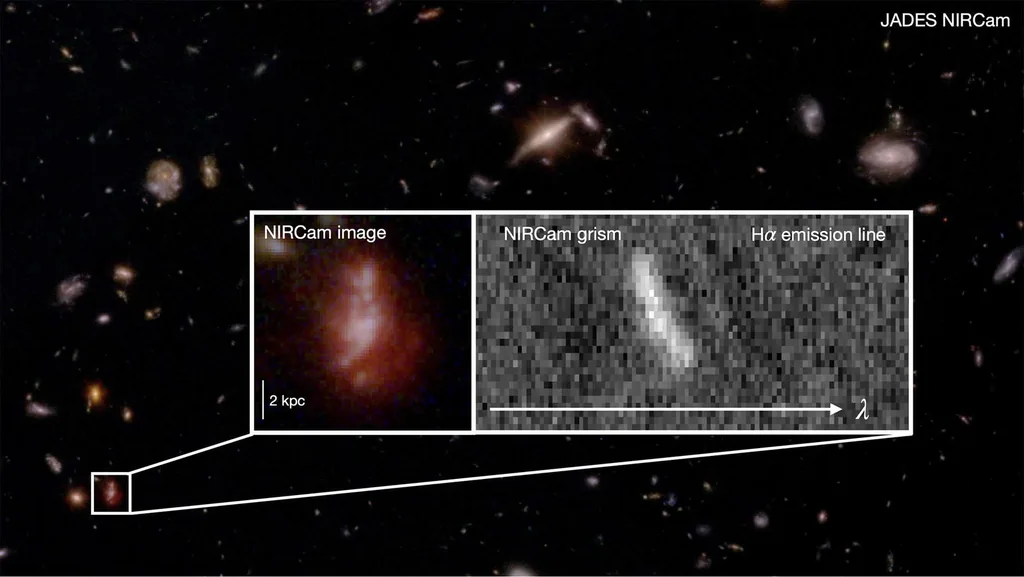
Researchers at the University of Cambridge analyzed over 250 observations from the James Webb Space Telescope targeting galaxies that existed about 800 million to 1.5 billion years after the Big Bang. Rather than a prevalence of smooth, rotating disks, the team found that most galaxies in this early period are irregular, clumpy and dynamically turbulent.
The study examined gas motions across a large population of relatively low-mass galaxies and found a broad range of kinematic states. Some systems show signs of emerging ordered rotation, but the majority exhibit disordered gas motions consistent with frequent mergers, intense star-formation episodes, and gravitational instabilities.
Technique: NIRCam grism spectroscopy
The team used slitless spectroscopy from the telescope's NIRCam instrument operating in grism mode. Grisms separate incoming light into wavelengths across the 2.4–5.0 micrometer range, allowing the measurement of infrared emission lines that trace ionized gas kinematics. The instrument provides spectral resolving power on the order of 1,600, enabling detailed velocity measurements across galaxies.
Originally developed for optical alignment, NIRCam's grisms offer both wide-field spectroscopy and time-series modes. For this work, the researchers applied a new algorithm to the grism spectra and existing imaging to map gas motions within individual galaxies across the surveyed sample.
Context and interpretation
The results help trace the transition from the epoch of reionization toward the later peak of cosmic star formation often called "cosmic noon," showing how small, chaotic building blocks gradually settled into more ordered structures like the spirals seen in the nearby universe.
Next steps
Publication
The results appear in Monthly Notices of the Royal Astronomical Society in a paper titled "The Dawn of Disks: Unveiling the Turbulent Ionised Gas Kinematics of the Galaxy Population at z ~ 4–6 with JWST/NIRCam Grism Spectroscopy."