Candidate jetted tidal disruption of a white dwarf by an intermediate‑mass black hole
Summary
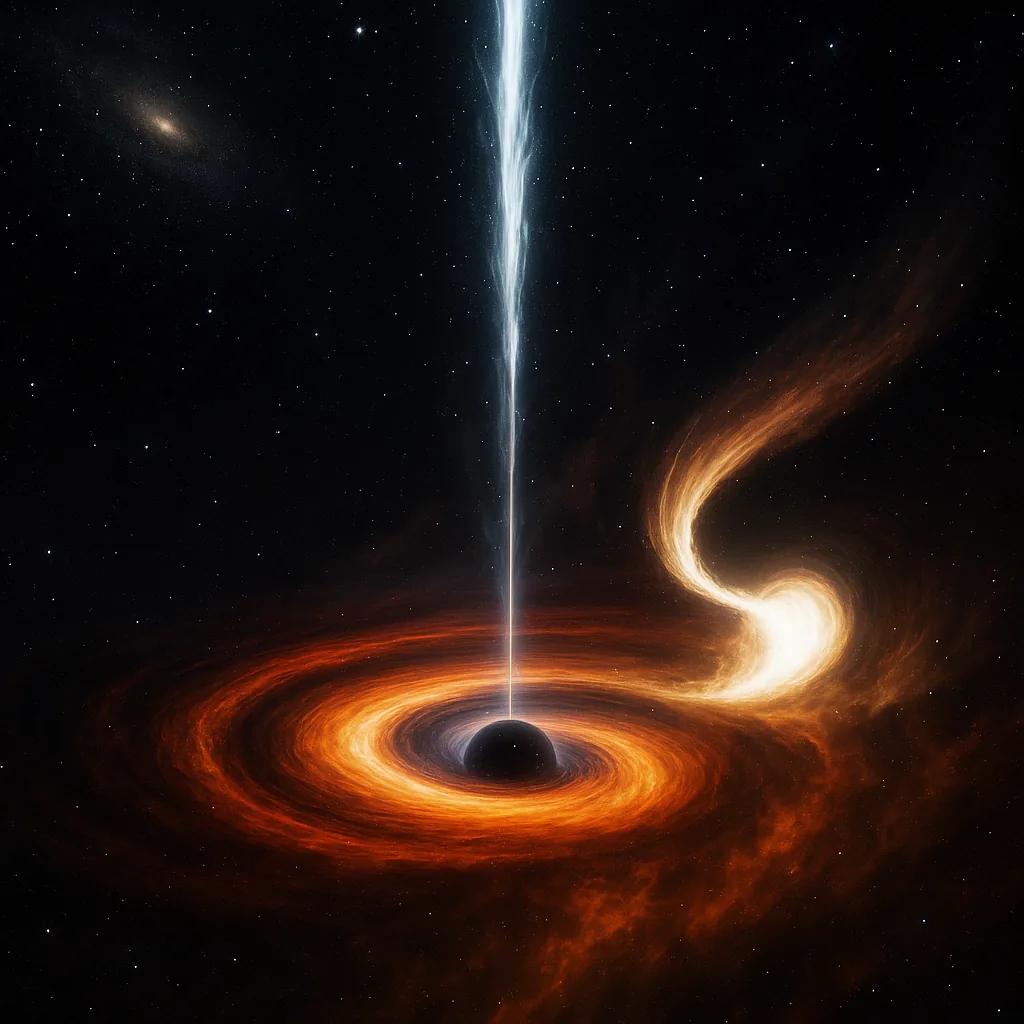
A recently reported transient displays a combination of properties — very rapid evolution, extreme luminosity, a hard gamma‑ray component and a precipitous decline — that do not match ordinary long‑lived tidal disruption events (TDEs) of normal stars, typical supernovae or known gamma‑ray burst classes. The event is interpreted as a jetted tidal disruption of a compact white dwarf by an intermediate‑mass black hole (IMBH).
Key observational properties
- Very short timescale: the high‑energy emission evolves and declines much faster than standard stellar TDEs.
- Extreme luminosity: peak output reaches values characteristic of relativistic, beamed outflows.
- Hard gamma‑ray / X‑ray component: an energetic high‑energy spectral component is present during the early phase.
- Sharp late‑time decline: the flux falls rapidly after the initial bright phase.
- Subsequent soft, super‑Eddington emission: at later times softer emission, consistent with an accretion disk or radiative outflow, becomes visible as the jet fades.
- Multiband follow‑up: space‑borne X‑ray and gamma‑ray instruments provided the discovery and early characterization, with additional multiwavelength observations constraining the later evolution.
Interpretation
The combination of a compact disrupted object and an intermediate‑mass black hole provides a coherent explanation. A white dwarf's small radius leads to rapid disruption and a brief phase of very high accretion power. If the encounter launches a highly relativistic jet, the observed hard high‑energy emission and extreme apparent luminosity follow naturally. The short duration and quick decline reflect the rapid falloff of available accretion fuel in such a compact disruption.
As the jet weakens, emission from a surrounding accretion disk or optically thick outflow can dominate, producing the observed late‑time soft, super‑Eddington signature. The inferred black hole mass required to produce the observed timescales and energetics lies in the intermediate range, roughly 102–105 solar masses.
Significance
If confirmed, this event would provide observational support for two connected phenomena: the existence of intermediate‑mass black holes and their ability to produce relativistic jets during compact‑object tidal disruptions. It points to a distinct, fast‑evolving class of TDEs tied to compact stars and offers new constraints on disruption rates, jet formation mechanisms, and accretion physics under extreme conditions.
Publication and dataset notes