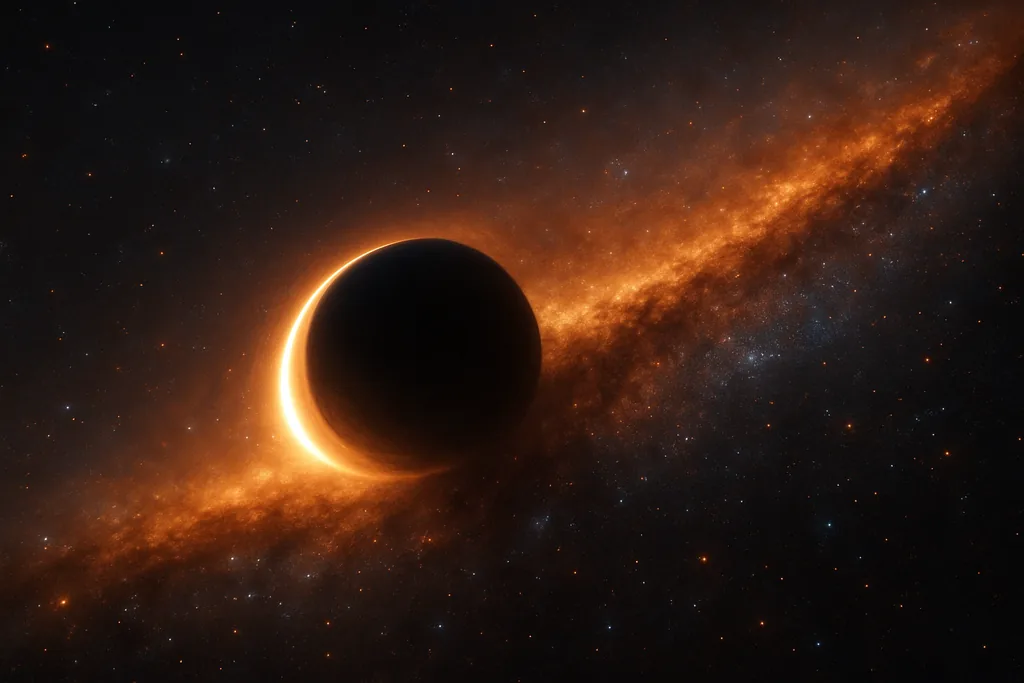
RBH-1: a supermassive black hole on the run
This week (18 December 2025), astronomers announced that follow-up observations with the James Webb Space Telescope have confirmed RBH-1 as a runaway supermassive black hole. The object, at a light-travel distance of roughly 7.5 billion years, carries at least 10 million times the mass of the Sun and is moving at nearly 954 kilometres per second — fast enough to punch through the tenuous gas around its host galaxy and escape toward intergalactic space. The evidence is striking: JWST's NIRSpec spectra map a sharp velocity jump across a luminous bow shock ahead of the object and a long, star-forming trail stretching for about 200,000 light‑years behind it.
How JWST nailed the motion
RBH-1 was first highlighted in Hubble images in 2023 because of a dramatic, comet-like structure: a bright shock at the front and a long string of young stars in its wake. To test whether that morphology really came from a massive object moving supersonically, Pieter van Dokkum's team at Yale used JWST's near-infrared spectrograph to measure the velocity of shock-excited gas across the feature. Because the entire structure is slightly tipped toward Earth, light from gas on the near side is blueshifted while gas on the far side is redshifted. The JWST dataset shows an abrupt velocity difference: gas behind the shock is moving some 600 km/s faster than the material ahead of it, and the configuration can only be explained by a heavy object ploughing through the circumgalactic medium at roughly 954 km/s.
That velocity, combined with the inferred mass and the geometry of the bow shock and wake, led the team to conclude that RBH-1 is not a transient bright spot or a chance stream of stars. Instead, it is a bona fide runaway supermassive black hole — the first where the kinematic and spectral signatures are measured well enough to be convincing.
What can kick a supermassive black hole that hard?
The leading hypothesis is gravitational recoil following the merger of two supermassive black holes. When two black holes spiral together they emit gravitational waves; if the outgoing waves are emitted asymmetrically the newly formed hole can receive a powerful kick. Simulations have long shown kicks of hundreds to a few thousand km/s are possible under plausible mass ratios and spin alignments. Alternatively, three-body interactions in a crowded galactic nucleus — for example when three black holes meet after successive galaxy mergers — can fling one of them outwards. The observed speed and the host galaxy's mass are consistent with recoil models, and van Dokkum's team argues that gravitational-wave recoil is the more likely origin for RBH-1.
Both mechanisms leave similar observational fingerprints: a displaced massive object, a bow shock where it compresses gas, and a trail of compressed, cooled gas behind that can trigger star formation. RBH-1 shows all three, which is why the JWST confirmation is such an important empirical milestone.
Runaways and contrails: other ways wandering holes announce themselves
RBH-1 is not the only object hinting that massive black holes can roam. In a separate result, JWST and ALMA observations of the nearby spiral NGC 3627 revealed a razor-straight, 20,000–light-year-long ribbon of cold molecular gas and dust that researchers interpret as a "galactic contrail" left by a compact intruder. Mengke Zhao and collaborators modelled the feature as the wake of a compact object with roughly 10 million solar masses moving supersonically through a disk; the compressed gas cooled into molecular form and now traces the passage. That contrail is narrower and colder than normal spiral-arm structure and its magnetic-field alignment implies shock compression rather than ordinary turbulence.
Another observational route comes from transient flares. A separate class of discoveries — tidal disruption events observed away from galactic centers — have revealed massive black holes that light up when they disrupt an unlucky star. Radio monitoring of an off-center tidal disruption (catalogued as AT 2024tvd) showed unusually bright and rapidly varying radio flares, suggesting powerful outflows from a black hole far from the galactic core. These radio signatures can flag the presence of a wandering hole even when it is otherwise invisible.
Why this matters for galaxy evolution and gravitational-wave astronomy
Confirming that supermassive black holes can be ejected from galaxy centers has several consequences. On the galactic scale, losing a central black hole alters how feedback — the energetic influence of the black hole on gas and star formation — operates. An ejected SMBH carries with it a minuscule retinue of bound gas and stars but leaves the galactic nucleus altered; repeated ejections over cosmic time could change the demographics of central black holes and the growth histories of galaxies.
For gravitational-wave astrophysics, RBH-1 is a direct, observable consequence of processes that also produce low-frequency gravitational waves. Measuring the rate and velocities of runaway SMBHs constrains the population properties of black-hole mergers — mass ratios, spin alignments and environments — which are exactly the parameters that determine gravitational recoil. That link ties electromagnetic surveys (JWST, ALMA, radio arrays) to the future observations of space-based gravitational-wave detectors.
Where the debate remains
Not every unusual black-hole environment points unambiguously to the same formation channel. Some systems, like the "Infinity Galaxy" reported from JWST surveys, have sparked debate about whether observed compact, rapidly growing black holes formed in situ by a rapid, direct collapse of gas (a so‑called heavy seed) or whether they arrived as interlopers. The data can be complex: ionized gas, X-ray emission and kinematic alignment all need to be measured to distinguish a black hole that formed locally from one that was kicked in. RBH-1's bow-shock geometry and measured velocity provide one of the clearest signatures yet in favour of ejection, but in other cases researchers still differ about which scenario the data support.
What comes next
RBH-1's confirmation will catalyse follow-up work across the electromagnetic spectrum. ALMA can map cold molecular gas in greater detail along the wake; radio arrays can look for jets or outflows tied to accretion; deep optical and near-infrared imaging can search for stellar overdensities carried with the hole. Surveys like the Vera Rubin Observatory's LSST will help find more candidates by identifying linear contrails, displaced active nuclei or off-center tidal disruption events. Meanwhile, improved gravitational-wave population models will fold in electromagnetic constraints to predict how many runaways should exist and where to look.
Beyond the technical advances, RBH-1 is a timely reminder that galaxies are dynamic, sometimes violent ecosystems. A single event — the asymmetric death of two titanic black holes — can launch a dark giant across space and leave a luminous scar that JWST can read billions of years later. Finding more of these scars will tell us how often the universe ejects its heaviest inhabitants, and what that means for the growth of galaxies and the black holes that anchor them.
Sources
- arXiv preprint (van Dokkum et al., JWST NIRSpec study confirming RBH-1)
- Astrophysical Journal Letters (initial RBH-1 discovery paper, 2023)
- PHANGS collaboration and associated arXiv paper (Mengke Zhao et al., contrail in NGC 3627)
- Yale University / Pieter van Dokkum research materials (JWST follow-up work)
- University of California, Berkeley (radio follow-up and AT 2024tvd tidal disruption studies)
- NASA / STScI (James Webb Space Telescope instrumentation and observing programmes)