Bright idea: LEDs that talk in sunlight
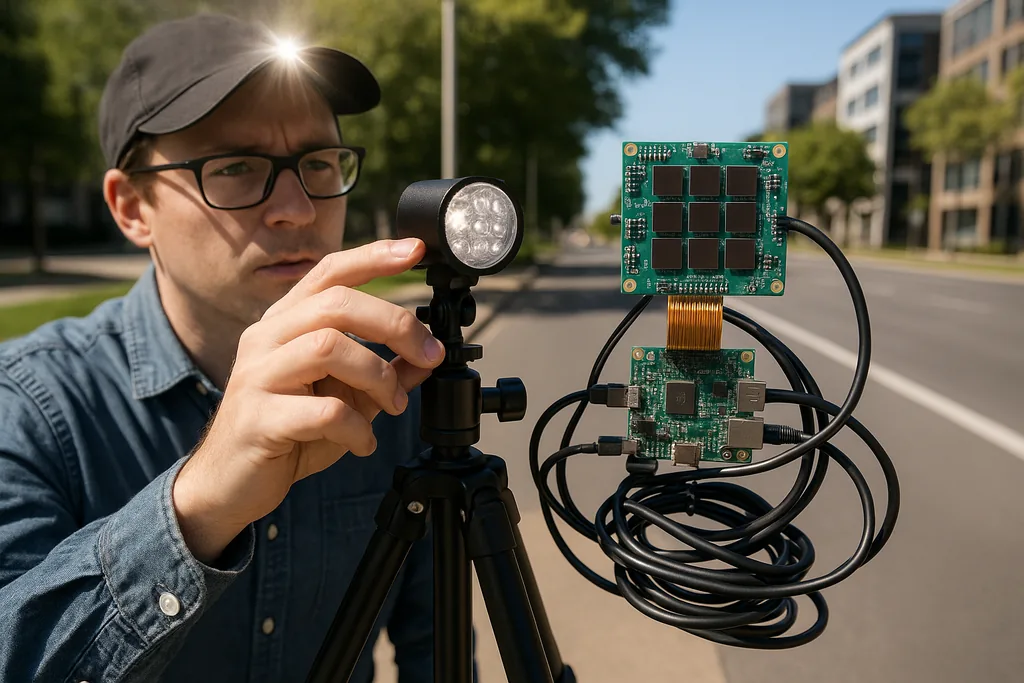
On a clear afternoon, when direct sunlight exceeds 90,000 lux, light is usually the enemy of optical communications. Yet a small team at Tokyo Polytechnic University has built a working visible‑light link that keeps talking in those exact conditions. By combining off‑the‑shelf hardware—a Raspberry Pi, an FPGA running custom serializer/deserializer logic—and a purpose‑designed line code called 8B13B, the researchers demonstrated stable outdoor data transmission at up to 3.48 Mbit/s over roughly three metres, with packet loss rates in the order of 10−4–10−5 for 893‑bit packets.
Engineering the signal to survive sunlight
Visible‑light communication (VLC), sometimes marketed as Li‑Fi, has long promised wireless links that piggyback on illumination. But the real challenge outdoors is twofold: ambient light can swamp photodetectors, and the intrinsic electrical and optical behaviour of LEDs distorts the waveforms used to encode data. The new work tackles those issues in software and hardware. The 8B13B line code the team designed uses a return‑to‑zero format and enforces a balanced number of logical ones and zeros to suppress visible flicker and to keep synchronization stable. Crucially, the receiver logic focuses on the rising edges of optical pulses rather than relying on pulse widths, which are prone to data‑dependent shrinkage caused by LED physics. That shift makes the link robust against the kind of pulse distortion that kills many outdoor VLC prototypes.
On the optical front, the researchers paired multiple photodiodes with a narrow‑band optical filter at the receiver to reduce the broadband noise from sunlight. That combination—careful coding, rising‑edge timing, and optical filtering—lets a simple LED lamp act as a moderate‑speed data transmitter in conditions that previously required highly specialised hardware. All of the key electrical components, including the LED driver, photodetectors and FPGA board, are commercially available, making the experiment straightforward to reproduce.
The implementation blends inexpensive computing and programmable logic. A Raspberry Pi generates the data stream and sends it to the FPGA over a standard serial peripheral interface (SPI); the FPGA implements the SerDes and the 8B13B encoder/decoder in Verilog. That architecture keeps the transmitter simple while offloading timing‑sensitive duties to the FPGA. The researchers also published their SerDes source code, which lowers the barrier for other labs and student teams to reproduce and build on the result.
Publishing both circuit diagrams and FPGA code is an important part of making VLC an accessible, experimental platform rather than a closed, proprietary technology. It lets academic groups, hobbyists and transportation labs test real‑world scenarios quickly and compare approaches on a common baseline. For a technology often demonstrated in tightly controlled indoor environments, openness like this is exactly what the field needs to move toward operational trials.
Where this sits in the wireless landscape
High‑speed VLC demonstrations have existed for some time: laboratory systems using advanced modulation schemes and specialised emitters can push gigabits per second over short distances. But those experiments typically occur in darkness or indoors and rely on optics and LEDs designed specifically for communications rather than general illumination. The Tokyo Polytechnic prototype takes a different tack: it sacrifices top‑end speed for robustness, reproducibility and cost. At 3.48 Mbit/s across a few metres, the link is slower than many indoor Li‑Fi demos but is notable for its stability under direct sunlight.
Visible light has complementary strengths to radio. It does not interfere with RF‑sensitive equipment, offers a very large unused spectrum around visible wavelengths, and can be spatially constrained by the illumination beam. That makes VLC appealing as an extra channel for vehicle‑to‑infrastructure messaging, short‑range sensor off‑loads, or information beacons embedded in streetlights and traffic signals. Researchers modelling hybrid systems have proposed combining VLC with other bands—including terahertz links—so each medium covers the other's weaknesses. Those hybrid approaches highlight that practical deployments will likely blend technologies rather than pick a single winner.
Potential use cases and practical hurdles
The Tokyo Polytechnic team frames their work with intelligent transport systems (ITS) in mind: traffic lights, streetlamps or road‑side units could broadcast intersection status, camera feeds or blind‑spot warnings directly to cameras or photodiode arrays on vehicles. A light‑based broadcast channel could deliver high‑fidelity, low‑latency telemetry to nearby receivers without eating into congested RF bands. Because the prototype is inexpensive and uses widely available parts, municipalities and carmakers could trial the idea without multi‑million‑euro infrastructure programs.
But significant hurdles remain. Visible light requires line‑of‑sight or near‑line‑of‑sight, so mounting positions, vehicle occlusion and beam steering become engineering problems. Weather and atmospheric scattering (rain, fog, dust) attenuate optical links; while narrow‑band filtering counters sunlight, it does not eliminate fog or particulate scattering. Uplink remains an open design question: cars and devices would need transmitters or leveraging other channels (RF, infrared, or camera‑based reflectance) to send data back. And scaling to city‑wide coverage requires robust multiplexing, addressing and medium‑access control that are still active research problems.
Paths forward: optics, modulation and standards
There are clear technical routes to improve range and throughput. Optics (lenses and concentrators) can increase received signal power without boosting emitter drive currents. Advanced modulation and multiplexing—OFDM, WDM or spatial multiplexing (MIMO)—can multiply capacity but add complexity. Materials work on faster LEDs and OLEDs has already pushed laboratory links toward gigabit speeds; combining better emitters with the kind of robust coding used in the 8B13B system could close the gap between laboratory speed and outdoor reliability. Field tests that pair the prototype’s low‑cost approach with optical optics and vehicle integration would show whether the idea scales beyond proof‑of‑concept.
Equally important are standards and interoperability. For ITS uses, a light‑based broadcast channel will need agreed message formats and safety‑oriented failover behaviours so a loss of the optical link does not cause hazardous misinterpretation. The reproducible, open‑source attitude the team adopted is a promising start: it enables consortiums, city labs and industry partners to iterate on hardware and protocols together rather than reinventing basic building blocks.
The Tokyo Polytechnic result is not a final answer to urban wireless congestion or autonomous vehicle networking, but it is a practical step toward real‑world VLC: a clearly described, reproducible kit that survives sunlight and can be built by students or engineers with a modest budget. If the community takes up the open code and the circuit designs, expect to see follow‑on tests that push range, robustness and integration into vehicles and traffic systems over the next two years.
Sources
- Electronics and Signal Processing (journal) — "A study of SerDes logic for visible light communication using 8B13B code"
- Tokyo Polytechnic University — Graduate School of Engineering (researchers Tokio Yukiya, Nobuo Nishimiya, Takayuki Uchida)
- University of Edinburgh — early Li‑Fi research and demonstrations