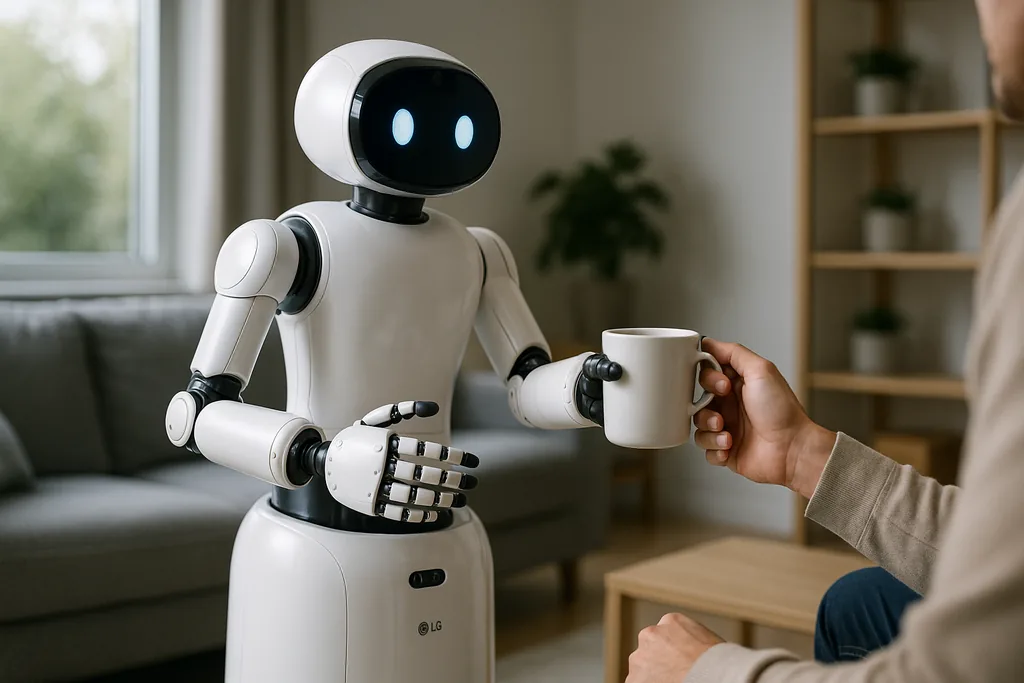
When LG announced the CLOiD home robot on Dec. 24, 2025, it framed the device not as another single-purpose gadget but as a building block of what it calls the “Zero Labour Home.” The company says CLOiD will be shown in action at CES 2026 in Las Vegas (January 6–9) and promises a machine capable of many household tasks — a clear attempt to move beyond vacuum cleaners and into general-purpose domestic automation.
The machine LG says will do more than clean
LG’s official materials describe CLOiD as a compact, indoor-oriented humanoid with two articulated arms, each with seven degrees of freedom, and five individually actuated fingers on each hand — components intended to give the robot fine motor control for delicate tasks. The robot’s head houses a dedicated chipset that LG calls its brain, alongside a display, speaker, camera and an array of sensors for navigation and communication. The company pitches CLOiD as part of a broader consumer ecosystem, integrating with appliances and smart-home controls.
A staged debut at CES 2026
LG has said attendees at its CES exhibit will be able to see CLOiD in a series of staged “Zero Labour Home” scenarios, where the robot operates inside simulated living spaces to demonstrate tasks and interactions. The company has reserved space on the show floor to pair the robot with other LG home appliances and services, showcasing how it could slot into the firm’s reworked Home Appliance Solution business. Those demonstrations will form the first public, real-world impression of whether the machine’s dexterity and perception hold up outside controlled lab footage.
Affectionate Intelligence and the robotics stack
LG brands the robot’s software under the name “Affectionate Intelligence,” a suite the company says is designed to enable more natural interaction and learning over time. The press materials emphasize sensory fusion (vision, depth, proximity) and voice interfaces as parts of that stack, together with onboard compute in the head for low-latency control. Behind the product announcement LG has also positioned new internal structures — including an HS Robotics Lab and the integration of a Robot Business Division into its Home Appliance Solution Company — to accelerate R&D and partnerships. Those organizational changes underline that this is intended as a strategic pivot, not a one-off concept demo.
Where CLOiD sits in a crowded, cautious market
Consumer robotics has a long history of bold promises and narrow deployments. The Roomba family remains the clearest commercial success story: iRobot reported that more than 40 million home robots had been sold worldwide in past corporate updates, a reminder that useful single-task machines can scale. But moving from a floor-cleaning robot to a general-purpose home assistant multiplies the technical and logistical challenges — perception, manipulation, safety, software updates, and serviceability — and raises questions about cost and value for typical households.
At the same time, other companies are also chasing general-purpose humanoid or domestic robots. High-profile efforts such as Tesla’s Optimus program and a string of industrial and research teams indicate the field is accelerating, but those projects have repeatedly highlighted how much remains to be solved to reach reliable, affordable consumer robots. Early demonstrations frequently rely on constrained environments or human supervision; independent observers caution that public demos do not yet equate to robust, in-home autonomy.
Promises, demos and the economics of domestic robots
LG’s CLOiD announcement is notably light on price and availability details. The press release focuses on capabilities and vision, but does not include a retail price or a ship date — a familiar pattern for ambitious product reveals that are still in early commercialisation stages. That omission matters because complexity typically translates into cost: dexterous hands, articulated arms, edge compute and sensors add hardware expense and post-sale support requirements that can push a device well above the price of today’s single-task appliances.
Critics argue that a “zero labour” narrative glosses over practical limitations and equity concerns. Opening homes to sophisticated, always-connected devices raises well-trodden questions about data collection, network updates, long-term support and repairability. Some commentators warn consumers to weigh convenience against privacy, subscription models and the potential for recurring service costs if complex robots require frequent professional maintenance. LG’s promotional language frames CLOiD as time-saving and life-enhancing, but independent coverage has urged scepticism until real-world performance, pricing and after-sales support become clear.
Technical obstacles that matter most
For CLOiD to be genuinely useful it will need reliable object recognition across many household items, delicate force control for handling fragile objects, robust navigation in cluttered and changing environments, and safe human-robot interaction practices. Each of those subsystems is an active research problem: perception models still struggle with rare or occluded objects; compliant, energy-efficient actuators remain expensive; and batteries impose duty-cycle limits that affect practical daily use. Even if a staged demo looks impressive, productising those capabilities at scale — and at a consumer-friendly price — is an engineering marathon rather than a sprint.
What to watch at CES and afterwards
At CES 2026 the most useful evidence will be concrete operational metrics: what tasks CLOiD completes reliably (and which it fails), how it deals with unfamiliar clutter, how quickly it recharges, whether it needs human reset or supervision, and — crucially — what LG says about pricing and service plans. Observers should also watch for third-party evaluations and whether LG releases developer tools or APIs that let the robot learn new chores from partners or end users. Demonstrations can show potential; sustained, independent testing will show readiness.
LG’s announcement is a notable moment because it signals one of the world’s largest appliance makers committing real product muscle and corporate structure to the idea of domestic robotics. If CLOiD becomes a commercially viable appliance, it would shift the industry dynamic from single-purpose devices toward integrated robotic services. But between promise and practical adoption lie questions of durability, price, safety and privacy — and those are the measures that will determine whether the “Zero Labour Home” becomes an everyday reality or another milestone on a longer road.
Sources
- LG Electronics press release (LG CLOiD home robot announcement, Dec. 24–25, 2025)
- LG webOS / corporate restructuring materials (Home Appliance Solution Company and HS Robotics Lab)
- iRobot corporate history and milestone statements (Roomba sales figures)