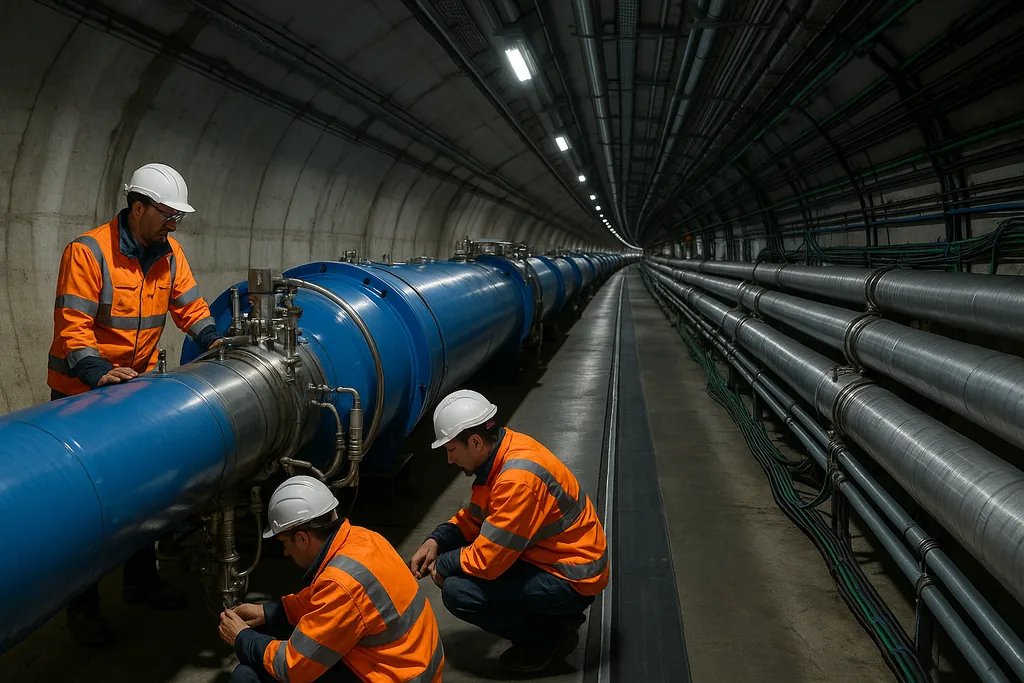
A planned pause beneath Geneva
In a stretch of tunnel 27 kilometres long under the French–Swiss border, operators are preparing to wind down the Large Hadron Collider (LHC) for an extended, carefully scheduled pause. CERN has revised the accelerator calendar so that Run 3 of the LHC will continue through July 2026; at that point the machine and its injector chain will enter Long Shutdown 3 (LS3), a multi‑year period of installation and refit ahead of the High‑Luminosity LHC era.
What the pause means in practice
The shutdown is not an abrupt power‑off but a complex sequence of planned access periods, civil‑engineering work and equipment installation that will transform both the accelerator and the four large experiments that sit on the ring. The goal is to prepare the LHC to operate at a much higher “luminosity” — the technical term for how many collisions a collider can deliver per second — so physicists can gather far larger datasets of rare phenomena. CERN’s timetable and project pages set out the transition from Run 3 into LS3 and the intended start of the High‑Luminosity LHC programme in the 2030 time frame.
Rebuilding for a tenfold increase in data
The High‑Luminosity LHC (HL‑LHC) is not a single new device but a coordinated set of upgrades across magnets, cryogenics, power delivery and the detectors themselves. Its purpose is to boost the integrated luminosity available to experiments by roughly a factor of ten over the life of Run 4, enabling precision measurements of the Higgs boson and searches for extremely rare processes that are impossible to see today. The installation campaign is large in scale and duration: project communications within the HL‑LHC collaboration describe a concentrated programme of work during LS3 that stretches over several years of tunnel and surface activity.
Why more luminosity matters
More collisions mean two things for particle physics. First, it improves the precision of measurements — for example, of the Higgs boson’s properties — which can reveal tiny deviations from the Standard Model that point to new physics. Second, it raises the chance of seeing very rare processes or new particles whose production rates are vanishingly small. The HL‑LHC is essentially a statistical engine: build it and you give experimenters the raw material they need to search deeper into nature’s rule book.
What engineers will do underground
LS3 will be heavily engineering‑led. Teams will install and commission new superconducting circuits and magnet systems, fit upgraded inner‑triplet magnets close to the collision points, deploy improved beam instrumentation and add novel hardware such as crab cavities that improve the effective collision overlap. Detector collaborations will replace or significantly upgrade sensitive sub‑systems — trackers, calorimeters and readout electronics — so they can operate in the more intense radiation and pile‑up environment that higher luminosity brings. Many of these activities require months of uninterrupted access to the cavern and tunnel infrastructure.
Logistics and international workshare
Because the LHC and its experiments are international endeavours, the LS3 programme is distributed among laboratories and industries across member states and partner institutes. Production of HL‑LHC components is already underway in many countries, and the shutdown window is the only practical period to assemble, ship, install and test these systems in‑situ. The schedule includes careful margin to validate installations before the machine is recommissioned, because the complexity and energy stored in superconducting systems leave little room for error.
Science will not stop in the silence
Even while beams are absent, the scientific output is expected to remain lively. Physicists will be analysing the enormous Run 3 dataset, producing measurements, cross‑checks and searches. Upgrades to software, reconstruction algorithms and computing infrastructure are an intrinsic part of the pause: the community uses the downtime to improve analysis pipelines, reprocess data with better calibrations and train new models for background subtraction and anomaly detection. As commentators and CERN leadership have noted, the hiatus offers the field a chance to digest what has already been collected and to refine the questions the HL‑LHC should answer.
Energy, environment and operations
Large accelerators are energy‑intensive facilities, and CERN tracks consumption and impact as part of the upgrade conversation. The organisation has published environment and energy reports detailing annual electricity use and targets to contain consumption growth even as performance increases. Some components of the machine (notably the cryogenic systems that keep magnets superconducting) draw significant power even when beams are off, so the operational and environmental dimensions are factored into scheduling and sustainment planning.
Costs, politics and the future of colliders
LS3 and the HL‑LHC are the next pragmatic step for extracting more physics out of the existing ring, but planners are simultaneously sketching longer‑term successors. CERN and its partners have released design studies for a proposed Future Circular Collider (FCC), a roughly 91‑kilometre ring that would sit alongside or eventually replace the LHC. The FCC proposal is at the blueprint stage and will require member‑state decisions and large capital commitments before it can proceed. How nations balance investment in HL‑LHC, future colliders and other research priorities will shape the roadmap for particle physics in the decades to come.
What to watch for
During the next 18 months watch three things: the completion of the Run 3 harvest and the papers that follow, progress reports from the HL‑LHC project as major components finish testing and manufacturing, and the political calendar for funding decisions on larger future facilities. Each of these will influence not only how the shutdown is executed but also what the community chooses to measure when the collider is brought back online.
The LHC’s pause is therefore both a technical challenge and a quiet, deliberate reset. The machine that restarts in the early 2030s will have a different personality — built not to go faster in energy but to gather collisions at a rate today’s instruments can only imagine. For physicists and engineers, the shutdown is where the next generation of discovery is being engineered, panel by panel and magnet by magnet; for the public and policymakers, it is a reminder that the era of large scientific infrastructure often alternates between periods of intense data taking and long, painstaking construction.
Sources
- CERN (press releases and schedule updates)
- High‑Luminosity LHC (HL‑LHC) project documentation and technical reports
- CMS Experiment communications and status reports
- ATLAS Experiment communications
- LHCb Experiment communications