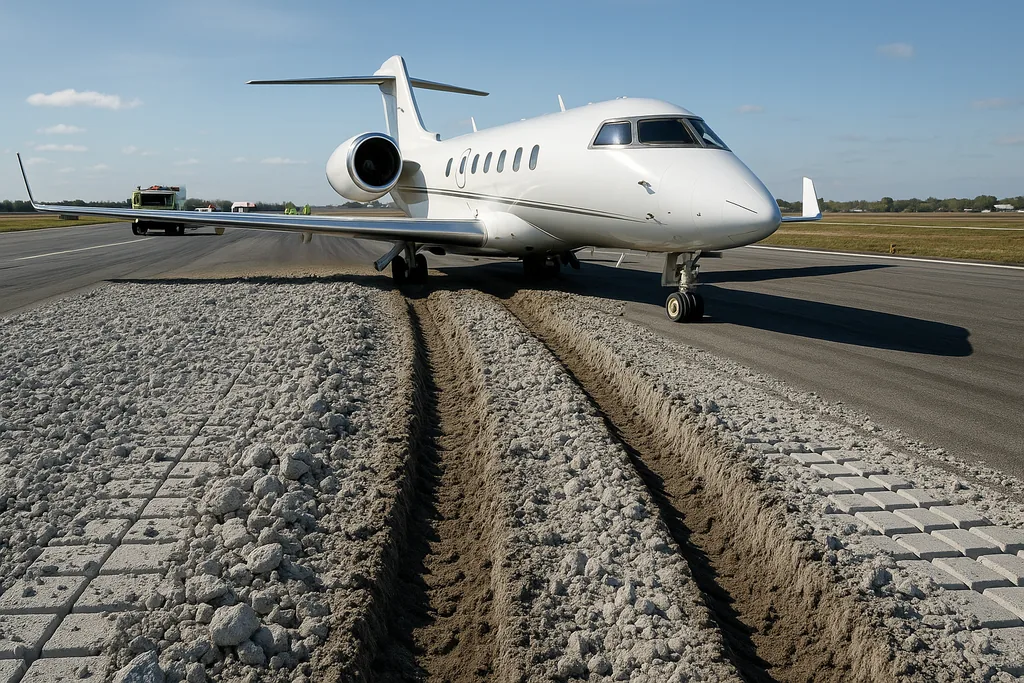
A narrow escape, captured on FAA video
Two arrests the same day
How EMAS does the hard work
EMAS is deceptively simple in concept and carefully engineered in practice: a bed of lightweight, crushable material sits beyond the runway end. When an aircraft runs off the pavement its landing gear sinks into the material and the progressive crushing absorbs the plane’s kinetic energy, rapidly slowing it in a short distance. The FAA’s design guidance says a properly designed EMAS will reliably stop most target aircraft that enter the bed at up to about 70 knots (roughly 80 mph). That combination of predictable behaviour and compact footprint makes EMAS the preferred fix where airports cannot provide full-length safety areas because of terrain, roads, or buildings.
Materials and manufacturers
EMAS beds today are built from engineered materials proven in testing and full-scale trials: cellular-cement blocks and poured silica-foam products are two widely used approaches. Manufacturers tailor block size, density and bed length to the runway profile and the fleet mix that uses the airport. One major supplier, Runway Safe, markets a cellular concrete product (EMASMAX®) and a recycled silica-foam option (greenEMAS®); both are accepted by regulators when they meet FAA design criteria. The choice of material matters for maintenance, repair speed after an overrun, and longevity — cellular blocks are modular and replaceable, while foam systems advertise faster repair cycles and sustainability credentials.
From research project to industry standard
The arrestor-bed idea dates back to FAA research in the 1990s, when the agency ran lab tests, numerical modelling and full-scale trials to develop a practical soft-ground arrestor. That work produced the advisory circular and design guidance airports use today and enabled the first operational installations in the late 1990s and early 2000s. The engineering pedigree matters: predictable, modelled crush behaviour was essential to convince designers and regulators that an engineered bed could reliably decelerate jets without creating new hazards.
Performance, record and spread
The FAA notes that dozens of U.S. airports now have EMAS where space constraints prevent full-sized runway safety areas. In agency briefings around the September 3 incidents the FAA reported roughly 122 EMAS installations across 70 airports in the United States; industry summaries and safety reporting show multiple arrestments over the system’s history. EMAS has a record of stopping everything from small business jets to commercial airliners, and the real-world arrestments frequently leave occupants with bruises or shock but no serious injuries, a far better outcome than the alternatives. The technology does have limits — performance is a function of approach speed, aircraft mass and the part of the gear that enters the bed — which is why careful engineering and regular inspection are prerequisites for each installation.
Costs, logistics and trade-offs
EMAS is not a drop-in, cheap fix: beds are custom-designed to match runway geometry, aircraft types and local constraints, and installation can take months of planning and construction. Manufacturers describe lead times for tailored blocks or foam production and emphasize after-sales repair packages so airports can restore a damaged bed quickly after an arrestment. On the funding side, U.S. legislation and FAA grant programs have explicitly recognised EMAS as an eligible runway safety investment, which helps airports secure federal dollars when land acquisition for a full safety area is impractical. The trade-off is therefore financial and operational rather than technical: airports decide between acquiring more land to extend the safety area or installing an engineered bed that delivers protection in a smaller footprint.
Why this matters for airports and communities
The video from Boca Raton is visceral precisely because it shows what every runway safety planner fears: a jet leaving the pavement close to unconstrained public space. When a highway, residential area or water lies just beyond a runway the consequences of an overrun escalate rapidly; EMAS offers a pragmatic risk-reduction tool that reduces that class of catastrophe to a survivable event. The September incidents also underline an operational truth: even as aviation becomes safer overall, a few locations will remain exposed because of legacy siting. EMAS is the engineering answer used in those constrained locations to prevent small mistakes or mechanical problems from becoming scenes of mass harm.
For passengers and pilots the arrestments read like a brutal brake test — occupants commonly describe a sudden, strong deceleration but walk away. For airport operators, the calculus is different: design, procurement, regular inspection and contingency-supply chains for repair materials are now part of routine safety budgets at airports that chose the bed-over-land approach. For communities, the benefit is direct — a road, a school or a line of traffic that would otherwise be in the path of an overrun is protected by an engineered cushion designed to sacrificially absorb energy and spare lives.
The FAA’s decision to publish video and photos from these recent saves brings the technology into public view, a useful reminder that some of the most consequential safety advances are not software patches or cockpit gadgets but civil-engineering solutions: materials and geometry tuned to dissipate energy when things go wrong. As airports continue to juggle space constraints, budget cycles and community pressures, EMAS remains a visible example of how applied materials science and conservative engineering can prevent headline-making tragedies.
Sources
- Federal Aviation Administration — Two EMAS Systems Successfully Stop Aircraft in Separate Incidents (FAA newsroom)
- Federal Aviation Administration — Engineered Materials Arresting Systems (EMAS) technical and factsheet pages
- DOT/FAA Airport Technology R&D report: "Development of Engineered Materials Arresting Systems From 1994 Through 2003" (technical development report)
- Runway Safe — manufacturer technical and product information on EMASMAX and greenEMAS systems