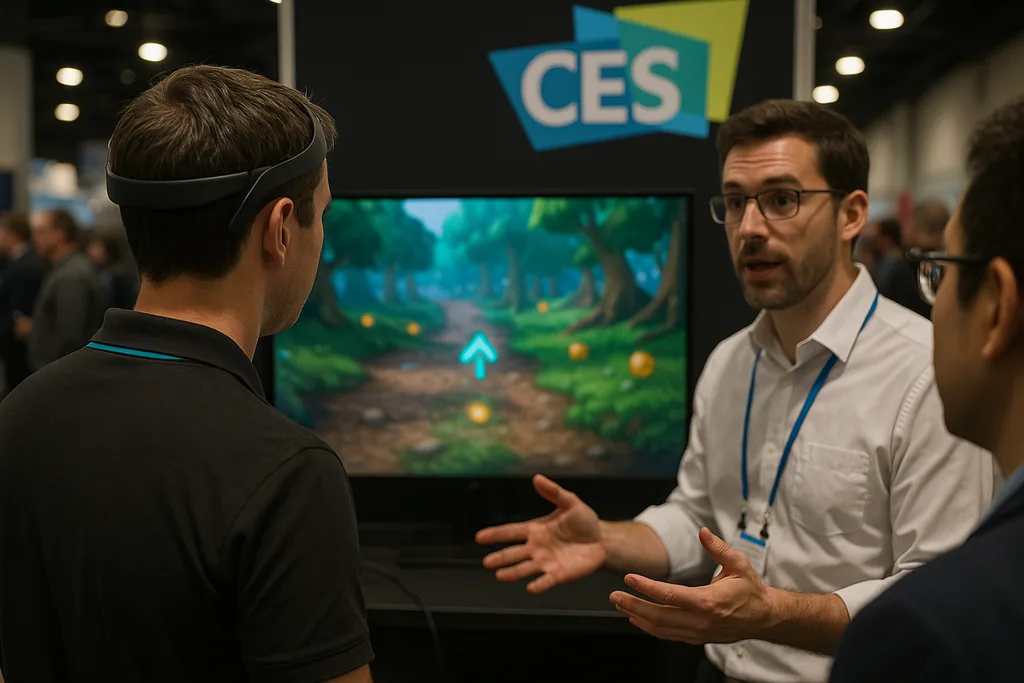
Bright lights, headsets and a live brain‑controlled demo
On Jan. 7, 2026, in a packed corridor at CES 2026 in Las Vegas, start‑up LumiMind staged what it called a public milestone for consumer neurotechnology: the debut of LumiSleep — a wearable that the company says guides users into a defined Sleep Onset Pattern™ using millisecond‑scale EEG monitoring — and a live, real‑time brain–computer interface (BCI) gameplay demonstration developed with the INSIDE Institute for NeuroAI. LumiMind presented the gameplay demo as a capability proof, arguing the same neural decoding pipeline that powers sleep guidance can also interpret and respond to moment‑by‑moment brain activity in interactive settings.
What LumiMind showed at the show
The company staged two connected showcases: hands‑on trials of LumiSleep at its booth, and a separate live demo where a player’s neural activity controlled game action in real time. LumiMind’s press materials say the device continuously records brain activity and uses personalized acoustic output to nudge the brain toward the Sleep Onset Pattern™, and that the product will ship in the first half of 2026. The firm emphasised that this modulation is non‑invasive and closed‑loop — the device listens and responds rather than delivering electrical stimulation.
At least one reporter who attended CES described the gameplay demo as a brain‑controlled playthrough of a mainstream title, noting LumiMind’s demonstration used a high‑profile game to underline responsiveness and latency. LumiMind framed that demo as an engineering demonstration of the performance ceiling for non‑invasive neural decoding rather than an immediate consumer gaming product.
Brains, models and the INSIDE Institute
LumiMind traces its decoding technology to the INSIDE Institute for NeuroAI and a so‑called Neural Signal Foundation Model that institute researchers have built using extensive intracranial electrophysiology datasets. According to the INSIDE Institute, the foundation model is designed to generalise across brain regions and signal modalities, a capability LumiMind says it leverages to translate intracranial research results into scalp‑EEG consumer hardware. External observers caution that transferring algorithms trained on invasive recordings to non‑invasive sensors is non‑trivial because surface EEG has lower spatial resolution and different noise characteristics.
How the system is said to work
In LumiMind’s description, the device pipeline is four‑phase: sense, decode, generate and modulate. Millisecond‑resolution EEG signals are combined with inertial sensors and algorithmic models to estimate a user’s brain state; an AI decoder maps that state to an actionable readout; the system generates personalised acoustic guidance (what the company calls AuthenticBeats™); and the closed loop gently guides the brain toward the targeted sleep pattern. That sequence is what LumiMind presented as the same backbone powering both sleep assistance and the live BCI demo.
Non‑invasive BCI in context
Non‑invasive BCIs — typically built on scalp EEG — have advantages: they are cheaper, portable and pose far fewer medical risks than implanted electrodes. But neuroscientists and engineers long note tradeoffs: EEG’s signal amplitude and spatial precision are attenuated by the skull and scalp, which historically limits fine‑grained decoding and the number of distinct control channels available to users. A growing body of technical literature documents both recent performance gains and persistent limitations, and reviewers emphasise that apparently high decoding accuracy can sometimes reflect choice of experimental design rather than generalisable robustness. At the same time, new machine learning strategies and multimodal sensor designs are steadily improving what non‑invasive systems can decode in real‑world settings.
There are concrete examples of progress: a recent Nature Communications study demonstrated a non‑invasive EEG system that could decode finger‑level commands to a robotic hand in real time, achieving meaningful control in experimental subjects. Those results show boundaries between lab demonstrations and day‑to‑day consumer use are shifting, but they also underline why companies must quantify robustness, participant variability and long‑term reliability before claiming clinical or mass‑market readiness.
Privacy, safety and the claims hurdle
Separately, independent researchers emphasise the need for open evaluation and careful experimental design: decoding claims must be validated across diverse users, realistic tasks and proper validation splits to avoid inflated performance estimates from trivial temporal correlations in EEG recordings. For consumer devices that actively modulate brain states, independent safety data and regulatory engagement will be essential.
What LumiMind’s demo means — and what it doesn’t
LumiMind’s CES presentation matters because it puts a polished consumer narrative around a technology that until recently lived mainly in research labs: closed‑loop, millisecond‑responsive EEG processing coupled to AI decoders. The live gameplay demo is a useful public demonstration of latency, robustness and the company’s confidence that the decoding stack generalises beyond sleep patterns. But demonstrations by definition are curated: they show peak behaviour in controlled settings, not the long tail of real‑world variability. Translating a lab demo into a product that reliably helps millions fall asleep, or that safely modulates mood and focus, requires extensive field testing, regulatory review and transparent performance reporting.
What to watch next
In the near term, LumiMind plans a consumer launch of LumiSleep in the first half of 2026 and further product rollouts tied to the company’s neural‑decoding roadmap. Independent technical evaluations, peer‑reviewed publications describing the decoding model and public safety data will be the most informative next signs of maturity. Observers should watch whether the company publishes validation studies that report out‑of‑sample performance across diverse participants and environments, and whether regulators or standards groups offer guidance specific to consumer BCI devices.
For now, LumiMind’s presence at CES 2026 is a visible marker of momentum: companies and research institutes are converging on practical ways to read and respond to the living brain without surgery. The gap between laboratory iEEG results and scalp‑EEG consumer products is narrowing, but the work to prove safety, privacy and reliability at scale is only beginning.
Sources
- LumiMind press materials and CES 2026 announcements (company press releases)
- INSIDE Institute for NeuroAI (institutional research and technical descriptions)
- Nature Communications (peer‑reviewed paper on EEG real‑time robotic control)
- Medicine in Novel Technology and Devices (open‑access review: non‑invasive BCI developments)
- Journal of Law and the Biosciences (research on neural personal information and legal protection)